Bakers juggling several tasks
If you need to time other tasks while your dough proves, independent countdowns make it easier to keep each one on track. TFA Dostmann says the TRIPLE TIME XL can run three timers at the same time.


For a single, short proving time, a clear countdown timer with a long enough maximum setting will do the job. For longer proving times, a timer that displays hours is a better choice. And if you’re keeping track of several kitchen tasks at once, independent timers can help. An adjustable or visual alarm can be a considerate choice in a shared kitchen. When the countdown ends, it’s time to check the dough – not proof that it’s ready.
If you need to time other tasks while your dough proves, independent countdowns make it easier to keep each one on track. TFA Dostmann says the TRIPLE TIME XL can run three timers at the same time.
If you need a continuous countdown that goes beyond 99 minutes and 59 seconds, look for a timer that displays hours. TFA Dostmann gives the 99HOURS a maximum run time of 99 hours and 59 minutes.
If a loud alarm might disturb others, adjustable volume levels and a visual signal are useful features to consider. TFA says the 99HOURS has three volume levels and an LED warning light.
First, check whether you’ll need to run one timer or several, and how long the countdown needs to last. Then consider the alarm and where you’ll place the timer so it’s easy to see.
The percentages refer to consumers choosing a digital timer for proving dough in a shared kitchen.
| What you need | What to check | Who it matters to |
|---|---|---|
| Keeping several tasks separate | Look specifically for timers that can run at the same time, rather than just saved settings. TFA Dostmann distinguishes between the three parallel timers on the TRIPLE TIME XL and the three stored times on the 99HOURS. | When I have other kitchen tasks to time as well as proving dough, I want to keep track of each countdown separately. Around 33% of consumers prioritise keeping parallel tasks separate. |
| A long enough run time | Compare the time you need with the model’s limit: TFA Dostmann gives the 99HOURS a maximum of 99 hours and 59 minutes, while Hama gives the 00002949 a maximum of 99 minutes and 59 seconds. | For a longer proving time, I want the countdown to run without interruption. Around 25% of consumers say a long enough run time is their main priority. |
| The right alarm | Check the volume levels, visual signal and whether you’ll be able to see it from where you plan to put the timer. TFA Dostmann says the 99HOURS has three volume levels and an LED warning light; Hama lists three sound modes and an LED signal for the 00002949. | In a shared kitchen, I want to choose an alarm I’ll notice without disturbing others unnecessarily. Around 25% of consumers prioritise having the right type of alarm. |
| A clearly visible position | Check the display and viewing angle, as well as how the timer can be mounted in your chosen spot. Westmark says its Big timer has large digits, a magnet and a stand. | If several people need to see how much time is left, I want to put the timer somewhere that’s easy to read. Around 17% of consumers prioritise visibility and positioning. |
Saved settings can be selected again, but they don’t automatically run at the same time. If you need to keep track of proving dough and other tasks in parallel, make sure the timer specifically supports multiple simultaneous countdowns.
Check the individual model’s details for its memory function and simultaneous operation. TFA Dostmann distinguishes between these features on the 99HOURS and the TRIPLE TIME XL.
Hama gives the 00002949 a maximum of 99 minutes and 59 seconds, as does Westmark for its Big timer. For longer proving times, TFA Dostmann says the 99HOURS can be set for up to 99 hours and 59 minutes.
First decide how long you need the countdown to run in one go, then check the maximum run time for the specific model.
A visual signal can be quieter in a shared kitchen, but it’s only useful if the person responsible notices it.
Choose an alarm mode to suit where you’ll put the timer, and check that you’ll be able to see the signal from there. If needed, choose an audible mode.
When the recipe timer ends, that alone doesn’t tell you whether the dough has finished proving. King Arthur Baking points out that proving times depend on several factors, and recipe timings should be treated as a guide.
Use the alarm as a reminder to check the dough, and look for the signs that are right for your recipe.
The TRIPLE TIME XL 38.2023 and 99HOURS 38.2049.02 models cater for different needs, from parallel timers to longer countdowns.
According to the manufacturer, the 00002949 digital kitchen timer is designed for a single countdown with an adjustable alarm.
The Big 10912280 digital timer is designed for shoppers looking for a large display and flexible positioning.
According to the manufacturer, the CONTARE 12330 digital timer is designed for shorter countdowns.
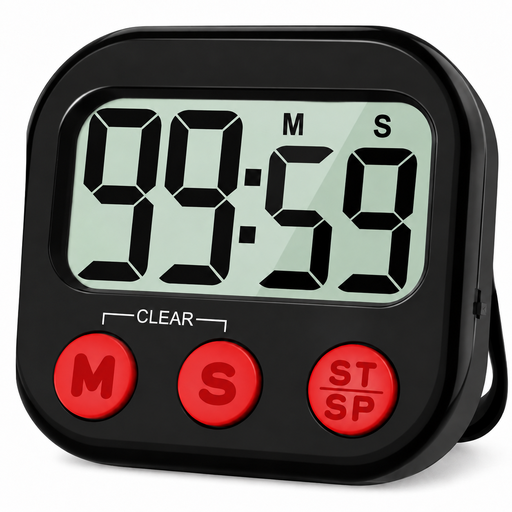
This timer is designed for a single countdown of up to 99 minutes and 59 seconds.
 No image available
For a single countdown of up to 99 minutes and 59 seconds; this run time isn’t long enough for longer proving times.
LCD display; magnet, stand or hanging hook for positioning; adjustable volume from low to high.
No. Use the countdown as a reminder to check: King Arthur Baking explains that factors such as the temperature of the water and air, and the shape and size of the dough, affect proving time. So the recipe timing is a guide; also check the dough for the visual signs that are right for your recipe.
Choose a spot where you can easily see the display while the dough is proving. On models with a magnet or stand, where you can place the timer will depend on the surfaces available. If you turn off the sound, remember to keep an eye on the visual signal.
Check the battery type and what’s included for the specific model: TFA Dostmann says the 99HOURS requires two AAA batteries, which aren’t included; the TRIPLE TIME XL comes with batteries, according to the manufacturer. The German Environment Agency recommends taking used batteries to collection boxes in shops or local collection points instead of putting them in household waste.
When you buy an ordinary timer online from a professional seller, you generally have a 14-day right to cancel from the date of delivery. Your Europe, the European Union’s information portal, notes that this doesn’t apply to purchases from private individuals. For ordinary claims relating to defects, § 438 BGB generally provides for a limitation period of two years from delivery; exceptions may apply. A voluntary guarantee is separate from these rights.
No. Under the German disposal rules explained by the German Environment Agency, waste electrical equipment must be collected separately from household waste. If used batteries can be removed easily, they should be taken separately to a suitable collection point.