
Lieferung heute & morgen

Qualitätsgarantie

Willkommens-Angebote freischalten: KOSTENLOSE Lieferung | Bis zu 80 % RABATT | Kostenlose 30-Tage-JoyPlus-Testphase
App herunterladen
A high-quality stand mixer can make cooking and baking significantly easier, from preparing heavy bread doughs to whipping up fluffy creams. But the market is crowded and full of marketing claims that don't always deliver. An uninformed decision often leads to an appliance that sits unused in a cupboard or fails to meet your actual needs.
As your Joybuy Product Recommendation Officer, I'll help you identify the crucial features and avoid common purchasing traps. This will ensure you find a model that truly fits your needs.
Before you invest, be wary of three common marketing tactics and product flaws that often lead to disappointment.
To make an informed decision, you should focus on a few critical technical features. These determine whether a stand mixer will perform its tasks reliably.
The efficiency of a dough mixer or stand mixer depends heavily on the interplay between the motor and the mixing system. A planetary mixing system is the gold standard for excellent results. With this system, the mixing tool not only spins on its own axis but also travels along the edge of the bowl. This ensures all ingredients at the bottom and sides of the bowl are captured and evenly incorporated. Combined with a motor that delivers high torque even at low speeds, even the toughest doughs can be handled with ease.
The longevity and safety of your stand mixer are heavily influenced by its materials.
The size of the mixing bowl should match your household's needs. For occasional baking in a two-person household, 3.5 to 4.5 litres is often sufficient. Families or ambitious home bakers who process larger batches should consider a model with 5 litres or more.
We have identified models that, based on their objective features, offer an ideal solution for different types of users.
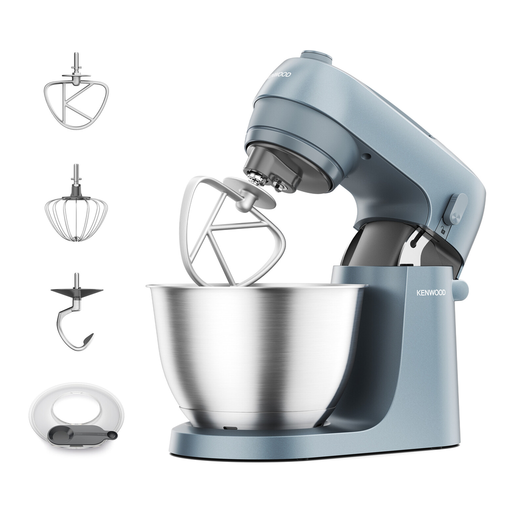
Why it's a match: Ideal for home bakers with limited space. The machine is only 30 cm tall, allowing it to fit easily under wall cabinets or in deep drawers without compromising on performance.
The sturdy metal housing provides stability and longevity, avoiding the pitfalls of an unstable plastic build. It focuses on essential functions without superfluous accessories.
800-watt motor with a planetary mixing system for standard baking projects. 4-litre stainless steel bowl and compact dimensions (33.5 x 18 x 30 cm).

Why it's a match: For those who bake regularly and in large quantities. The integrated scale and DuoBowl system (7L and 5L bowls) streamline the workflow and offer maximum flexibility for demanding recipes.
The 1200-watt ChefMotor proves that efficiency matters more than just wattage. It offers variable speed control and enough power for heavy doughs. The integrated scale is a useful feature, not a superfluous gimmick.
Integrated EasyWeigh scale for weighing directly in the bowl. DuoBowl system with 7L and 5L stainless steel bowls. Includes a comprehensive set of high-quality accessories.

Why it's a match: For users seeking a single appliance for a wide range of kitchen tasks. This model combines a dough mixer with a meat grinder and a blender, covering a broad spectrum from kneading and mixing to grinding.
Instead of requiring multiple separate appliances, this model bundles useful functions. The accessories are designed for core tasks (kneading, grinding, blending), avoiding the cost of unused extras.
7-in-1 functionality including a meat grinder and blender jar. 6.2-litre (6.5 QT) stainless steel bowl for large batches. 8 speed settings plus a pulse function for precise control.
While many stand mixers specialise in kneading and mixing, a powerful blender can be an equally versatile alternative for tasks like puréeing, chopping, or making smoothies.
If your primary use case is blending and puréeing, we've curated a selection of appliances that fit the bill.
1. How much wattage does a good stand mixer really need? For most household applications, including processing heavy bread doughs, a machine with a motor between 800 and 1200 watts is sufficient, provided the drivetrain and component quality are high. Focus more on the housing's stability and the mixing system's efficiency than on the wattage number alone.
2. What is a planetary mixing system, and is it necessary? A planetary mixing system is a mechanism where the mixing tool (e.g., the dough hook) spins on its own axis while also orbiting the inner edge of the bowl. This ensures an exceptionally thorough and even incorporation of all ingredients. For anyone who bakes regularly and aims for a homogeneous dough consistency, this system is an indispensable feature.
3. What's the easiest way to clean my stand mixer? Most mixing bowls and accessories made of stainless steel or coated metal (dough hook, flat beater, whisk) are dishwasher-safe. Always check the manufacturer's instructions to be sure. The machine's housing should never be submerged in water. Instead, simply wipe it down with a damp cloth and then dry it.