
Lieferung heute & morgen

Qualitätsgarantie

Willkommens-Angebote freischalten: KOSTENLOSE Lieferung | Bis zu 80 % RABATT | Kostenlose 30-Tage-JoyPlus-Testphase
App herunterladen
A high-performance stand mixer can significantly simplify the preparation of bread, cakes, and other dishes. However, the market is flooded with appliances whose marketing claims often fail to deliver. As a Joybuy Product Recommendation Officer, I see every day which features truly matter and which are just empty advertising buzz. This guide will help you make an informed decision and find a model that meets your needs as a home baker or for everyday family use.
Many buyers focus on superficial features, overlooking critical design details. This often leads to disappointment. Here are the three most common pitfalls you should avoid:
To avoid a bad purchase, you should focus on the core technical features that ensure durable and reliable performance.
The most important component is the drive unit. Pay attention to the following specifications:
The capacity of the stand mixer must suit its intended use.
The standard accessories should be robust and functional. A good stand mixer for baking will always come with the following three attachments:
Check the product specifications to see if the accessories are dishwasher-safe. This makes cleanup much easier.
Based on the criteria above, we have identified a few models that are particularly well-suited for different user profiles.
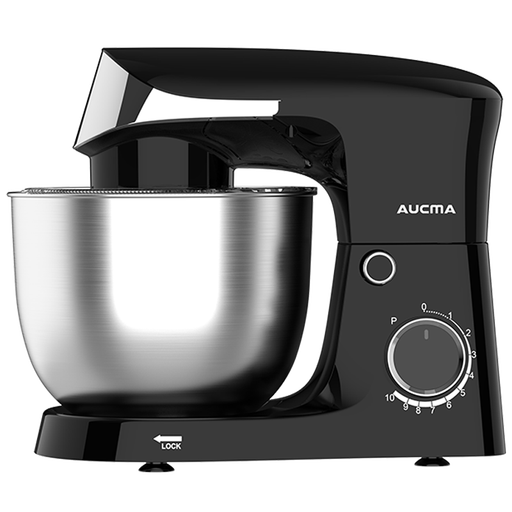
Why This Fits Their Persona: Ideal for households looking for a reliable entry-level machine for occasional baking. The 5-litre bowl offers enough capacity for standard recipes without taking up too much kitchen space.
This model features suction cup feet that counteract the instability trap and ensure a stable base. The overheating protection prevents motor damage under excessive load.
Excellent value for money; 10 speed settings plus a pulse function for flexible control; standard accessories (dough hook, whisk, beater) are included.
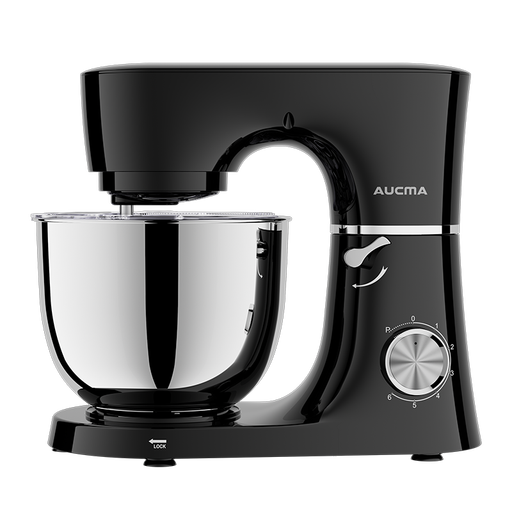
Why This Fits Their Persona: Perfect for families and anyone who bakes frequently and in larger batches. The 6-litre bowl and high-torque motor handle even heavy bread doughs with ease.
This model bypasses the wattage trap with a 450W pure copper DC motor. It is more efficient and quieter (≤72dB according to the manufacturer) than many AC motors with higher wattage. The all-metal gear structure prevents wear and tear.
Quiet and powerful DC motor, ideal for heavy doughs. Large 6L stainless steel bowl for family-sized portions. Sturdy construction with vibration absorption.
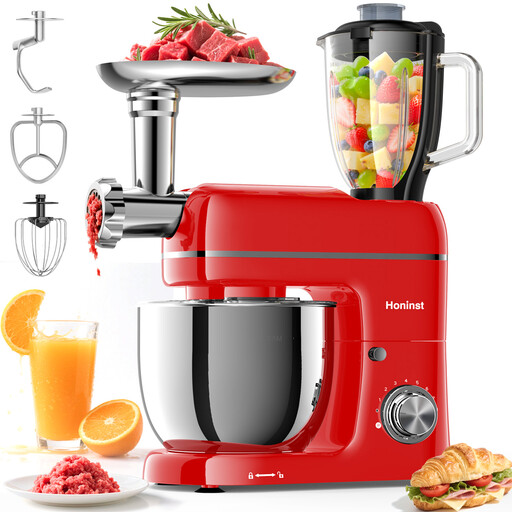
Why This Fits Their Persona: For users who want more than just a mixer. This appliance combines the functions of a dough mixer with a meat grinder and a blender, saving space and the cost of separate appliances.
It avoids the impractical accessory trap by integrating fully-fledged additional functions like a meat grinder and a blender attachment. The large 6.5-QT bowl (approx. 6.2 L) also offers a high capacity.
High multifunctionality (kneading, mixing, blending, meat grinding). Powerful motor for diverse tasks. Great value for a combination appliance.
We have compiled a complete, up-to-date list of products that fully meet these strict selection criteria and all applicable safety regulations.
Wattage alone is not a meaningful indicator. The motor type and gearbox quality are more important. A well-engineered direct current (DC) motor with 400–500 watts can deliver better and more consistent performance when kneading dough than a simple alternating current (AC) motor with 1200 watts. Focus on the overall construction rather than a single number.
No, not every appliance is designed for it. Kneading heavy dough requires a robust machine with a high-torque motor, an all-metal gearbox, and a stable housing that doesn't shift. Models explicitly advertised as a dough kneading machine or those with the features mentioned are the right choice. Cheaper units with plastic gears can be damaged by such a load.
Always read the manufacturer's instructions. Typically, the stainless steel bowl and mixing tools (dough hook, whisk, flat beater) are dishwasher-safe. The machine's housing should never be submerged in water; instead, wipe it with a damp cloth. Always unplug the appliance before cleaning and changing accessories.