
Lieferung heute & morgen

Qualitätsgarantie

Willkommens-Angebote freischalten: KOSTENLOSE Lieferung | Bis zu 80 % RABATT | Kostenlose 30-Tage-JoyPlus-Testphase
App herunterladen
Kitchen appliances can make everyday life easier in households, shared flats, offices and when camping. At the same time, unclear product information can quickly lead to unsuitable purchases. For example, a compact multifunction cooker is not automatically suitable for frying just because it lists several cooking methods. A large blender may not fit in your kitchen cupboard, while an inexpensive kettle can use more electricity than necessary if its power rating is unnecessarily high.
This guide explains what households in the UK should look for when buying kitchen appliances – from capacity and power to cleaning, safety features and the intended use.
Descriptions such as ‘multifunction’ or ‘4-in-1’ reveal little about an appliance’s actual suitability on their own. What matters is which tasks are specified in the product description. A small electric cooking pot may be suitable for soups, pasta or stews, but not necessarily for high-heat frying.
You should also check the permitted ingredients and maximum operating time when choosing a food chopper. For example, the stated continuous operating time for the Bear Food Chopper QSJ-D03W5 is no more than 40 seconds, followed by a cooling break. According to the product information, hard foods such as ice cubes, bones and frozen ingredients are not suitable.
A high wattage initially indicates electrical input power, not necessarily better cooking results. An electric rice cooker rated at 860 W may be suitable for a household of three to four people, while a 600 W appliance may be sufficient for one person. With a blender, the blade design, speed settings, capacity and minimum quantity of liquid are also important.
The Bear Table Blender LLJ-B12K1 is specified as having 500 W of power, a 1.2-litre container and four stainless-steel blades. At the same time, at least 300 ml of liquid should be added during use. Restrictions like these are just as important for small portions as the motor power.
An appliance that is difficult to dismantle, or whose delicate components must not come into contact with water, can become impractical for everyday use. Look for removable parts, dishwasher-safe components and clear cleaning instructions.
Appliances involving steam, hot liquids or sharp blades require additional care. A food steamer, slow cooker and electric cooking pots must be placed on a stable, heat-resistant surface. The main unit, cable and plug must generally not be immersed in water.
The usable capacity should match your actual needs:
The external dimensions are just as important. An appliance with a large capacity can take up too much space on a small worktop, in a compact kitchen or in a motorhome.
Always compare wattage together with capacity and function. A kettle rated at 2,200 W heats 1.7 litres of water quickly, but uses a corresponding amount of energy at full power. Electricity consumption can be estimated as follows:
Power in kilowatts × operating time in hours = consumption in kilowatt-hours.
An appliance rated at 2,000 W that runs for half an hour uses approximately 1 kWh in theory. With an induction hob, you also need to consider whether the cookware is suitable and how evenly heat is distributed. The cookware must be magnetic; aluminium or ceramic pots without a magnetic base will not work properly.
Only suitable kitchen utensils made from wood, silicone or plastic should be used with coated pots and pans. Metal can damage the coating. Also check:
An ice cube tray is not an electrical kitchen appliance, but it is a practical piece of kitchen equipment for many households. According to the product description, the flexible TPE/TPR/ABS tray from 5Five is dishwasher-safe. When filling it, leave a little room because water expands as it freezes.
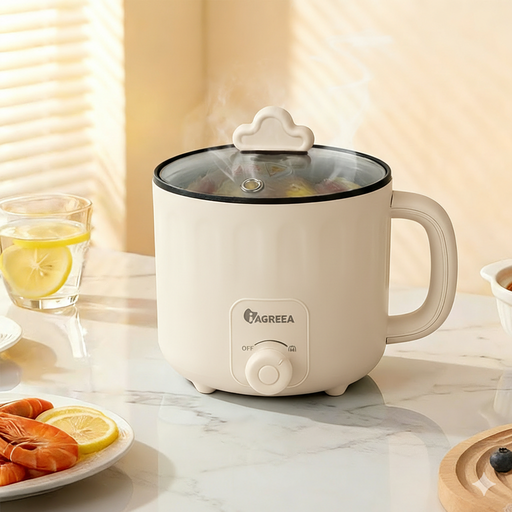
Why this product suits this profile: This compact electric cooking pot is designed for individuals, students and small homes. With a 1.6-litre capacity, 600 W of power and one-button operation, it is suitable for pasta, soups and simple stews.
The capacity and intended functions are clearly stated. Automatic switch-off and boil-dry protection address common risks when heating.
Compact dimensions, non-stick coating, ergonomic handle and two essential safety features.
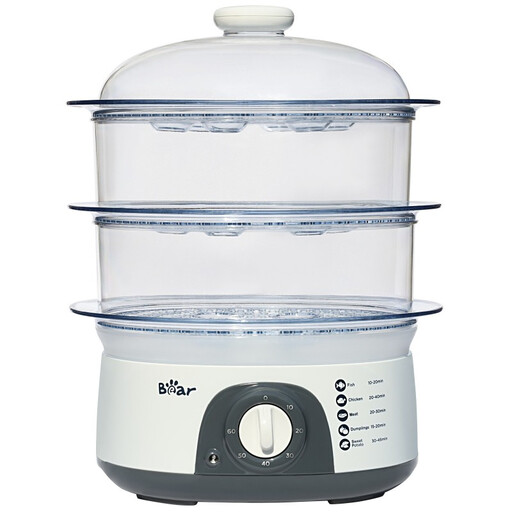
Why this product suits this profile: With three tiers and a stated 10-litre capacity, this food steamer is aimed at households that want to cook several ingredients at once. A 60-minute timer helps you plan your cooking.
The cooking capacity and stackable design are clearly specified. Removable parts make cleaning easier, although you still need to take care around the steam outlet.
Three tiers, transparent lid, drip tray and timer of up to 60 minutes.

Why this product suits this profile: This portable induction hob is suitable as an additional cooking zone, for small kitchens, holiday lets or campsites with a suitable power connection. Ten power levels and six functions support a variety of cooking tasks.
The product information expressly states that the cookware must be magnetically compatible. Child lock and boil-dry protection are also listed.
2000 W, touch controls, ten power levels, six preset functions and a slim housing.

Why this product suits this profile: Its stated capacity is designed for three to four people. As well as rice, the product description mentions porridge, soup, cake, a keep-warm function and a steaming insert.
The 4-litre capacity gives a clear indication of the household size it is intended for. Check the instructions on the steam vent, maximum fill level and cleaning before use.
4-litre inner pot, keep-warm and delayed-start functions, several programmes, plus a steaming insert and rice paddle.
For drinks, a kettle or coffee machine with a suitable capacity and automatic switch-off is important. If you mainly prepare smoothies, sauces or soups, you can choose between a blender, hand blender and food chopper. A hand blender takes up little storage space and can be used directly in the pot, while a jug blender usually offers a larger container. A food chopper, on the other hand, is designed for onions, vegetables or portions of meat, but its sharp blades require particular care.
If space is limited, a microwave with a 20-litre capacity and several power levels may be sufficient for reheating and defrosting. If you regularly want to prepare vegetables, fish or side dishes without adding extra fats, check the size and number of tiers on a food steamer. For slow-cooked dishes, consider slow cookers with lower temperature settings.
We have put together a complete, regularly updated list of products that fully meet these strict selection criteria and the safety regulations applicable in the EU.
Compact appliances with several clearly described functions are ideal for small flats. These include a hand blender, a small electric cooking pot, a 1.6-litre rice cooker or a portable induction hob. Before buying, check the available surface area, cable length, weight and storage requirements.
The right power rating depends on the capacity and intended task. 600 W may be sufficient for small pots, while a large induction hob or food steamer requires a higher rating. Wattage should never be assessed in isolation. Temperature settings, a timer, overheat protection and the manufacturer’s stated maximum operating time are also important.
Appliances with removable containers, smooth surfaces and few hard-to-reach areas are generally easier to clean. Do not use metal utensils with non-stick coatings. Electrical components, mains plugs and cables must not come into contact with water. Always unplug the appliance first and allow it to cool down completely.