
Lieferung heute & morgen

Qualitätsgarantie

Willkommens-Angebote freischalten: KOSTENLOSE Lieferung | Bis zu 80 % RABATT | Kostenlose 30-Tage-JoyPlus-Testphase
App herunterladen
A kitchen cutting board has to handle a lot every day: chopping vegetables, slicing bread, preparing meat or carrying ingredients straight to the hob. Even so, many shoppers choose mainly based on appearance or price. Small design details can later lead to practical problems.
The term antibacterial cutting board does not mean that cleaning is unnecessary. With stainless steel, bamboo or plastic surfaces, food residue and liquids still have a bearing on hygiene. What matters is a smooth, easily accessible surface, suitable cleaning and thorough drying.
With a reversible cutting board, one side can also be designated for raw meat and fish, and the other for vegetables or bread. This reduces the risk of preparing different food groups one after another on the same surface. It does not, however, replace proper cleaning.
A large cutting board gives you more room to work when preparing food. However, models measuring 45 to 50 cm in length need sufficient space on the worktop and in the cupboard. Before buying, you should therefore measure your work surface, sink and storage location.
A small kitchen cutting board can push ingredients towards the edge. A board that is too large, on the other hand, can be difficult to clean and carry. For many households, formats between approximately 34 × 24 cm and 45 × 30 cm are a practical starting point.
A cutting board with a juice groove can catch liquid when cutting fruit, vegetables or meat. However, the groove takes up working space and needs to be cleaned carefully. With a cutting board with a handle, the handle should be securely attached and should not unnecessarily reduce the usable cutting surface.
Weight also matters: a heavy board is often more stable, but less convenient to serve with or put away. A thin, lightweight board is easy to move, but may be more likely to slide on smooth work surfaces.
A wooden cutting board made from beech or walnut has a warm appearance and is comparatively kind to knives during normal use. Wood should generally not be soaked or cleaned in the dishwasher. After washing, it should be dried immediately and left upright until completely dry. Occasional treatment with food-safe oil can help care for the surface.
A bamboo cutting board is an option for shoppers who prefer a firm, natural surface. Bamboo is not automatically maintenance-free, however. Hand washing, thorough drying and following the manufacturer’s instructions are still important. If the board develops cracks, chips or warping, it should no longer be used.
A board made from wheat straw, rice husk or PP composite material can be lightweight and easy to handle. Claims such as “environmentally friendly” or “antibacterial” should be assessed against the specific material and care information, rather than treated as a substitute for good hygiene.
A stainless steel cutting board is generally resistant to moisture and easy to wipe clean. However, stainless steel can be harsher on knife blades than wood or bamboo. A model with two different sides therefore offers a practical combination: a robust stainless steel side and a softer composite side for more delicate cutting tasks.
Material thickness affects stability and weight. For wooden and bamboo boards, approximately 17 to 30 mm can provide a solid base, although suitability also depends on the construction, underside and work surface. Non-slip edges or silicone borders are helpful when the board is placed on smooth kitchen worktops.
You should also check:
After every use, the board should be cleaned with warm water and a mild detergent, then dried thoroughly. Boards used for raw meat or fish should not be used for bread and vegetables without cleaning them first. When preparing different food groups, a cutting board set with various sizes or clearly separated areas of use can be a practical choice.
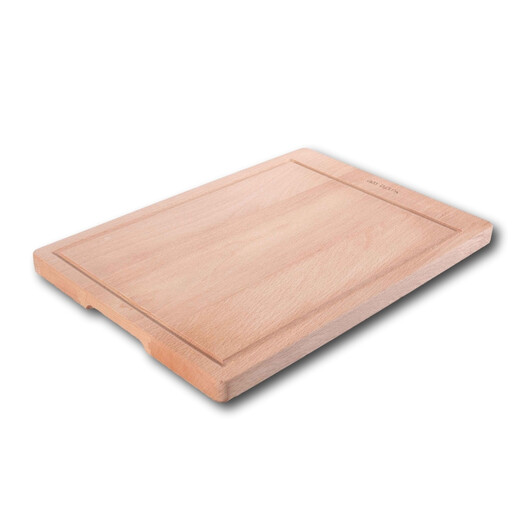
Why this product suits the profile: Measuring 34 × 24 × 2.2 cm, it is suitable for everyday cutting tasks without taking up excessive storage space.
The clearly stated dimensions prevent you from underestimating the worktop space or storage required. The care instructions expressly specify hand washing and immediate drying.
Beech wood surface, 2.2 cm thickness and a rectangular format that suits many kitchens.

Why this product suits the profile: The large working surface, surrounding juice groove and reversible design make it appealing to households that cook frequently and enjoy preparing a wide range of dishes.
The specific dimensions make it easier to plan the available space. The hand-washing requirement prevents incorrect expectations about cleaning it in the dishwasher.
Bamboo, 45 × 30 cm, a juice groove and reversible design for separate food preparation areas.

Why this product suits the profile: Three sizes, from 13 × 9.5 to 16 × 11.5 inches, allow you to prepare and serve different ingredients separately.
The different formats remove the need for one oversized board for every task. As hand washing is recommended, the care requirements remain clear.
Three bamboo boards with handles and integrated juice grooves; according to the product details, they are designed for cutting and serving.
We have put together a complete, regularly updated list of products that fully meet these strict selection criteria and the safety regulations applicable in the EU.
That depends on how you intend to use it. Wood and bamboo are often kind to knife blades, but require hand washing and thorough drying. Stainless steel is more resistant to moisture and easy to clean, but can put greater strain on the knife blade. When choosing, consider the material, care instructions and intended use together.
It is not possible to give one fixed lifespan for all models. Regular hand washing, thorough drying and avoiding soaking can help extend the service life of a wooden or bamboo board. Deep cracks, severe warping, mould or protruding splinters are all reasons to replace the board.
A juice groove is useful when cutting juicy fruit, meat or roasts, as it catches liquid. It is not needed for bread or dry ingredients. After every use, it should be thoroughly brushed out or rinsed so that no residue remains.