
Lieferung heute & morgen

Qualitätsgarantie

Willkommens-Angebote freischalten: KOSTENLOSE Lieferung | Bis zu 80 % RABATT | Kostenlose 30-Tage-JoyPlus-Testphase
App herunterladen
A cutting board for the kitchen is part of every kitchen’s daily essentials. However, it often takes a few weeks to discover whether a model stays firmly in place, catches liquid and can be cleaned without much effort. An attractive wood finish or the label “antibacterial” alone says little about how practical it is for everyday use.
A compact kitchen board may seem space-saving, but it quickly becomes impractical when chopping vegetables, bread or meat. When ingredients and a knife are on the board at the same time, there is often not enough room to work comfortably. For families or regular meal preparation, dimensions from around 30 × 20 cm are generally more convenient. However, a large cutting board also needs a sufficiently deep and stable work surface.
A juice groove can catch liquid around the edge, but it does not replace thorough cleaning. If the groove is very shallow, juice can still spill over when there is a larger amount. A cutting board with a handle is easy to carry and can also be used as a serving board. When cutting, however, the handle should not reduce the usable surface too much or make the board unbalanced.
Many wooden and bamboo boards are hand-washable, but are not suitable for the dishwasher. Heat, prolonged exposure to moisture and harsh cleaning products can encourage warping or cracking. If you are buying a wooden cutting board, check in advance whether it needs regular oiling and how it should be dried after cleaning.
A bamboo cutting board is relatively lightweight and provides a smooth work surface. With proper care, bamboo absorbs less moisture than some softer types of wood. Nevertheless, the board should not be left standing in water. Products made from beech, walnut, acacia or rubberwood differ in grain, weight and care requirements.
A wooden cutting board is often suitable both for food preparation and serving. Natural variations in colour and grain are characteristic of the material. If deep cracks, splinters or permanent warping become visible, the board should be replaced.
A stainless steel cutting board is easy to clean and does not absorb wood oils. However, stainless steel is a hard surface that may put more strain on the blade, depending on the knife and cutting technique. Models with a second side made from wheat straw fibre and PP combine an easier-care surface with a softer cutting surface. The term “antibacterial” should always be understood as a product characteristic of the specific listing; it does not replace cleaning or separate use for different types of food.
For everyday use, sizes of approximately 30 × 20 cm to 40 × 28 cm are versatile. A large cutting board measuring 50 × 35 cm provides plenty of space for dough, bread or several ingredients, but requires more storage room and is heavier.
Thickness affects stability. Boards between approximately 17 and 26 mm are generally more stable in larger formats than very thin models. A non-slip underside or sufficiently high weight can provide additional support. Before buying, also check whether the board will fit in your sink and the cupboard where you plan to store it.
For raw meat and poultry, a separate meat cutting board or clearly separated use is recommended. After contact with raw animal products, the surface must be cleaned thoroughly and dried completely. A separate kitchen or serving board can be used for bread, fruit, vegetables and cheese. A cutting board set with several sizes makes this separation easier while providing suitable surfaces for different tasks.
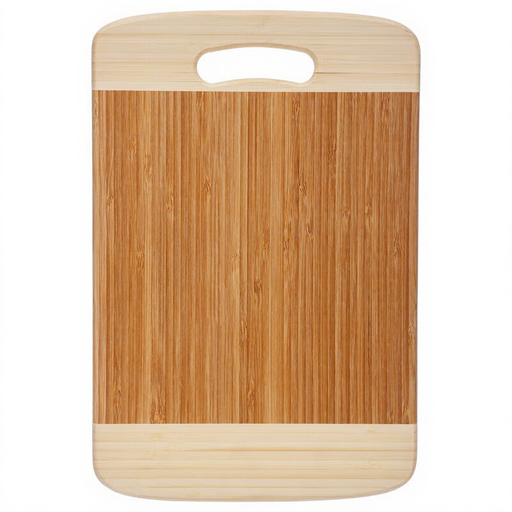
Why this product suits this profile: The 30 × 20 cm bamboo board is designed for smaller kitchens, occasional preparation and everyday essentials. The integrated handle makes it easier to carry and hang up.
The specific size prevents beginners from accidentally buying an oversized board that takes up unnecessary storage space. Hand washing is expressly recommended.
Bamboo surface, integrated handle and easy cleaning with mild washing-up liquid and water.
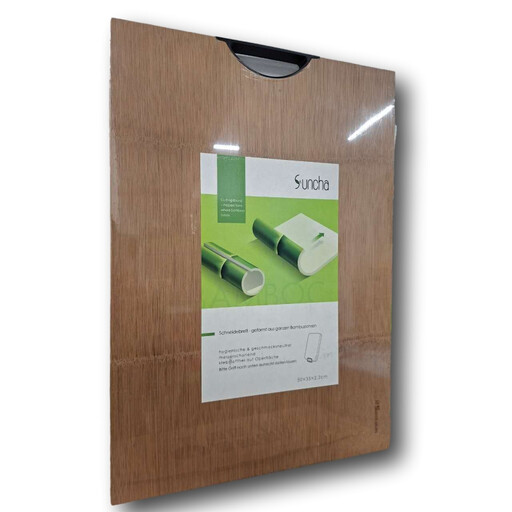
Why this product suits this profile: Made from a single bamboo board, this XXXL board provides a generous 50 × 35 cm work surface for elaborate meals, preparing dough and bread.
The 26 mm thickness and 1,99 kg weight are clear specifications indicating improved stability. At the same time, the intended storage space must be large enough to accommodate its dimensions.
50 × 35 cm work surface, one-piece bamboo construction and integrated handle.

Why this product suits this profile: Three sizes from 13 × 9,5 to 16 × 11,5 inches make it possible to allocate boards by ingredient and task. Juice grooves and handles support both preparation and serving.
The set reduces the temptation to use a single board for all foods. The juice groove addresses liquid run-off, while hand washing reflects the board’s actual care requirements.
Three formats, integrated juice grooves, carrying handles and a stated thickness of 1,5 inches for the largest board.
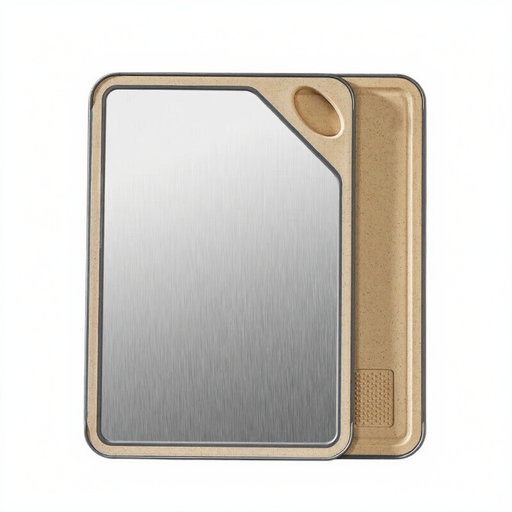
Why this product suits this profile: Measuring 25 × 36 cm and suitable for use on both sides, this board combines 304 stainless steel with a wheat straw fibre and PP side. It is ideal for households that prefer different surfaces for different ingredients.
The material specification is more informative than a general hygiene claim. The two sides make it easier to separate different uses; this board must also be cleaned after every use.
304 stainless steel side, softer composite side, reversible design and hanging hole.
We have put together a complete, regularly updated list of products that fully meet these strict selection criteria and the safety regulations applicable in the EU.
That depends on how you intend to use it. Bamboo and various types of wood offer a natural, knife-friendly surface and can also be used as serving boards. Stainless steel is easy to care for and resistant to moisture, but depending on how it is used, it may put more strain on the knife blade. The construction, thickness and specific care instructions are also important.
Around 30 × 20 cm is sufficient for smaller preparation tasks. Families and frequent users often benefit from boards measuring 36 × 25 cm or larger. Before buying, consider the work surface, sink size and available storage space. A cutting board set can be a sensible choice if you need several sizes or separate work surfaces.
There is no fixed service life. The condition of the surface is the deciding factor. Minor signs of use are normal with regular use. Deep cuts, cracks, splinters, mould or permanent warping indicate that the board should be replaced. A smooth, easy-to-clean surface is particularly important for boards used with raw meat.