
Lieferung heute & morgen

Qualitätsgarantie

Willkommens-Angebote freischalten: KOSTENLOSE Lieferung | Bis zu 80 % RABATT | Kostenlose 30-Tage-JoyPlus-Testphase
App herunterladen
A kitchen dish rack with draining tray should hold your crockery neatly after washing up, keep water off the worktop and take up as little space as possible. In practice, however, the differences are not limited to design. Dimensions, material, water drainage and cleaning all determine whether a dish drying rack will remain suitable for everyday use in your kitchen.
If you are also looking for biodegradable washing-up sponges, a coordinated bundle can combine two common tasks: drying dishes and organising your daily kitchen cleaning routine.
A high capacity may sound practical at first. However, a two-tier kitchen dish rack can be too wide or too tall for the space available. Before buying, measure the clear worktop area and the distance from wall units. The distance to the sink is also important if the draining tray needs to be emptied regularly.
Not every tray reliably prevents standing water. If liquid cannot drain away or be poured out easily, moisture remains beneath the dish rack. This makes cleaning more difficult and can leave water marks on the worktop. Look for a removable or easily accessible tray and, where available, a spout or water deflector.
“Metal” is not a precise material description. For a dish drying rack, it is important to know whether the load-bearing parts are made from stainless steel, coated steel or plastic. Stainless steel can cope well with daily moisture, but it still needs to be wiped down regularly. Coated surfaces should not be treated with abrasive products, as these can damage the coating.
A space-saving dish rack does not necessarily have to be small. What matters is the relationship between the external dimensions and the usable internal space. The Maxcook stainless steel dish drying rack measures 42 × 29 × 12,7 cm and has a single-tier design. According to the product description, it has space for plates, cups and kitchen utensils.
For households with a large amount of crockery, a two-tier model may be a sensible choice. The 5five 2-Tier Dish Drainer measures 50 × 30,5 × 34 cm and, according to the product details, can hold up to 17 plates. However, its greater height should only be chosen if there is sufficient clearance beneath the wall units above.
Check whether plates stand securely in the designated slots and whether cutlery can be stored separately. An integrated cutlery holder prevents smaller items from lying between plates or being scattered across the worktop.
According to the product description, the Maxcook model is made from stainless steel, complemented by a PP draining tray. The rotating water deflector can help you adjust the drainage direction to the position of the sink. This feature is particularly useful when the dish rack is placed directly beside the sink.
A draining tray should be removable and easy to wipe clean without complicated dismantling. Remove water and food residue regularly rather than leaving them in the rack for long periods. For stainless steel, a soft cloth with mild cleaning product is often sufficient. Scouring sponges can scratch surfaces.
For more conscious zero-waste kitchen cleaning, loofah sponges for the kitchen are worth considering. The product details for the Maxcook natural loofah sponge state a size of 11 × 7 cm and natural loofah fibres. According to the product description, the sponges are biodegradable and compostable. Nevertheless, check the disposal instructions and local waste management practices before buying.
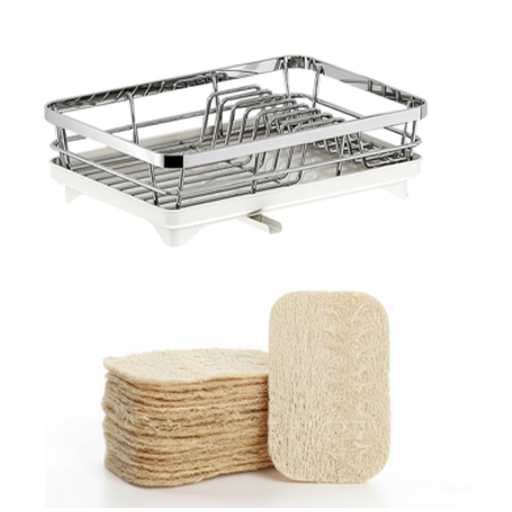
Why this product suits this profile: This bundle combines a single-tier stainless steel dish rack with 30 natural loofah sponges. It gives first-time buyers a combined solution for drying dishes and everyday washing-up tasks.
The dimensions of 42 × 29 × 12,7 cm make the required footprint clear. The integrated PP draining tray collects water beneath the rack.
Single-tier stainless steel rack, draining tray and 30 loofah sponges in one product bundle.

Why this product suits this profile: This model is aimed at households that want to compare material specifications, fixed dimensions and defined water drainage before buying.
The product description specifies stainless steel, a PP tray and a rotating water deflector. This makes the key construction features easy to verify.
Stainless steel construction, integrated draining tray, water drainage and a design requiring no assembly.
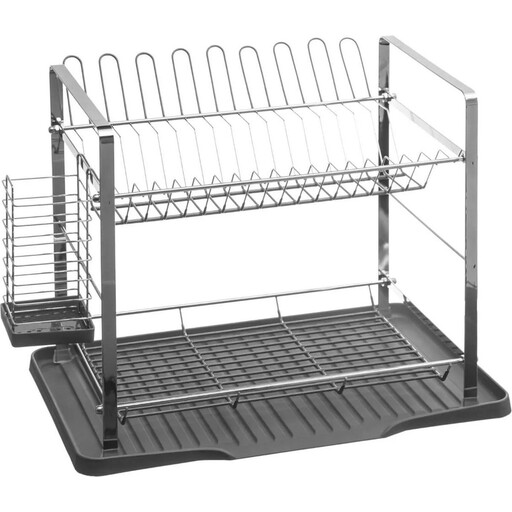
Why this product suits this profile: Families and frequent users benefit from two tiers when several plates, cups and pieces of cutlery need to dry each day.
The footprint and height are specified as 50 × 30,5 × 34 cm. This lets you check in advance whether the two-tier format will fit your kitchen.
Two tiers, removable cutlery basket, non-slip base and a stated capacity of up to 17 plates.
A washing-up sponge set containing several sponges can be more hygienic and practical to manage if you change sponges regularly. According to the product details, loofah fibres are suitable for a range of washing-up tasks. For delicate surfaces, test the material on an inconspicuous area first to check whether it causes scratches.
For zero-waste kitchen cleaning, it is also important to use them correctly:
We have put together a complete, regularly updated list of products that fully meet these strict selection criteria and the safety regulations applicable in the EU.
Place the rack fully on the draining tray and direct any water deflector towards the sink. Also check that the rack is level and that the tray is correctly positioned. After washing up, excess water should not be left standing in the tray for long periods.
Its service life depends on the material, load and care. Stainless steel parts should be dried regularly after contact with water. Coated or plastic components should not be treated with harsh cleaning products. Bent bars, sharp edges or an unstable construction are reasons to stop using the product.
Apart from the purchase price, ongoing maintenance costs are usually low. The main expenses are cleaning products and, where necessary, replacement sponges. For a set containing biodegradable washing-up sponges, consider how often they need changing, the material specifications and local disposal options when making your purchase decision.