
Lieferung heute & morgen

Qualitätsgarantie

Willkommens-Angebote freischalten: KOSTENLOSE Lieferung | Bis zu 80 % RABATT | Kostenlose 30-Tage-JoyPlus-Testphase
App herunterladen
Blunt kitchen knives make slicing, chopping and filleting more difficult. When looking for a suitable kitchen knife sharpener, many shoppers initially focus on claims such as “fast”, “multifunctional” or “professional”. What really matters, however, is the sharpening angle, stability, suitable sharpening stages and compatibility with your own knife.
This guide is aimed at households, keen home cooks and kitchen users who want to compare a kitchen knife sharpener using clear, practical criteria.
A 4-in-1 knife sharpener or 3-stage knife sharpener can cover several tasks. However, this is only useful when the stages are clearly intended for specific purposes. A coarse sharpening stage is generally used to remove more material, while a fine stage refines the cutting edge.
If you only want to sharpen a knife occasionally, you do not necessarily need four functions. Additional slots can make the device more complicated to use and may not be suitable for every blade if used incorrectly.
A knife sharpener with a suction cup or non-slip underside can make it easier to guide the blade. The key is to ensure that the surface is clean, dry and smooth. On damp, textured or heavily soiled worktops, the grip may weaken.
An unstable knife sharpener increases the risk of the blade slipping sideways. The sharpener should therefore be checked for a secure hold before every use.
Not every household knife sharpener is suitable for serrated edges, very thin blades, ceramic knives or single-bevel Japanese knives. Many manual models are primarily designed for smooth-edged blades made from stainless steel or similar materials.
For serrated bread knives, a conventional V-shaped sharpener is usually not the right choice. A honing rod also serves a different purpose from a knife sharpener: with suitable knives, it realigns the cutting edge, but depending on its design, it removes less material than an abrasive sharpener.
The sharpening angle affects how the blade is guided into the sharpening slot. A pre-set angle can make the device easier to use, but it limits the range of suitable knives. According to the product description, the ZWILLING TWINSHARP is designed for an angle of approximately 35 degrees for smooth-edged knives.
Before buying, check:
A manual knife sharpener may use steel, ceramic or other abrasive elements. Steel and ceramic inserts can perform different tasks. According to the product description, the ZWILLING TWINSHARP combines stainless steel and ceramic discs for coarse and fine sharpening.
With a multi-stage model, the order should be easy to understand:
A scissor function is not automatically suitable for every type of scissors. The relevant manufacturer’s instructions remain decisive.
Compact dimensions make it easier to store the sharpener in a kitchen drawer. The “Knife Sharpener 215x50x55mm” model is specified with these dimensions, making it an interesting option for users who prioritise a compact format.
You should also look for:
The blade should always be guided through the designated slot in a controlled manner and without sideways pressure. Sharpening too frequently or applying excessive force can remove material from the cutting edge.
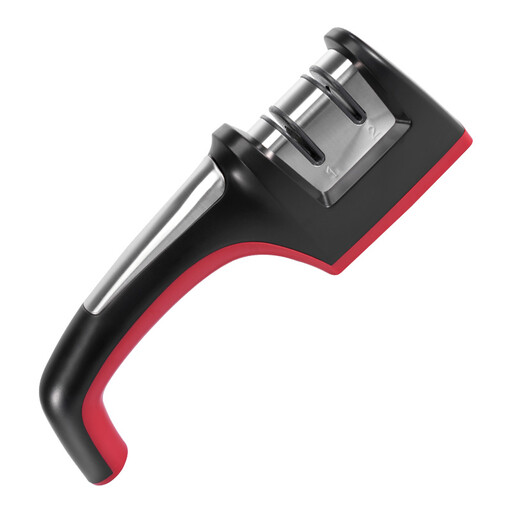
Why this product suits this profile: The combination of a manual sharpening stone and honing rod appeals to households that want to try different tools for knife care.
The product name explicitly mentions both types of tool. This means the choice does not have to rely solely on a general “multifunctional” claim.
Manual use, plus two different approaches to knife care in a single product.
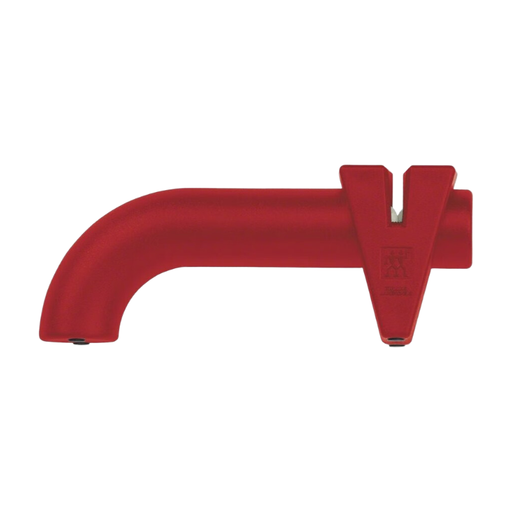
Why this product suits this profile: Anyone who prefers a clearly defined solution gets a compact model with a fixed angle and two sharpening components.
The product description states the pre-set angle of approximately 35 degrees and suitability for smooth edges. Compatibility can therefore be checked.
17 cm length, ABS plastic, plus stainless steel and ceramic discs for coarse and fine sharpening.
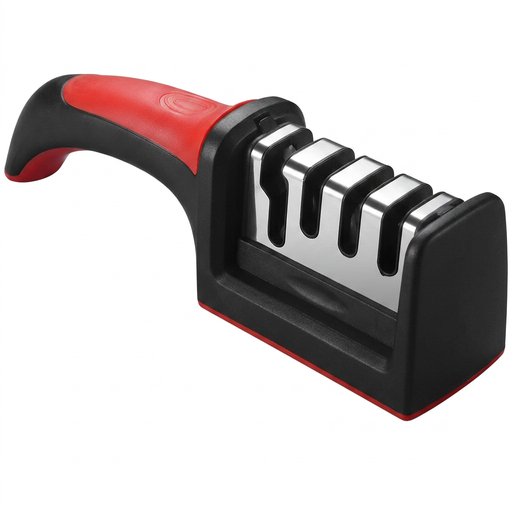
Why this product suits this profile: This model is aimed at users who want to sharpen scissors as well as kitchen knives and need several clearly labelled stages.
The four designated areas are described as coarse, fine, scissors and polishing. Buyers can therefore check whether the functions meet their needs.
Four separate openings and, according to the product description, secure fixing on the worktop.
Place the knife sharpener on a stable, dry surface. With a model featuring a suction cup, check that it is firmly attached before inserting the blade. Draw the knife through the opening with even pressure, following the instructions. Avoid sideways movements or pressing too hard.
Clean the device according to the manufacturer’s instructions. Sharpening residue should be removed before the product is put away. After sharpening, knives themselves should be cleared of residue and dried by hand. A kitchen knife sharpener does not automatically extend a blade’s service life: the wrong angle, unsuitable cutting surfaces and cleaning in the dishwasher can still damage the condition of the knife.
We have put together a complete, regularly updated list of products that fully meet these strict selection criteria and the safety regulations applicable in the EU.
This depends on how the knife is used, the steel, the cutting surface and the level of sharpness required. If you cook regularly, it can be useful to check the edge before the knife becomes noticeably blunt. For suitable knives, a honing rod is better suited to ongoing maintenance; a sharpener is used when material actually needs to be removed from the cutting edge.
A suction cup can improve stability on smooth, clean and dry surfaces. However, it does not replace correct handling. Before every use, check that the device is firmly attached and that the blade can be guided according to the instructions.
There is no standard service life that can be inferred from the product type alone. It depends on the abrasive material, frequency of use, pressure, cleaning and storage. Check that the sharpening inserts are intact and that the housing is free from cracks. If there is visible damage, stop using the kitchen knife sharpener.