
Lieferung heute & morgen

Qualitätsgarantie

Willkommens-Angebote freischalten: KOSTENLOSE Lieferung | Bis zu 80 % RABATT | Kostenlose 30-Tage-JoyPlus-Testphase
App herunterladen
Blunt kitchen knives make cutting tasks more difficult and increase the risk of slipping when pressure is applied to the ingredients. A kitchen knife sharpener can restore the edge – provided its design and use are suitable for the knife. Manual knife sharpeners, honing steels, whetstones and electric devices differ significantly.
A multi-stage knife sharpener can combine coarse grinding, fine sharpening and polishing. However, this does not automatically mean that every stage is suitable for every knife. A coarse slot can remove unnecessarily large amounts of material from a blade that is only slightly blunt. For regular maintenance, the fine or polishing stage is often sufficient.
So check whether the stages are clearly labelled and in what order they should be used. A 4-stage knife sharpener with an additional scissors function only makes sense if that function is actually needed.
A knife sharpener with a suction cup can make handling easier. However, its grip depends on the work surface. Dust, moisture, uneven surfaces or textured worktops can affect stability. Before sharpening, the suction cup should be attached securely to a smooth, dry and firm surface.
If the sharpener is not held firmly in place, it may slip. A non-slip base or a model with a wide footprint may be the more suitable solution for your household.
Depending on its design, a honing steel removes very little material and mainly realigns the cutting edge. It is suitable for regularly maintaining an edge that is still working well, but it does not always replace a knife sharpener or a whetstone for kitchen knives.
A whetstone allows controlled sharpening with a water- or oil-based bond and requires more practice. Manual pull-through sharpeners usually guide the blade at a set angle, making them easier to use. However, the word ‘quick’ says nothing about whether a product is suitable for a particular blade in the long term.
The sharpening angle affects how the edge is treated. A fixed angle makes use easier for beginners, but it is not automatically suitable for every blade shape. Check whether the manufacturer specifies an angle and whether the device is intended for straight edges or also for serrated blades.
Many manual models are primarily designed for smooth-edged kitchen knives. Serrated bread knives should not be pulled through a standard slot unless this is expressly approved. Very thin, single-bevel or particularly hard blades may also require different care.
The labels ‘coarse’, ‘fine’ and ‘polishing’ describe the purpose of each stage. Coarse sharpening surfaces are intended for more heavily worn edges, while fine elements are used for finishing. Depending on the material, steel, ceramic or coated abrasive elements may be used.
The number of stages alone is not what matters; their function should be clear and logical. A multi-stage knife sharpener should also include easy-to-understand instructions. With a scissors sharpener, the slot intended for scissors must be clearly separate from the knife slots.
A compact knife sharpener fits in drawers, but it should still stand securely on the worktop. Check the dimensions, grip area and base. The ‘Knife Sharpener 215x50x55mm’ is listed with dimensions of 215 × 50 × 55 mm, so it requires comparatively little storage space.
Metal particles may be produced during sharpening. The device should therefore be cleaned in accordance with the manufacturer’s instructions. Knives themselves should be rinsed and dried thoroughly after sharpening. Use a stable cutting surface while sharpening, and keep your fingers away from the sharpening slots and the blade.
The following models differ in the number of stages, operating concept and intended use. The selection is based on the stated product features, not on sweeping claims about quality.
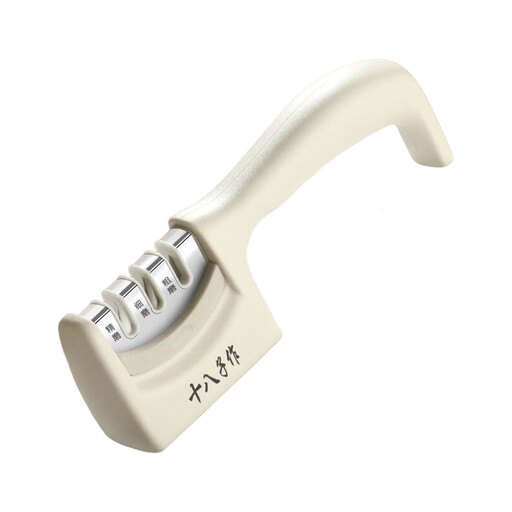
Why this product suits this profile: The three separate stages provide a clear introduction to sharpening kitchen knives, without the need to set up a whetstone.
The stages make the difference between coarse sharpening and fine finishing clear. This means you do not automatically start every sharpening session with the coarse stage.
Manual operation and three sharpening stages for smooth-edged kitchen knives.
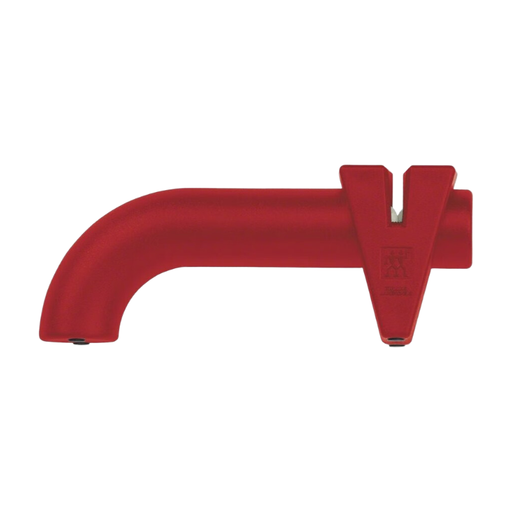
Why this product suits this profile: This compact device combines two sharpening stages with a specified fixed angle of around 35°.
The guided angle reduces uncertainty when positioning the blade manually. According to the product information, this model is intended for knives with a smooth edge.
17 cm length, ABS plastic, plus stainless steel and ceramic discs for coarse and fine sharpening.
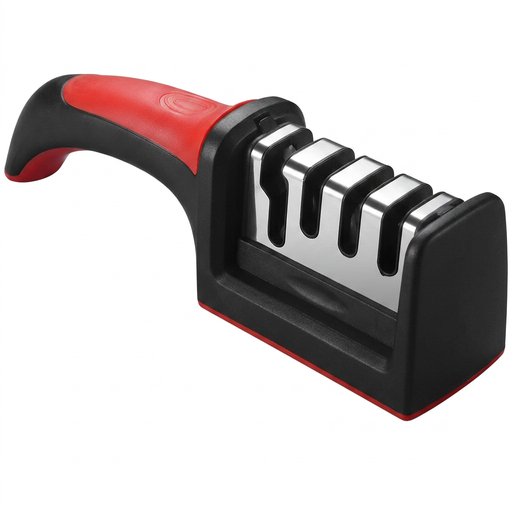
Why this product suits this profile: Four separate sections cover coarse sharpening, fine sharpening, scissor sharpening and polishing.
The clearly separated functions prevent scissors or slightly blunt knives from automatically being sharpened in the coarse slot.
Four stages and a dedicated scissor function; according to the product description, it is designed for secure attachment to the work surface.
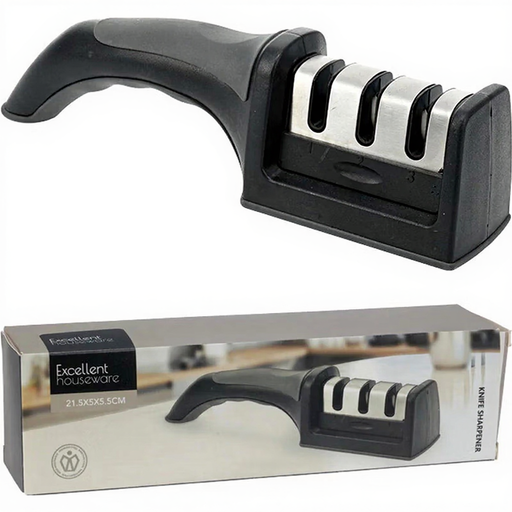
Why this product suits this profile: Its stated dimensions allow for space-saving storage in drawers or smaller kitchen areas.
The precise dimensions help you realistically assess the available space before buying, rather than relying solely on product photos.
Compact dimensions of 215 × 50 × 55 mm and manual operation for kitchen knives.
We have compiled a complete, regularly updated list of products that fully meet these strict selection criteria and the safety regulations applicable in the EU.
Before use, follow the instructions provided by the manufacturer. Clean and dry the knife, position the sharpener securely and guide the blade in a controlled manner through the appropriate slot. Do not apply excessive pressure. If necessary, start with the coarse stage and then move on to the finer setting.
A honing steel is generally run along the cutting edge and is suitable for regular maintenance. A whetstone for kitchen knives, on the other hand, requires an even motion and control of the angle. For households that mainly need straightforward finishing, a manual knife sharpener with clearly defined stages may be more practical.
Do not sharpen your knives automatically after every use. First check whether the blade is actually blunt. Sharpening too aggressively too often can shorten the life of the edge. Knives with damage, chips or specialised bevels should be treated according to the manufacturer’s instructions.
This depends on usage, blade material, cutting surface and cleaning. If you cook regularly, occasional light finishing may be sufficient. A honing steel can be used between sharpening sessions for maintenance. The key indicator is how the knife feels when cutting, not a fixed schedule.
No. Many models are designed for smooth-edged, double-bevel kitchen knives. Serrated edges, single-bevel blades, ceramic knives and very thin specialist blades may require different treatment. Check the compatibility information before buying.
The work surface must be smooth, clean, dry and stable. Test the grip before inserting the blade. If the suction cup comes loose, do not continue using the device until it has been secured properly.