
Lieferung heute & morgen

Qualitätsgarantie

Willkommens-Angebote freischalten: KOSTENLOSE Lieferung | Bis zu 80 % RABATT | Kostenlose 30-Tage-JoyPlus-Testphase
App herunterladen
A kitchen strainer is one of the most frequently used utensils in British households. It helps with draining pasta, washing rice, rinsing fruit and vegetables, and sifting flour. Even so, choosing the right model is not always straightforward. Buyers often decide based solely on diameter or material and overlook important details such as mesh size, stability and storage.
A compact strainer for one portion of berries is not automatically suitable for family-sized portions of pasta. If a pasta strainer is too small, the weight of the food can make it harder to handle. Conversely, a large draining strainer takes up a lot of space and is often impractical for small quantities.
The description “fine strainer” is not always enough. Flour, icing sugar and very small particles require a finer mesh than coarse pasta or salad. If no opening size is provided, it is difficult to assess the product’s actual suitability.
Stainless steel is durable and easy to clean, but not every strainer is made from the same grade of stainless steel. With plastic frames, buyers should also check the stated temperature limit. A model with plastic components may be suitable for cold or lukewarm water, but not for boiling liquids. Handles and edges also deserve attention: sharp metal edges or a poorly secured handle can compromise safe use.
A stainless steel kitchen strainer is uncoated, odour-neutral and can be cleaned in the dishwasher if the manufacturer permits this. Models made from 304 stainless steel or 18/10 stainless steel are commonly used for kitchen utensils. However, the material specification alone does not replace checking the care instructions and quality of the construction.
Plastic can reduce weight and allows for foldable or extendable designs. With a strainer featuring a plastic frame, its temperature resistance should be taken into account. For example, the Stainless Steel and Plastic Mesh Sieve has a stated frame temperature limit of 70 °C. Boiling water should not be poured directly into this hand-held strainer.
For everyday use, the following sizes provide a rough guide:
A kitchen strainer with a handle can easily be held over a bowl. A colander with side handles and a stand, on the other hand, can stand independently and leave both hands free for transferring food. For sinks of different widths, an extendable or foldable kitchen strainer can be a practical solution.
A strainer for draining spaghetti needs larger openings than one designed for flour or fruit pulp. For rice, quinoa and small grains, evenly distributed smaller openings are helpful. A traditional mesh strainer can retain fine particles, while a perforated pasta strainer usually allows liquid to drain more quickly.
Before buying, check the following:
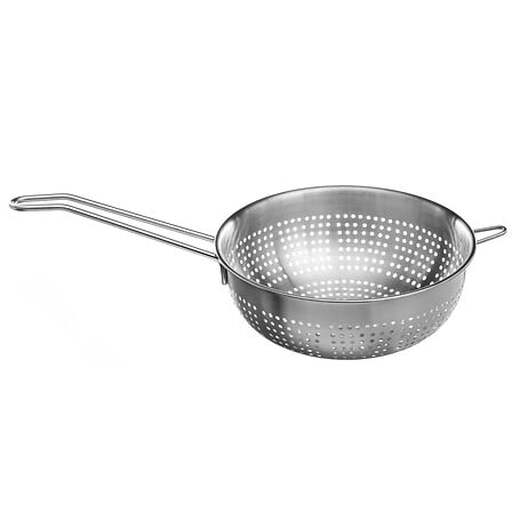
Why this product suits this profile: With a capacity of 0.5 litres and a long handle, it is suitable for small portions, berries, individual portions of vegetables or one serving of pasta.
The capacity is clearly stated, making it easier to assess before buying whether the compact format suits your needs.
Stainless steel construction, 0.5-litre capacity and a long handle; according to the product description, it is suitable for cupboard storage or hanging up.
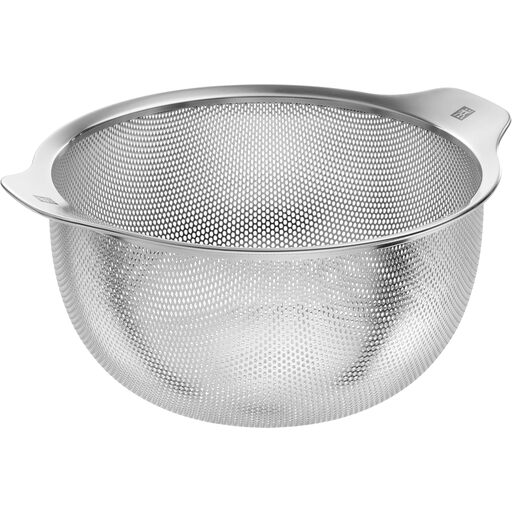
Why this product suits this profile: The 24 cm diameter, side handles and raised stand are designed for larger quantities of pasta and vegetables.
The product details specify the material, size, handles, stand and dishwasher suitability. This makes it easier to check the key details before buying.
18/10 stainless steel, 24 cm diameter, integrated side handles and, according to the product description, dishwasher-safe.
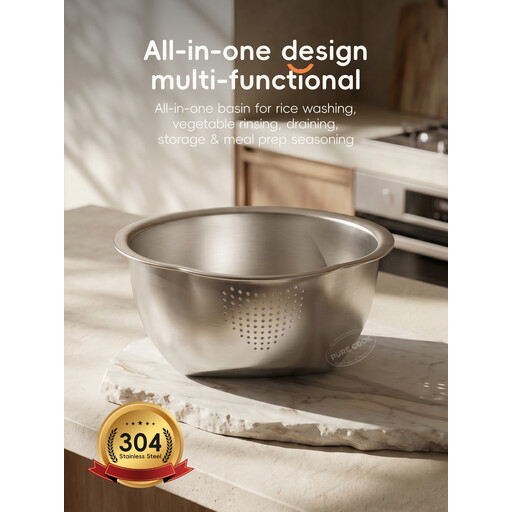
Why this product suits this profile: The 27 cm basin with side handles is designed for rice, quinoa, fruit, vegetables and larger food preparation tasks.
The product description specifies 304 stainless steel, evenly distributed openings, polished edges and clear care instructions.
304 stainless steel, 27 cm diameter, side handles and, according to the product description, dishwasher-safe.
We have compiled a complete, regularly updated list of products that fully meet these strict selection criteria and the safety regulations applicable in the EU.
Before first use, every kitchen strainer should be rinsed with warm water and a mild cleaning product. Fine mesh can retain residue, so it should be rinsed immediately after use. Steel wool, abrasive cleaning products and hard brushes can damage the mesh or surfaces.
When handling hot liquids, always follow the relevant manufacturer’s instructions. A plastic frame should not automatically be used with boiling water. A heat-insulating handle does not mean that the entire strainer is heat-resistant. After cleaning, the strainer should be allowed to dry completely, particularly if it will be stored in a cupboard for an extended period.
For small kitchens, a foldable kitchen strainer or an extendable model saves space. If you regularly drain pasta for several people, choose a rigid stainless steel pasta strainer with a sufficiently wide stable base.
A rice strainer should have evenly distributed, sufficiently small openings to prevent the grains from falling through. A model with a diameter of around 20 to 27 cm provides more space for washing larger quantities. For frequent use, stainless steel models with smooth edges and easy cleaning are practical.
That depends on the individual product. Stainless steel itself is often dishwasher-safe, but handles, plastic frames or coatings may require different care. The specific manufacturer’s instructions are what matter. With delicate surfaces, hand washing can help reduce signs of wear.
A fine kitchen strainer is often used for sifting flour or straining out small particles. A colander or coarsely perforated pasta strainer is generally designed for draining pasta, potatoes and vegetables. For rice, berries and small ingredients, smaller openings or a finer mesh structure are more suitable.