
Lieferung heute & morgen

Qualitätsgarantie

Willkommens-Angebote freischalten: KOSTENLOSE Lieferung | Bis zu 80 % RABATT | Kostenlose 30-Tage-JoyPlus-Testphase
App herunterladen
A wardrobe needs to do more than hide clothes behind doors. The key considerations are finding the right dimensions, choosing a practical interior layout and making sure it can be used safely every day. Whether you’re looking for a bedroom wardrobe, a white wardrobe, a sliding-door wardrobe or a fabric wardrobe, the product name alone tells you little about how well it will work in everyday life.
A wardrobe that’s 200 cm wide sounds spacious. But shelves, central dividers and door mechanisms can reduce the usable space inside. So don’t just check the width and height. Look at:
A large wardrobe won’t necessarily fit every bedroom, either. Be sure to account for door frames, skirting boards, radiators and sockets when planning where to put it.
A sliding-door wardrobe takes up less space in front than a model with hinged doors. However, its runners need to be properly aligned. If you choose a wardrobe with a mirror, make sure the mirrored surface won’t come into contact with hard objects.
With hinged doors, check whether the bed, desk or chest of drawers will get in the way when they’re opened. In a small home, a wardrobe for small spaces around 70 to 90 cm wide, or a modular system, may be more practical.
Clothes, coats and full drawers can add considerable weight. Check the maximum load capacity before you buy. Tall wardrobes must also be fixed to the wall according to the manufacturer’s instructions. This is especially important in homes with children or pets.
For a self-assembly wardrobe, you’ll need a level floor, all the fittings checked and enough people to assemble it safely. Don’t try to move heavy parts on your own.
Measure the available alcove in several places. Be sure to account for:
A slim wardrobe with a depth of 40 to 50 cm may be enough for folded clothes and shorter garments. For clothes hangers, a greater internal depth is a good idea so that clothes don’t rest against the doors or back panel.
A wardrobe with a hanging rail is ideal for shirts, jackets and dresses. Shelves are handy for folded clothes, bags and storage boxes. A wardrobe with drawers provides enclosed storage for underwear, accessories and smaller items.
Look for specific details, such as:
Laminated chipboard with ABS or PVC edging is easy to care for. MDF, engineered wood, metal frames and plastic modules vary in weight, sensitivity to moisture and ease of assembly. A fabric wardrobe is lightweight and flexible, but needs to be kept in a dry place and securely anchored.
For tall furniture, wall fixing to prevent tipping is an important part of safe use. Check whether the fixings are included and suitable for your type of wall. Mirror glass can break if hit hard, while sliding doors can create pinch points where they meet.
With a modular wardrobe, make sure all the connectors click fully into place. For systems made with plastic panels and metal tubes, check the load limit for each compartment carefully, as it’s often lower than for a solid wardrobe frame.
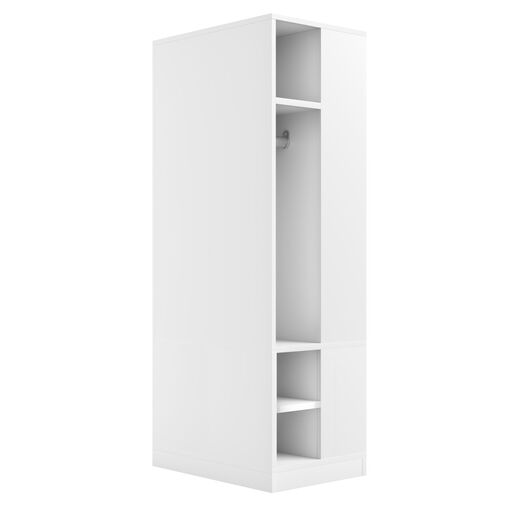
Why this product suits your needs: At 70 cm wide and 170 cm tall, it’s a good fit for compact bedrooms, children’s rooms or homes with limited floor space. Two hanging rails and two drawers keep hanging clothes separate from smaller items.
The exact external dimensions and interior layout make it easier to judge the available storage than a size description alone. The drawers provide extra enclosed storage.
Compact dimensions of 70 × 50 × 170 cm; two hanging rails and two built-in drawers.
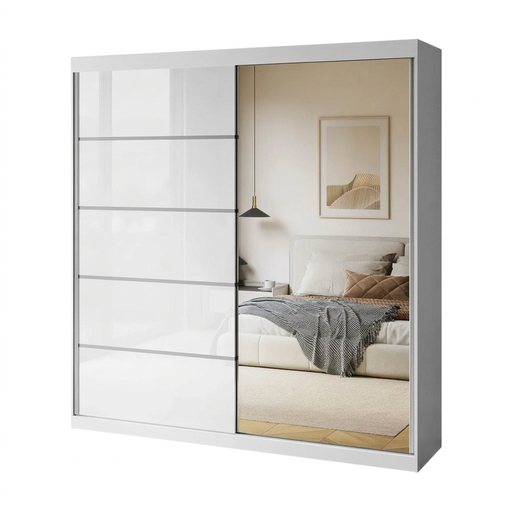
Why this product suits your needs: This model measures 200 × 58 × 215 cm and comes with nine shelves and a hanging rail. Its glossy white finish and mirrored door work well in a carefully planned bedroom.
The interior layout is clearly specified, with nine shelves and a hanging rail. The sliding doors don’t need extra clearance to swing open in front of the wardrobe.
16 mm laminated chipboard with ABS edging; mirrored door and aluminium runners, according to the product details.
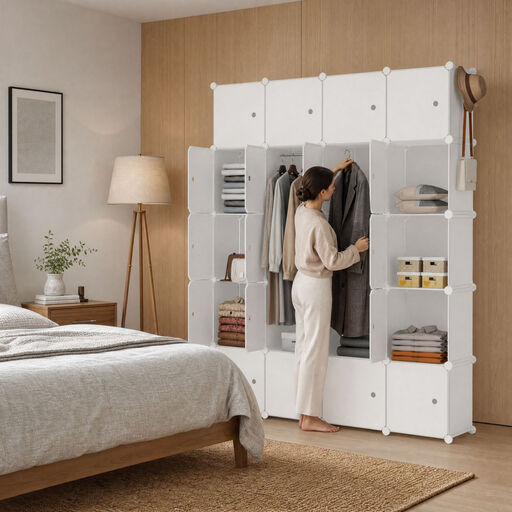
Why this product suits your needs: This modular system can be configured for clothes, books, toys or accessories. Each cube measures 35 × 35 cm, and the units can be combined to suit your room layout.
The flexible layout reduces the risk of buying a fixed-size wardrobe that won’t fit your alcove. The stated load limit of 10 kg per cube also makes it easier to plan what to store.
Tool-free assembly system; PP plastic panels and a steel frame with moisture-resistant properties, according to the product description.
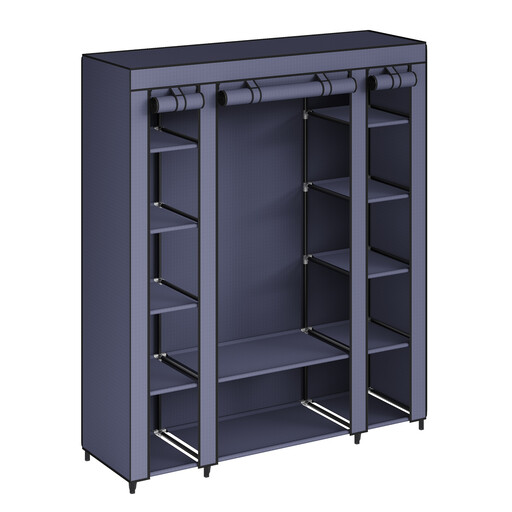
Why this product suits your needs: Measuring 150 × 45 × 175 cm, this portable fabric wardrobe is a good option for rented homes, guest rooms or seasonal clothes. Twelve compartments and a movable hanging rail give you a flexible layout.
The load limits are listed separately: up to 15 kg for the hanging rail and 5 kg per compartment. This makes it easier to avoid overloading the wardrobe.
Tool-free assembly; roll-up or closable fabric cover to help keep out dust, according to the product details.
We’ve put together a complete, regularly updated list of products that meet these strict selection criteria and fully comply with the safety regulations in force in the EU.
With hinged doors, make sure they can open fully without hitting the bed or other furniture. Sliding doors don’t need this swing space, but you’ll still need enough room in front of the wardrobe to take out and sort your clothes. Also follow the assembly and ventilation clearances in the instructions.
Its lifespan depends on the materials, quality of the fittings, load, moisture and assembly. A sturdy frame, properly aligned doors and the recommended wall fixings can help it stand up to everyday use. Only load drawers and hanging rails within the stated limits.
A standard wardrobe doesn’t use electricity, so it has no ongoing running costs. Extra features such as built-in LED lighting do use energy. If you’re considering a model with lighting, check the product details for the connection type, switch, light source and power consumption. Replacement parts or additional modules may also be worth considering for fabric and modular systems.