
Lieferung heute & morgen

Qualitätsgarantie

Willkommens-Angebote freischalten: KOSTENLOSE Lieferung | Bis zu 80 % RABATT | Kostenlose 30-Tage-JoyPlus-Testphase
App herunterladen
A clothes rail can give you extra storage, keep clothes close to hand or provide a mobile solution for drying laundry. But not every design is right for every home. Small castors, unclear weight limits or misjudging the available height can quickly lead to an impractical purchase.
This buying guide explains which features to look for before you buy and which models suit different needs.
A stated load capacity often applies only when the weight is evenly distributed and the rail is on a level surface. A clothes rail on castors can still become unstable if the weight is concentrated in one place or if heavily loaded hangers are used. So check whether the figure applies to the whole frame, just one rail or the shelves as well.
An extendable clothes rail can be adjusted to fit different room dimensions. Before buying, however, you need to measure the width, height and depth of the space where you plan to put it. With a telescopic clothes rail, it’s also important to check that the ceiling is sufficiently sturdy and level. A model designed to fit between the floor and ceiling is very different from a freestanding mobile clothes rail.
A clothes rail on castors can be moved around the bedroom, hallway or utility room. If you have delicate flooring, check the castor design and make sure the load can be distributed evenly. Two lockable castors can stop the rail moving when you take clothes off it. Small castors are often less suitable for carpets than larger wheels.
A lower load capacity may be enough for lightweight outerwear. Winter coats, suits or several fully loaded clothes rails need more capacity. Key details include:
Don’t mistake these figures for a general indication of quality. They simply describe the limits stated by the supplier.
An adjustable clothes rail is particularly useful in rented homes, alcoves and rooms with changing layouts. Check the:
An open wardrobe with several levels makes use of the room’s height, but takes up more floor space than a single clothes rail.
Metal tubes, steel frames and stainless steel rails can have different load capacities depending on their design. Plastic connectors are lightweight, but should fit together securely. The stability of a clothes rail depends not only on its material, but also on its base, joints and centre of gravity.
Laundry rails need to meet a few extra requirements: a rust-resistant rail, enough space between items and surfaces that are easy to clean are all useful in everyday use. A clothes rail for drying laundry shouldn’t be confused with a wardrobe organiser.
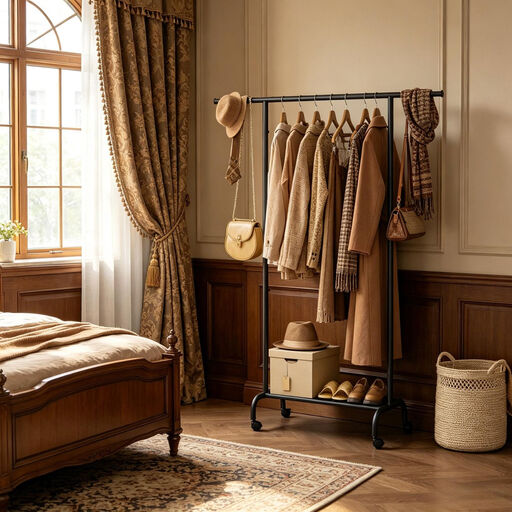
Why this product suits this type of user: Its adjustable width of 84 to 124 cm and lower Oxford shelf offer a compact solution for bedrooms, hallways or smaller homes.
The product details list separate limits: up to 21 kg for the main rail, up to 2 kg for each extendable end and up to 10 kg for the shelf.
Four castors, two of which lock, plus extra storage for shoes, bags or accessories.
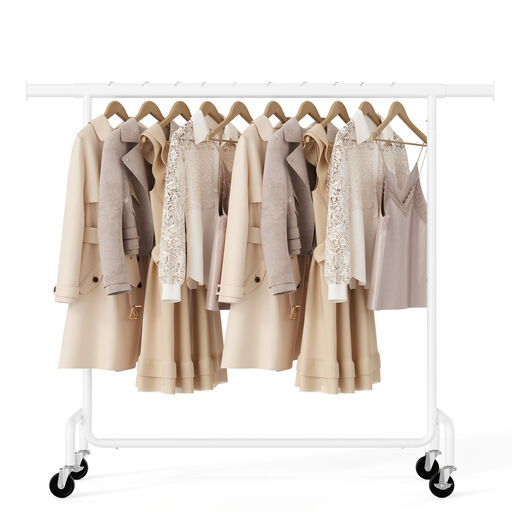
Why this product suits this type of user: Its steel-tube construction is a good choice if you often move clothes and need a higher stated load capacity.
The stated maximum load capacity is up to 130 kg, and the width can be extended from 110 to 150 cm. The rail should be placed on a level surface.
Four 360-degree castors, two with brakes, and a depth of 45 cm and height of 162,9 cm.
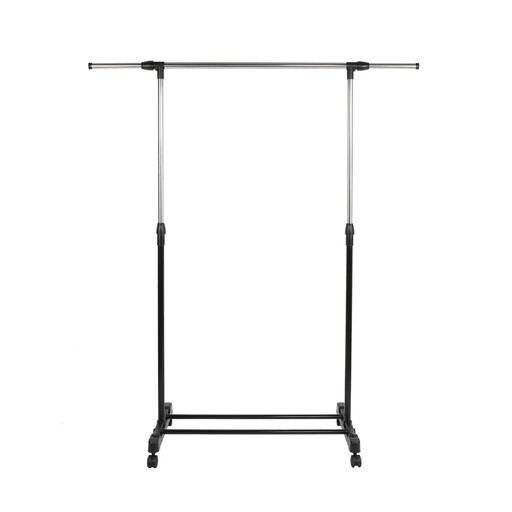
Why this product suits this type of user: Its adjustable height and width make it suitable for laundry, long garments and changing locations around the home, on a balcony or in a hallway.
Its height range of 90 to 158 cm and width of 80 to 145 cm are clearly stated. The stainless steel rail is described as rust-resistant for its intended use.
Four swivel castors, foldable storage and a no-drill design.
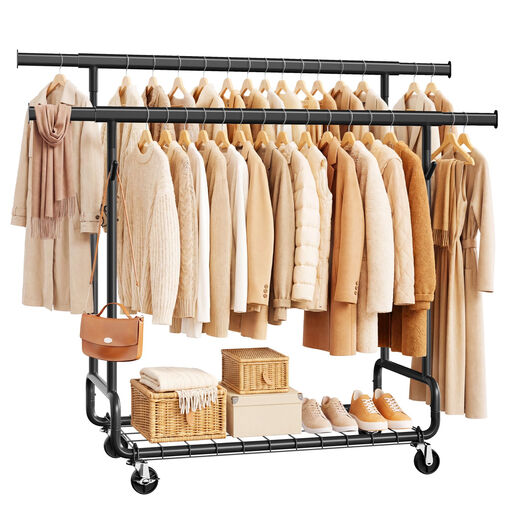
Why this product suits this type of user: Two extendable clothes rails, a shelf and six side hooks provide separate spaces for clothes and accessories.
The stated overall load capacity is up to 270 kg. The height range, width range and castor function are also clearly specified.
Steel construction, two lockable castors and height-adjustable rails from 144,2 to 164,2 cm.
We’ve put together a complete, regularly updated list of products that meet these strict selection criteria and fully comply with the safety regulations in force in the EU.
Before assembly, make sure the floor is level and clear of obstacles. For a freestanding model, fit all the connectors securely and check them afterwards. Lock the castors before loading the rail. Distribute clothes as evenly as possible; don’t hang all your heavy coats from an extendable end section.
For a clothes rail that doesn’t require drilling, check whether it is genuinely freestanding or held in place between the floor and ceiling. Tension-mounted models need firm, suitable surfaces. Screws, wall plugs and wall brackets should be appropriate for the type of wall. Metal and plastic can usually be cleaned with a soft, slightly damp cloth. Check the joints and locking mechanisms regularly.
Stability depends on the frame, base, distance between the castors, floor surface and load. Lockable castors stop the rail rolling away, but don’t automatically increase its load capacity. Always check the stated load limits for the model.
A lower rail is fine for shirts and jackets. Dresses, coats and long garments need more clearance from the floor. Measure your longest item, including its hanger, and allow extra room for the base.
A mobile clothes rail may be suitable for hanging a few items of laundry, provided its load capacity and spacing between rails are suitable. For larger loads, a model specifically designed as a clothes airer is usually more practical. Don’t exceed the maximum load, even when drying wet, heavier laundry.