
Lieferung heute & morgen

Qualitätsgarantie

Willkommens-Angebote freischalten: KOSTENLOSE Lieferung | Bis zu 80 % RABATT | Kostenlose 30-Tage-JoyPlus-Testphase
App herunterladen
A Klemmfix pleated blind without drilling can provide privacy and sun protection without leaving behind wall plugs, screws or permanent drill holes. This is especially handy for tenants. However, quick installation does not automatically mean the right solution. What really matters are your window frame, measurements, light filtration and the actual fixing method.
Terms like “blackout”, “room darkening” or “light-blocking” are used differently across retailers. With a blackout pleated blind, light can still enter from the sides or bottom of the fabric. While the fabric itself may significantly reduce light, a full perimeter seal is usually not present on Klemmfix models.
For bedrooms and children’s rooms, buyers should therefore check whether the seller mentions a fully light-blocking fabric layer or simply refers to light filtering and privacy.
For many products, the order width includes the brackets and tracks. As a result, the usable fabric width can be several centimetres narrower. With the WOLTU double roller blind, the fabric is reportedly about 4 to 5 cm narrower than the total width.
If you’re buying a pleated blind for windows and doors, you shouldn’t just measure the glass area. Window handles, seals and protruding fittings must also be taken into account.
A Klemmfix pleated blind is usually attached to the window sash using clamp brackets. Other models use adhesive pads or self-adhesive fixings. Clamp brackets are often more practical if you need to remove the blind frequently, whereas adhesive solutions require a smooth, clean and grease-free surface.
On uneven, rough or damaged frames, adhesion may be compromised. Before buying, you should also check whether the permitted frame thickness matches your own window.
Frame thickness is a technical must-have value. With the WOLTU double roller blind, the clamp brackets are designed for frames 13 to 23 mm. Another WOLTU clamp roller blind with blackout fabric is suitable for 16 to 22 mm, according to the product details. The WOLTU honeycomb pleated blind is designed for frames 10 to 23 mm.
Not every model is suitable for roof windows, sliding windows, fixed-glazed windows or wooden frames. For tilt-and-turn windows, the fixing must not interfere with the movement or the seal.
Measure the glass width and the full frame height at several points. For some products, an order width roughly 4 cm wider than the glass width is recommended. This allows the fabric to cover the glass area better. At the same time, the pleated blind must not block the window handle.
For balcony or patio doors, height is especially important. A roller blind without drilling that is too short will leave a visible gap at the bottom. For narrow windows, a fixed size such as 60 × 100 cm or 70 × 120 cm may suffice; for doors, variants with a height of 200 cm are an option.
Polyester is widely used in the products mentioned. It can usually be cleaned with a soft cloth or a soft brush. Harsh cleaning agents, vigorous rubbing and excessive moisture should be avoided.
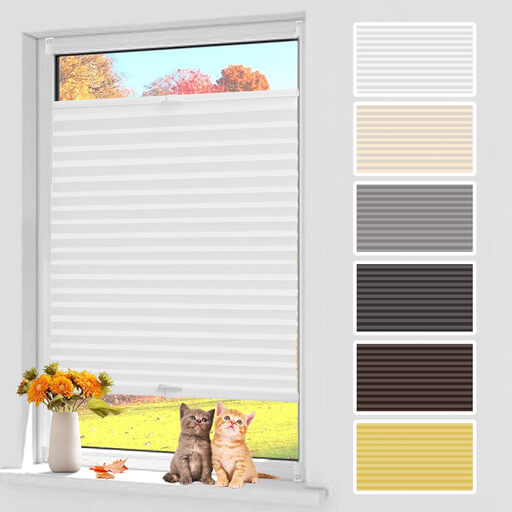
Why This Fits Their Persona: The compact size and tool-free clamp or adhesive mounting suit smaller standard windows in rental flats, offices or kitchens.
The product description states the specific size 60 × 100 cm and advises checking the frame thickness. This helps you avoid an unsuitable fixing before ordering.
Polyester fabric, tool-free installation and adjustable light diffusion. This model is intended for indoor windows and doors.

Why This Fits Their Persona: The double honeycomb structure appeals to buyers who want to combine light protection, flexible operation and a coated or multi-layer design.
The frame compatibility of 10 to 23 mm is specified. It is also explicitly noted that this model is not intended for roof windows.
Upper and lower operating handles, metal frame, moisture-resistant polyester and Klemmfix mounting for window and door frames.

Why This Fits Their Persona: For bedrooms, studies or rooms with direct sunlight, the opaque, coated design with cordless operation is a functional option.
The description states the required frame thickness of 16 to 22 mm and a fabric width roughly 4 cm narrower. This allows you to check two common ordering mistakes in advance.
200 g/m² polyester, silver-coated backing, clamp or screw mounting and operation via the bottom rail without an exposed pull cord.
We have compiled a complete, real-time list of products that fully satisfy these strict selection criteria and UK safety regulations.
Before installation, the frame should be dry, clean and free of grease. Clamp brackets are fitted according to the instructions and tightened without twisting the window sash. For adhesive solutions, the surface must be smooth and load-bearing. After fixing, check that the window or door can still open and tilt fully.
For models with a cord, a cord tensioner should be used. Cords and chains must be kept out of reach of children. A Klemmfix pleated blind should also be checked regularly for loose fixings. For bathrooms and kitchens, moisture-resistant materials are helpful; however, many products are designed only for indoor use and not for permanent exposure to moisture.
Durability depends on the frame, mounting method, usage and fabric weight. Clamp brackets require a suitable frame and should be checked regularly for a secure fit. Self-adhesive fixings can come loose due to dust, grease, uneven surfaces or high humidity.
Measure the glass width, frame width and frame height. Then compare these values with the product instructions. If the fabric width is smaller than the order width, this must be taken into account when selecting. Window handles and seals must not obstruct the installation.
A pleated blind can often be positioned flexibly from top and bottom, making it well suited for privacy at different heights. A thermal roller blind without drilling usually has a coated or multi-layer backing that reduces light and solar radiation more effectively. The right choice depends on your window size, desired blackout level and ease of operation.