
Lieferung heute & morgen

Qualitätsgarantie

Willkommens-Angebote freischalten: KOSTENLOSE Lieferung | Bis zu 80 % RABATT | Kostenlose 30-Tage-JoyPlus-Testphase
App herunterladen
A Klemmfix pleated blind without drilling is a practical solution for rented flats, offices and modernised windows: it attaches to the window sash without leaving any dowels or drill holes. However, not every pleated blind without drilling suits every window. Common buying mistakes often arise from incorrect measurements, an unsuitable mounting method, or unrealistic expectations about blackout and thermal insulation.
This buying guide shows you which details to check before purchasing and which models work best for different situations.
With many Klemmfix blinds, the stated width includes the brackets. The actual fabric width can be several centimetres narrower. For example, the WOLTU double roller blind states that the fabric is approximately 4 to 5 cm narrower than the total width.
If you only measure the visible glass area and ignore the construction, you may end up with insufficient coverage. For a well-fitting screen at your window, you should measure the glass width, frame width and window handle separately.
A light-filtering pleated blind softens daylight and reduces visibility from outside, but still lets brightness into the room. A blackout pleated blind, on the other hand, uses a denser fabric or a coating. Nevertheless, light gaps can remain at the sides if the blind is narrower than the glass area.
So pay attention to the specific product description: terms like "light-filtering", "opaque", "blackout" or "room-darkening" describe different properties and should not be treated as the same.
Clamp brackets require a compatible window frame. For instance, the WOLTU double roller blind is designed for a frame thickness of 13 to 23 mm, while other models suit 16 to 22 mm or 10 to 23 mm. Additionally, seals, protruding handles or angled frames can affect installation.
Some products are explicitly not suitable for roof windows, wooden frames or certain window types. You should check these restrictions before ordering.
First, measure the glass width and the height of the entire window sash. For many models, an order width roughly 4 cm wider than the glass width is recommended. This allows the fabric to cover the area better. At the same time, the blind must not protrude beyond the window handle or other protruding parts.
For doors and floor-to-ceiling windows, also check that operation is not hindered when opening or tilting. A pleated blind for windows and doors should also be fixed securely enough if it is moved frequently.
There are three common options:
Before buying, compare the frame thickness, material and surface condition with the manufacturer's specifications.
A sun protection blind with a light-filtering fabric is ideal for living rooms, kitchens or workspaces where you want the room to stay bright. For bedrooms or rooms with direct sunlight, a blackout blind without drilling is a better choice.
A thermal pleated blind or one with a coated backing can influence light reflection and heat gain. However, claims about energy savings or specific temperature reduction should not be taken at face value. Room orientation, glazing, mounting distance and fabric coverage all affect the final result.
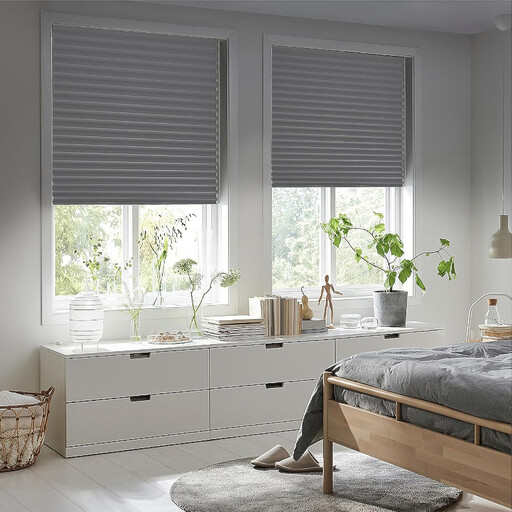
Why this product fits the profile: This model offers clamp or adhesive mounting without drilling and is designed for windows and doors in several living areas.
The product details state the mounting options, the size 70 × 140 cm and suitability for smooth, clean surfaces. This allows you to check the frame and installation beforehand.
Polyester fabric, height-adjustable design and cleaning with a damp cloth.

Why this product fits the profile: This design combines a honeycomb structure, a metal frame and clamp brackets for window frames from 10 to 23 mm.
The stated frame thickness and the restriction to indoor use make the installation requirements clear. This model is not intended for roof windows.
Top and bottom operating handles, wipe-clean polyester fabric and a two-tone white colour design.

Why this product fits the profile: This blind is designed for rooms where a dense fabric, privacy and cordless operation are required.
The details specify the suitable frame thickness of 16 to 22 mm, the narrower fabric width and the exclusion of roof windows.
Cordless operation via the bottom rail, polyester fabric with a coated backing and two mounting options.
We have compiled a complete, regularly updated list of products that fully meet these strict selection criteria and the safety regulations in force in the EU.
Before mounting, make sure the window frame is clean, dry and free of grease. Clamp brackets must sit evenly and must not prevent the window sash from closing properly. For adhesive brackets, follow the manufacturer's specified waiting or pressing time.
For cleaning the models mentioned, a soft, slightly damp cloth or a soft brush is usually sufficient. Harsh cleaning agents, sharp objects and excessive pulling can damage the fabric and mechanism. Products with chains or cords should be mounted so that they are out of reach of children.
No. The key factors are frame thickness, frame shape, seals and protruding handles. Check the specific manufacturer's instructions. Roof windows, wooden frames or rough surfaces are excluded for several models.
Measure the glass width and the height of the entire window sash. Then check whether the stated product width includes the brackets. With some models, the fabric is about 4 cm narrower than the total width. For better coverage, you may need extra width beyond the glass area.
A general lifespan cannot be given. It depends on the installation, frequency of use, sunlight exposure and cleaning. A correctly matching frame thickness, careful operation and regular dust removal can help extend its life.