
Lieferung heute & morgen

Qualitätsgarantie

Willkommens-Angebote freischalten: KOSTENLOSE Lieferung | Bis zu 80 % RABATT | Kostenlose 30-Tage-JoyPlus-Testphase
App herunterladen
A knife block set combines several kitchen knives with dedicated storage in one place. This saves time searching, protects the blades from coming into contact with other items in a drawer and helps keep your worktop tidier. However, the number of knives alone does not determine whether a set is practical for everyday use.
Many buyers initially focus on a high piece count or a well-known brand. Important details such as the actual contents, care instructions and the block’s footprint can easily be overlooked. The following criteria will help you compare a knife block with knives objectively and avoid common buying mistakes.
A 7-piece knife set might contain four knives, a pair of scissors, a knife sharpener and the block. A 5-piece knife set, on the other hand, may include several knives but no sharpening tool. That is why you should check the product description carefully to see exactly what is included.
The following knives are generally the most useful for everyday kitchen tasks:
An additional slot in the block does not automatically mean that the corresponding knife is included.
Some sets are described as dishwasher-safe. However, high temperatures, detergents and contact with other cutlery can put more strain on the blades, cutting edges and handles than gentle hand washing. With wooden or bamboo blocks, standing moisture can also damage the material.
It is therefore important to distinguish between:
Knives should be dried completely after washing and only then placed in the block.
A wooden or bamboo knife block needs a stable, dry surface. Check the dimensions before buying. Models measuring around 36 × 16 × 15 cm require more worktop space than compact blocks. The block should not be positioned on an edge or somewhere it could easily tip over.
Also check whether the slots are intended only for the included knives. Other blades may be too wide, too long or unsuitable for integrated sharpening modules.
Corrosion-resistant specialist steel is practical for kitchen knives, but it does not replace proper care. Specifications such as FRIODUR ice-hardening, SIGMAFORGE forging technology or a hardness of around 57 to 58 HRC describe the construction or material properties. They do not guarantee that a knife will never need sharpening.
A blade forged from a single piece may be joined to a full tang and riveted handle scales. This can affect balance and stability. When choosing, however, you should also consider how the handle feels, the weight of the knife and how you intend to use it.
A 20 cm chef’s knife offers plenty of cutting surface, but may initially feel unfamiliar to beginners with smaller hands. A Santoku knife with an approximately 18 cm blade is designed for many vegetable and meat preparation tasks. A paring knife measuring 8 to 10 cm is better suited to small ingredients and precise cuts.
Choose a chef’s knife set based not only on the brand, but also on your cooking style:
Bamboo and beechwood are common materials for knife blocks. They differ in colour, finish and care requirements. An integrated knife sharpener can make handling easier, but only works with compatible knives and should be used according to the instructions.
In the ZWILLING VIER STERNE version, ceramic sharpening modules are built into the designated slots. According to the product description, these are intended exclusively for the specified knives. This is practical if you want to avoid regular manual sharpening, but it requires correct use.

Why this product suits this profile: With a chef’s knife, bread knife, utility knife, paring knife and slicing knife, this 5-piece set covers typical tasks in a home kitchen. The acacia wood block provides secure storage.
The included knife types are listed individually in the product description. This makes it easy to compare the contents with your own requirements before buying.
Five stainless steel knives and an acacia wood block; hand washing is recommended for care.

Why this product suits this profile: This 7-piece knife set combines several classic knife shapes with kitchen scissors, a honing steel and a bamboo block. According to the product description, the blades are made from corrosion-resistant specialist steel and ice-hardened using FRIODUR technology.
The contents are clearly specified: a 10 cm paring knife, 13 cm utility knife, 20 cm chef’s knife, bread knife, scissors and honing steel.
Forged from a single piece according to the product information; block dimensions of 36.5 × 16 × 15 cm and storage for the included kitchen tools.
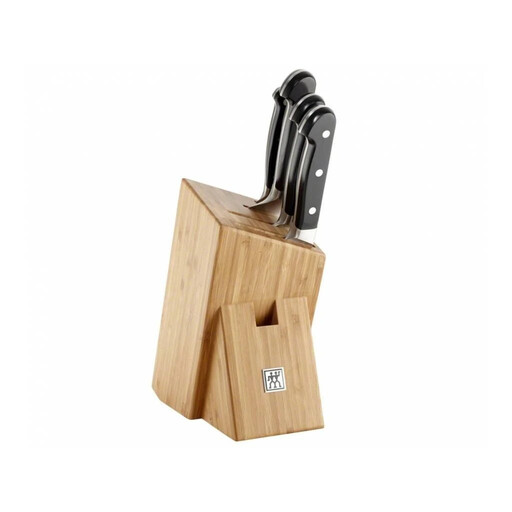
Why this product suits this profile: According to the product information, the set contains a Santoku knife, a Chinese chef’s knife, a paring knife and a bamboo block. This combination is aimed at households that frequently prepare vegetables and ingredients in an Asian style.
The product contents explicitly state that four knives and the block are included. According to the product information, kitchen scissors are not included.
18 cm Santoku, 18 cm Chinese chef’s knife, 16 cm blade and 10 cm paring knife; FRIODUR ice-hardened specialist steel according to the product description.
We have put together a complete, regularly updated list of products that fully meet these strict selection criteria and the safety regulations applicable in the EU.
The lifespan of a kitchen knife set depends heavily on how it is used. Use a wooden or plastic chopping board and avoid glass, stone or hard work surfaces. Do not cut bones, frozen food or particularly hard objects unless the product is explicitly designed for this purpose.
For everyday use, we recommend:
For a small household, three to five carefully selected knives are often sufficient. A 6-piece knife set or 7-piece knife set is worthwhile if scissors, a honing steel or a specialist knife will also be used regularly.
A wooden or bamboo block can provide hygienic storage if the knives are inserted clean and dry. Do not soak the block. Instead, clean it with a slightly damp cloth and then dry it completely.
This depends on how often it is used, the chopping board, the steel and the care it receives. A honing steel realigns the edge during everyday use. If cutting performance noticeably deteriorates, an appropriate sharpening method is required depending on the type of blade. The manufacturer’s instructions for the particular kitchen knife set should always take priority.