
Lieferung heute & morgen

Qualitätsgarantie

Willkommens-Angebote freischalten: KOSTENLOSE Lieferung | Bis zu 80 % RABATT | Kostenlose 30-Tage-JoyPlus-Testphase
App herunterladen
A knife block set can make everyday kitchen tasks easier: the essential knives are close at hand, stored safely and do not require extra space in a drawer. However, kitchen knife sets vary considerably in terms of contents, materials, care requirements and storage. A large number of pieces does not automatically mean the selection is right for your household.
A knife set with a block can seem appealing because of its high piece count. However, this often includes accessories or knives with similar uses. For most households, a chef’s knife, a bread knife and a small paring or utility knife are more useful than several speciality knives that are rarely used.
So check the following before buying:
A self-sharpening knife block can hone the edge as a compatible knife is removed and replaced. However, this does not eliminate the need for all other forms of care. The function depends on the block’s design and on assigning the knives to the correct slots. Other knives should not be placed in sharpening slots intended for specific models.
Terms such as “razor-sharp” or “long-lasting sharpness” should also not be assessed in isolation. More useful details include the blade material, hardness, grind and care instructions.
Wooden blocks, such as a wooden knife block, can look attractive on the worktop, but they should generally not be soaked. Moisture can warp the material or compromise hygienic storage. For the knives, the manufacturer’s dishwasher guidance is crucial. Even if a kitchen knife set is described as dishwasher-safe, hand-washing can be gentler on the blade and handle.
A practical knife set for the kitchen should cover the most common tasks:
More pieces are mainly worthwhile when they serve different purposes. A kitchen utensil set with a knife block, scissors, honing steel or wooden spoons can save additional storage space, but it should be selected based on your actual needs.
With stainless steel knives, corrosion resistance, the grind and care instructions are important considerations. Greater hardness can contribute to good edge retention, but it requires suitable handling: hard surfaces made from glass or stone, as well as cutting through bones, frozen foods or very hard skins, can damage the edge.
High-quality ranges often specify whether the knives are made in one piece, the blade hardness or particular hardening processes. These details are more objective than general marketing claims. A professional knife set should also offer a secure grip, balanced weight distribution and clear storage positions for the knives.
The block must stand securely and should not easily tip over at the edge of the worktop. Pay attention to:
A magnetic stand requires fewer enclosed slots, but it must also be stable. This can be a space-saving solution for small kitchens, while a classic kitchen knife block conceals the blades more effectively.
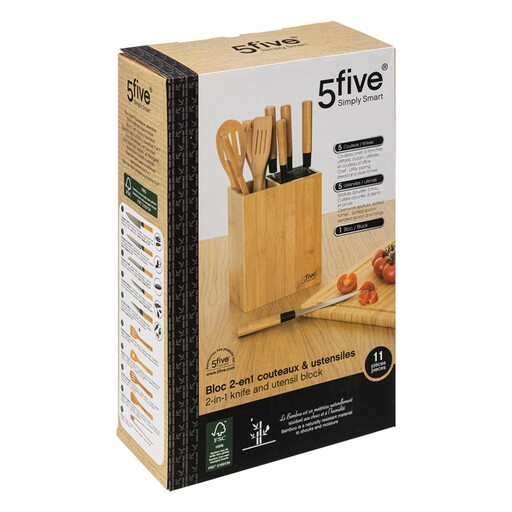
Why this product suits this profile: This set combines five types of knife with four kitchen utensils, covering many typical household tasks. The bamboo block keeps the equipment together on the worktop.
The product description specifies the individual knives and utensils. This makes it easy to check exactly what is included before buying.
Bamboo/PP construction, five different knives, a ladle, turner and tongs.
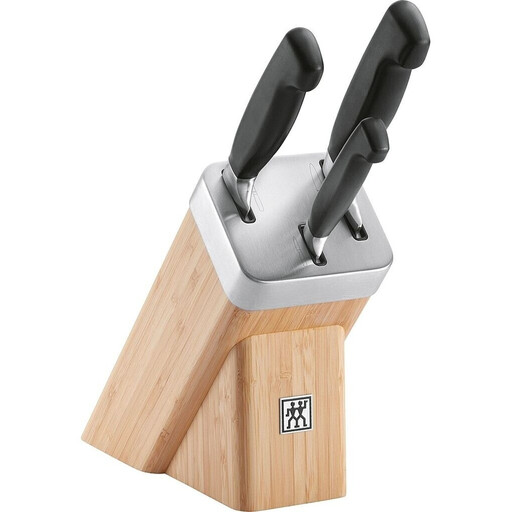
Why this product suits this profile: This compact Zwilling knife block set focuses on three essential knives and a bamboo block with KiS technology.
The contents are clearly specified: a 20 cm chef’s knife, a 16 cm slicing knife and a 10 cm utility knife. The ceramic modules are assigned to the intended slots.
FRIODUR ice-hardened special steel, a bamboo block and automatic honing when the compatible knives are inserted and removed.
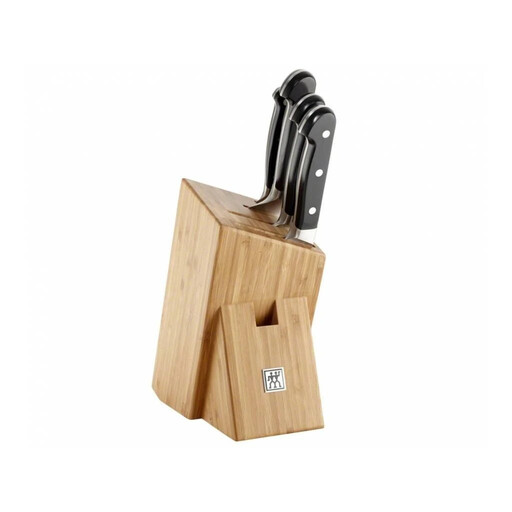
Why this product suits this profile: This selection is aimed at households that often prepare Asian dishes and want to use a Chinese chef’s knife and a cleaver alongside a Santoku.
The product details list the four included knives individually and point out that scissors are not included. This prevents misleading expectations about the number of pieces.
Four knives, a bamboo block, one-piece SIGMAFORGE construction and FRIODUR ice-hardened special steel according to the product details.
We have put together a complete, regularly updated list of products that fully meet these strict selection criteria and the safety regulations applicable in the EU.
Whenever possible, wash kitchen knives with warm water, mild washing-up liquid and a soft sponge. Dry the blades immediately afterwards before returning them to the block. For wooden blocks, a slightly damp cloth is sufficient; avoid soaking them completely.
Use a wooden or plastic chopping board. Glass, stone and other hard surfaces can put greater strain on the edge. A honing steel is suitable for the regular care of certain blades, while professional sharpening may be needed when cutting performance has noticeably declined. With a self-sharpening knife block, only the knives intended for it should be placed in the sharpening openings.
Store the set securely and out of children’s reach. The knives are sharp and intended exclusively for preparing food. Damaged blades or loose handles should no longer be used.
For a typical household, three to five clearly different knives are often enough: a chef’s knife, a bread or utility knife and a small paring knife. Additional pieces are worthwhile if they are used regularly, such as a Santoku, a honing steel or kitchen scissors.
A wooden block can be used as long as it is kept clean and dry. The knives should be completely dry before being inserted. The block itself should not be left in water and should be cleaned regularly with a slightly damp cloth. Suitable, easily accessible slots are also important.
How long an edge lasts depends on the material, grind, chopping board, food and care. Hand-washing, drying the knives immediately and using a suitable honing steel can help maintain their performance. It is not possible to give a general lifespan, as daily use varies from one household to another.