
Lieferung heute & morgen

Qualitätsgarantie

Willkommens-Angebote freischalten: KOSTENLOSE Lieferung | Bis zu 80 % RABATT | Kostenlose 30-Tage-JoyPlus-Testphase
App herunterladen
A knife block set can be a tidy addition to your kitchen kit, saving you from buying individual knives one by one. However, attractive packaging and long parts lists don't automatically mean you're making the right choice. What really matters are the actual knife types, the quality of construction, how they're stored and how much upkeep they need.
This buying guide from the Joybuy Product Recommendation Officer shows you what details to check before purchasing a kitchen knife set, and which models suit different households and cooking habits.
A set might look generous at first glance, yet still lack certain essential knife types. For everyday use, you'll typically need a chef's knife or Chinese chef's knife, a smaller paring knife, and a knife for bread or fine slicing work. Extra kitchen utensils may boost the piece count, but they won't replace a versatile blade.
So check the product list carefully: which blade is included, how long is it, and what task is it designed for? A 5-piece knife set could, for example, consist of five knives, or it might count the knife block and other components in that total. The detailed description is what counts.
Some dishwasher-safe kitchen knives can be cleaned in the machine according to the manufacturer's instructions. However, to keep the edge in good condition long-term, product details often still recommend hand washing and drying immediately. Heat, moisture and detergents can put extra strain on the blade, handle or joining elements.
A bamboo knife block should also never be left wet. Only placing knives into the block once they're completely dry reduces moisture inside the slots.
A Zwilling knife block or another branded product may come with established construction features. Even so, you should still look for verifiable data when comparing: blade material, manufacturing method, hardness rating, handle construction, dimensions and what's included in the box. Terms like "professional" or "extra sharp" are only meaningful if backed up by technical explanation.
For classic European dishes, a chef's knife covers most cutting tasks. Fans of Asian cuisine often reach for a Santoku knife for vegetables, fish and meat. A Chinese chef's knife usually has a broad blade and can be used for slicing and chopping, depending on the design. However, it's not automatically suitable for use as a cleaver on bones.
A cleaver should only be used for the foods the manufacturer intends. For fruit, vegetables and small prep jobs, a paring knife with a short blade is more practical. When choosing a knife set for home cooks, it's not just the number of blades that matters, but how the functions are distributed.
Objective details such as "special steel", "stain-resistant" or "FRIODUR ice-hardened" give clues about the build, but they don't replace proper care. For forged kitchen knives, it's also important whether the blade is made from a single piece and how the handle and blade are joined.
The Zwilling PRO Series Set has a hardness of around 57 HRC on the Rockwell scale, SIGMAFORGE single-piece forging and a full tang with three rivets. A full tang can help support the stability of the handle construction. Actual cutting performance also depends on blade angle, usage, chopping board, and sharpening.
A sturdy knife block should stand securely and have sufficiently deep, well-fitting slots. Check that all the knives supplied actually fit. For the Zwilling PRO Series Set, four knife slots and one scissors slot are listed, but a kitchen scissors is not included according to the product contents. That's important to know before you buy if you're expecting a complete set.
Bamboo is easy to care for, but should be kept dry and never soaked in water. A knife block protects the blades from being left loose and can keep your worktop tidier. Sharp knives should always be kept out of reach of children.
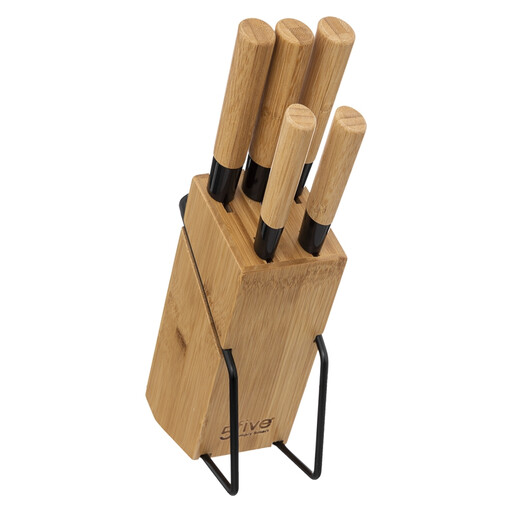
Why this product fits the profile: This set offers a compact basic kit with stainless steel blades and a black bamboo stand for everyday kitchen use.
The product description clearly states which knives are included, as well as the storage stand. This makes it easier to compare the contents with your own needs before buying.
Five stainless steel knives and a separate bamboo stand; hand washing and thorough drying are recommended for care.

Why this product fits the profile: This set combines several classic knife types with a kitchen scissors, sharpening steel and bamboo block, and is aimed at households with a wide range of food preparation needs.
The contents are described in detail with blade lengths and functions. The details about stain-resistant special steel and FRIODUR ice-hardening are verifiable product features, not a vague quality promise.
Includes chef's knife, bread knife, paring knife, sharpening steel and block; the knives are listed as dishwasher-safe according to the product info, but hand washing is recommended.
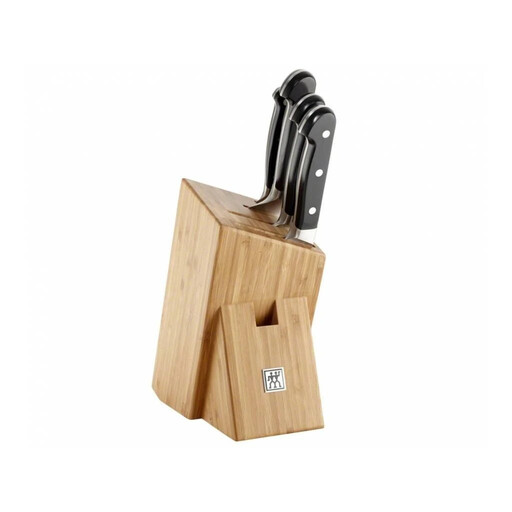
Why this product fits the profile: This Asian-style knife set contains a Chinese chef's knife, Santoku knife, paring knife and cleaver in a bamboo block.
The four knives are listed with their type and blade length. It also clearly states that the kitchen scissors is not included, even though the block has a slot for one.
FRIODUR ice-hardened special steel, approximately 57 HRC, SIGMAFORGE construction and an ergonomic plastic handle with full tang and three rivets.
We've put together a complete, regularly updated list of products that fully meet these strict selection criteria and the safety regulations in force in the EU.
For a household of two to four people, a basic set of a chef's knife, paring knife and one specialist knife is often enough. If you regularly prepare bread, meat or Asian dishes, you'll benefit from a bread knife, Santoku knife or Chinese chef's knife. The right number depends more on your menu than on the sheer piece count.
That depends on the model. Some products are labelled as dishwasher-safe, while hand washing is recommended to protect the blade. Bamboo blocks and bamboo handles should never go in the dishwasher or be soaked for long periods. Always follow the manufacturer's instructions.
It's not possible to give a reliable fixed lifespan. The chopping board, what you're cutting, pressure, cleaning method and regular sharpening all affect how long the edge lasts. If you notice visible damage, stop using the knife.