
Lieferung heute & morgen

Qualitätsgarantie

Willkommens-Angebote freischalten: KOSTENLOSE Lieferung | Bis zu 80 % RABATT | Kostenlose 30-Tage-JoyPlus-Testphase
App herunterladen
A knife block set combines several kitchen knives with a dedicated storage block. This saves space on the worktop and protects the blades from being left loose in drawers. However, a set can often look more comprehensive in product images than it actually is in everyday use. That is why hobby cooks, beginners and discerning households should take a closer look at the types of knives, the block’s construction and the care instructions.
A 7-piece knife set may contain four knives as well as a block, kitchen scissors and a sharpening steel. The number alone therefore does not show whether the set includes the knives you actually need for everyday cooking. Check the precise contents:
A 5-piece knife set can be sufficient for everyday use if the knives included have been chosen sensibly.
Stainless steel is resistant to corrosion, but it is not impervious to moisture, salt and harsh cleaning products. If knives are stored wet in the block, stains may develop. A wooden knife block should not be soaked or cleaned in the dishwasher either. A slightly damp cloth followed by thorough drying is generally the more suitable care method.
A knife block with sharpening steel is primarily useful for regularly realigning the existing cutting edge. If the blade is already noticeably blunt or damaged, honing it with a steel will not always be enough. With self-sharpening blocks, there is an additional point to remember: only the knives intended for the relevant slots should be inserted.
A chef’s knife with a blade length of around 20 cm is a practical standard size for many household tasks. Shorter blades measuring between 8 and 10 cm are suitable for peeling, trimming and handling small ingredients. A bread knife or carving knife measuring 16 to 20 cm complements a kitchen knife set if you regularly cut bread, roasts or larger foods.
Also pay attention to the balance between the handle and blade. A full tang, a sturdy connection and a secure grip can improve control. However, these features are no substitute for a handle that suits your hand size and proper cutting technique.
When considering a Damascus and stainless steel knife set, buyers should distinguish between genuine Damascus steel and a merely decorative pattern. With stainless steel knives, details about the type of steel, blade construction and care are more meaningful than general claims such as “extremely sharp”.
According to the product descriptions, several ZWILLING sets in this selection use FRIODUR ice-hardened special steel. Selected ranges also mention SIGMAFORGE, meaning a forged, one-piece construction. These details are easier to compare than unexplained marketing claims. The hardness specified for the product, at around 55 to 58 HRC, is a technical guideline, but on its own it says nothing about every practical characteristic of the blade.
Measure the available space before ordering a kitchen knife block. Models with several knives, scissors and a sharpening steel often require a footprint of around 36 × 15 cm or more. The block should stand on a dry, level surface and should not be able to tip over at the edge of a worktop.
Cleaning should also form part of your comparison:

Why this product suits this profile: The set contains five stainless steel knives for typical kitchen tasks and stores them in an acacia wood block. This gives beginners a manageable basic selection without the need to buy additional knives separately.
The contents are clearly specified: chef’s, bread, utility, paring and slicing knives, rather than a piece count promoted without further detail. Hand washing is recommended for care.
Five clearly designated stainless steel knives and an acacia wood block for organised storage.
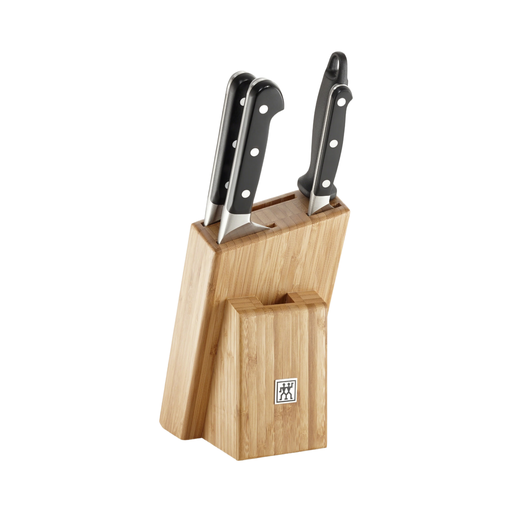
Why this product suits this profile: The ZWILLING knife set combines a 10 cm paring knife, an 18 cm Santoku knife, an 18 cm Chinese chef’s knife, a 23 cm sharpening steel and a bamboo block.
The product description specifies the blade material, FRIODUR ice hardening, SIGMAFORGE construction and V-Edge grind. This makes the technical features clearly verifiable.
The Santoku and Chinese chef’s knife cover different cutting styles, while the bamboo block and sharpening steel are included.
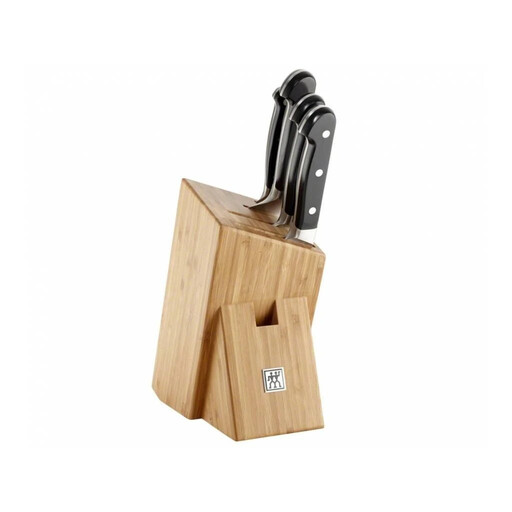
Why this product suits this profile: The set is designed for Asian-style cutting tasks and, in addition to a paring knife, Santoku knife and Chinese chef’s knife, includes a 16 cm folding knife and a bamboo block.
The four knives are described with their blade lengths and intended uses. The block has four knife slots and a place for scissors; according to the product details, scissors are not included.
FRIODUR ice-hardened special steel, ergonomic plastic handles with three rivets and a selection designed for different Asian-style cutting tasks.
For traditional households, a 6- or 7-piece knife set with a bread knife, chef’s knife and meat knife may be more practical than an Asian-style set. According to the product details, the ZWILLING Professional S 7-Piece Bamboo Knife Block Set includes, among other items, a paring knife, utility knife, chef’s knife, bread knife, kitchen scissors and sharpening steel. This type of selection is ideal if you want as many regularly used tools as possible close at hand.
If you prefer a self-sharpening knife block, the ZWILLING Four Stars Knife Set with Block and KiS Technology is worth considering. The bamboo block has ceramic modules in the designated slots. According to the product information, the knives are not dishwasher-safe and should be cleaned by hand.
We have put together a complete, regularly updated list of products that fully meet these strict selection criteria and the safety regulations applicable in the EU.
For many households, three to five well-chosen knives are enough: a chef’s knife, paring knife and bread knife, plus an optional utility or Santoku knife. A larger set is worthwhile if the additional knives will genuinely be used and can be stored safely in the block.
A wooden or bamboo knife block can be used every day provided that knives are clean and completely dry before being inserted. The block should be cleaned regularly with a slightly damp cloth and dried afterwards. Avoid soaking it or cleaning it in the dishwasher unless the manufacturer states otherwise.
The lifespan of a cutting edge depends on the chopping board, frequency of use, food being prepared and care routine. Soft wooden or plastic boards, hand washing and correct sharpening can help protect the blade. Hard foods such as bones or frozen products should only be cut with knives designed for that purpose.