
Lieferung heute & morgen

Qualitätsgarantie

Willkommens-Angebote freischalten: KOSTENLOSE Lieferung | Bis zu 80 % RABATT | Kostenlose 30-Tage-JoyPlus-Testphase
App herunterladen
A high-quality knife set is the foundation of any well-equipped kitchen. But the market is crowded and full of marketing promises that often obscure more than they clarify. Many home cooks invest in large knife blocks, only to find that most of the blades go unused and quickly lose their edge. As your Joybuy Product Recommendation Officer, I'll help you navigate the common pitfalls and make an informed decision that will pay off for years to come.
Before we dive into the key features, let's look at the two most common mistakes that lead to disappointment and wasted money.
A thoughtful purchase focuses not on the number of knives, but on the performance and purpose of each component.
To buy a sharp knife that maintains its performance, you should check three objective criteria. These will help you separate the wheat from the chaff and identify a professional knife set or individual high-quality knives.
The steel determines how sharp a blade can get, how long it stays sharp (edge retention), and how resistant it is to rust and chipping.
A good basic set requires no more than three knives. Focus on acquiring these in high quality:
Speciality knives, such as a Zwilling cheese knife or a flexible filleting knife, are sensible additions, but only once your basic setup is complete.
Instead of a one-size-fits-all recommendation, we have selected products that fit specific user profiles and meet the quality criteria mentioned above.
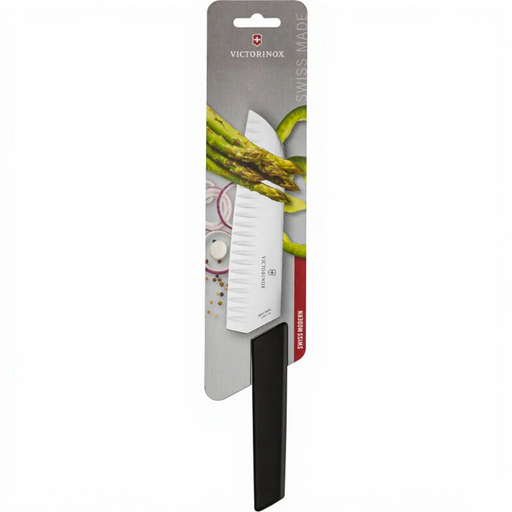
Why it's a great fit: This Santoku knife is an extremely versatile tool for daily kitchen tasks. It's suitable for vegetables, fish, and meat. The synthetic handle is hygienic, easy to care for, and provides a comfortable grip.
Instead of investing in a set with many unnecessary pieces, you get a single, highly functional knife that masters 80% of all cutting tasks with ease. The focus is on functional quality.
The hollow edge reduces food from sticking. The blade, made of stainless steel, is durable and, according to the manufacturer, dishwasher-safe.
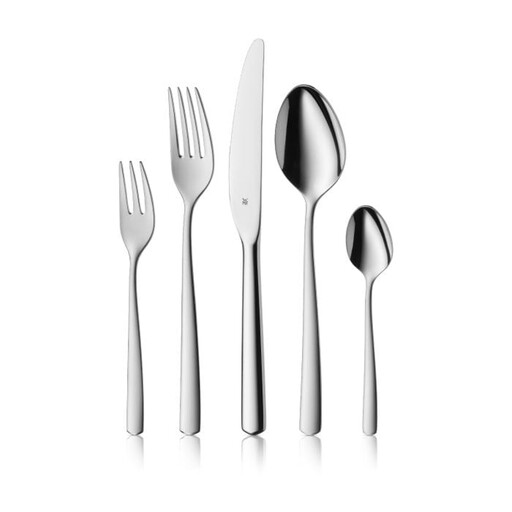
Why it's a great fit: For hosts who value a uniform and elegant table setting. This comprehensive WMF cutlery set for 12 people stands out with its timeless design and polished finish.
Instead of owning a hodgepodge of different knives, you are investing in a complete, high-quality set for the dining table. The quality is consistent throughout and designed for durability.
Made from polished Cromargan 18/10 stainless steel, the set is rust-proof, dimensionally stable, and acid-resistant, according to WMF. The Monobloc knives are forged from a single piece of steel, guaranteeing long-lasting sharpness.
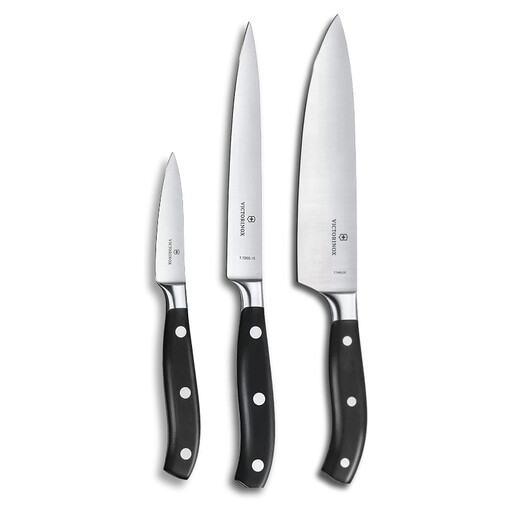
Why it's a great fit: For anyone who sees cooking as a passion and is looking for a professional knife set. The forged blades in this series offer excellent balance, precision, and durability for demanding tasks.
This set avoids the quantity trap by offering three essential, high-performance forged knives (a chef's knife, a carving knife, and a paring knife) instead of a dozen stamped blades.
The blades are fully forged and transition seamlessly into the handle, ensuring optimal stability and control. The modern handle is ergonomically shaped and designed for maximum hygiene.
We have compiled a complete, up-to-date list of products that fully meet these strict selection criteria and rigorous safety standards.
The frequency depends heavily on usage. For daily use in a home kitchen, it's advisable to hone the blade weekly with a honing steel to maintain the fine burr on the cutting edge. A fundamental re-sharpening with a whetstone or by a professional is recommended about once or twice a year, depending on the steel quality and frequency of use.
The main difference lies in the blade shape and the resulting cutting technique. The classic chef's knife has a curved blade that enables a rocking motion, which is ideal for mincing herbs. The Santoku knife has a wider blade with a straighter edge and a tip that curves down. It is optimised for chopping and pushing cuts and is particularly well-suited for vegetables.
A high price is not automatically a guarantee of high quality. The value of a knife or set lies in objective factors: the quality of the blade steel, the craftsmanship (forged vs. stamped), the handle ergonomics, and the balance. A single, well-made chef's knife for €80 can be a far better investment than a 15-piece kitchen knife set for the same price where corners were cut on materials and craftsmanship.