
Lieferung heute & morgen

Qualitätsgarantie

Willkommens-Angebote freischalten: KOSTENLOSE Lieferung | Bis zu 80 % RABATT | Kostenlose 30-Tage-JoyPlus-Testphase
App herunterladen
A knife set with a knife block can handle a range of cutting tasks and keep your knives neatly stored. However, a large kitchen knife set won’t automatically suit every household. What matters is which knives are actually included, the materials used, the care they need and how stable the block is.
A high piece count may sound appealing at first. In the kitchen, though, it’s the right types of knives that matter most. A chef’s knife, bread knife, paring knife or Santoku knife each has a different purpose. Several similar all-purpose knives won’t necessarily give you the same range.
Before you buy, check:
The label ‘stainless steel kitchen knives’ doesn’t automatically tell you about the build quality or care requirements. Look for clear information about the blade material, handle and, where relevant, hardness. For example, a ZWILLING knife set specifies German stainless steel, a hardness of around 57 HRC, and the SIGMAFORGE and FRIODUR processes.
A higher hardness can be associated with good edge retention, but it doesn’t make the blade indestructible. Avoid hard surfaces such as glass or stone. Cutting technique, frequency of use and care also affect how long a knife lasts.
A wooden or bamboo knife block can look right at home in your kitchen. But practical considerations include a stable base, suitable slots and enough space between the blades. A block that’s too light or poorly proportioned may tip when you remove a knife.
Place the block on a dry, stable worktop. Knives should sit fully in their designated slots, without sticking out loosely.
For most households, a useful selection is often a better choice than a set with as many pieces as possible. Knives commonly used include:
Look for a well-balanced combination. A 20-cm chef’s knife is versatile, while a paring knife with an 8.5–10-cm blade offers more control with smaller ingredients.
For stainless steel kitchen knives, corrosion-resistant materials and a well-made join between the handle and blade are important considerations. An ergonomically shaped handle can make a knife easier to use, but it’s no substitute for safe cutting technique.
With forged knives, a full-length construction such as the one described for SIGMAFORGE may indicate a particular manufacturing method. Treat these brand terms as product features, not as a blanket guarantee for every use.
Washing by hand with mild washing-up liquid and drying the knives afterwards helps protect the blades and surfaces. Even if the manufacturer says a knife is dishwasher-safe, regular hand-washing may help preserve its appearance and sharpness. Don’t leave knives loose in a drawer; store them in the knife block provided or another suitable knife storage solution.
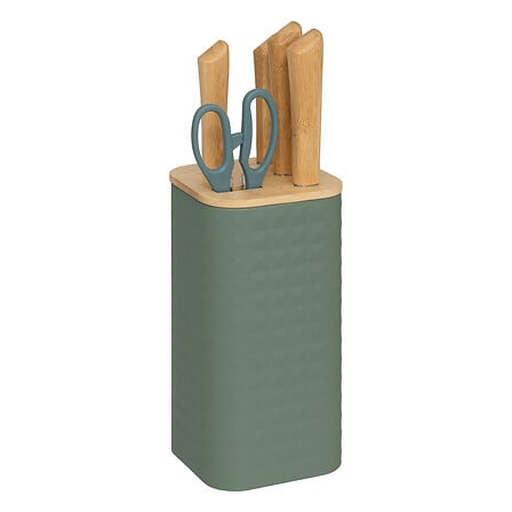
Why this product suits you: This compact set covers everyday cutting tasks and comes with a block, so you won’t need a separate storage solution.
The contents are clearly listed: a bread knife with a 20-cm blade, a chef’s knife with a 20-cm blade, a utility knife, a paring knife and kitchen scissors. That makes it easy to see what you’re getting.
Five practical items, a block and a stated weight of 0,710 kg. Hand-washing and thorough drying are recommended.
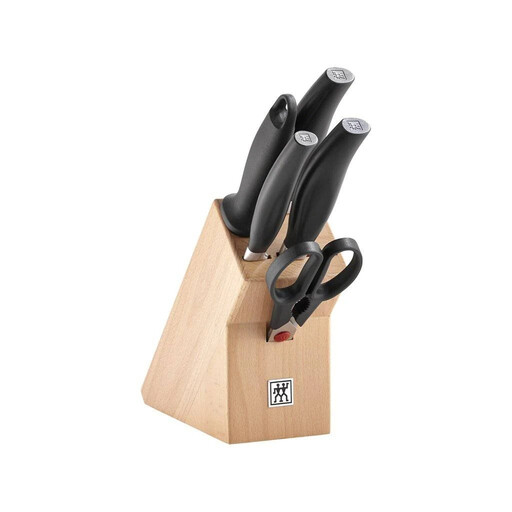
Why this product suits you: This knife block set combines several classic knife types with kitchen scissors, a honing steel and a beechwood block for an organised kitchen.
The set offers more than just a piece count: the chef’s knife, Santoku knife, paring knife, scissors and honing steel are described by their blade lengths or functions.
Features include German stainless steel, around 57 HRC, SIGMAFORGE and FRIODUR, plus a beechwood block. Hand-washing is recommended, despite the stated dishwasher suitability.
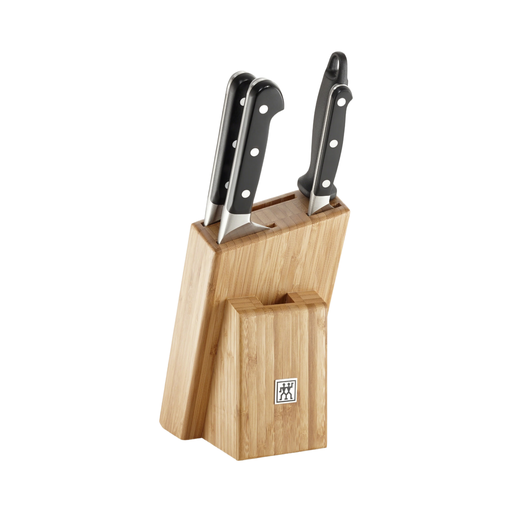
Why this product suits you: This set is for anyone who wants to use a Chinese chef’s knife as well as a Santoku knife, and values having a built-in honing steel.
The selection is tailored to specific tasks: the paring knife, Santoku knife, Chinese chef’s knife, honing steel and bamboo block are all listed individually.
Features include FRIODUR blades, SIGMAFORGE construction, a triple-riveted synthetic handle and a V-Edge grind. The bamboo block needs a stable surface.
A kitchen knife’s lifespan doesn’t depend on its purchase price alone. These habits can help prevent common damage:
We’ve put together a complete, regularly updated list of products that meet these strict selection criteria and fully comply with the safety regulations in force in the EU.
For many households, a chef’s knife, bread knife and paring knife are enough. Depending on your cooking habits, you might also find a Santoku knife, kitchen scissors or a honing steel useful. It’s the function of each item that matters, not just the number of pieces.
A wooden or bamboo knife block should be kept dry and cleaned regularly on the outside. Knives should be completely dry before you put them away. Moisture in the slots can affect the material and hygiene.
It depends on the product. The ZWILLING FIVE STAR Knife Block Set is listed as dishwasher-safe, but hand-washing is also recommended. Always check the product information and dry the knives thoroughly after cleaning.