
Lieferung heute & morgen

Qualitätsgarantie

Willkommens-Angebote freischalten: KOSTENLOSE Lieferung | Bis zu 80 % RABATT | Kostenlose 30-Tage-JoyPlus-Testphase
App herunterladen
A knife set with a knife block may seem like a practical all-in-one solution at first glance: several knives are ready to hand, safely stored and visually coordinated with the kitchen. However, a high number of pieces does not automatically mean versatile equipment. For home cooks, families and quality-conscious households, the most important factors are suitable knife types, clear material specifications and a stable knife block.
Our selection shows what to look for when comparing sets and which combinations suit different kitchen profiles.
A kitchen knife set with ten or more pieces may look appealing. However, if it contains several similar knives or lots of steak knives, it may lack essential kitchen tools such as a chef’s knife, bread knife, paring knife or a knife for cutting vegetables. So do not just check the number of pieces; look at the exact contents.
For everyday food preparation, three to five carefully selected knives are often enough:
Terms such as “ultra-sharp” or “stays sharp permanently” say little about how the knife will perform in practice. More useful details include blade material, manufacturing process, hardness range, edge finish and care requirements. A hard blade can retain its cutting performance for a long time, but depending on the material it may also be more susceptible to impact or incorrect use.
A stainless-steel knife set is generally easy to care for and corrosion-resistant in everyday use. With a forged knife set, buyers should check whether the description really refers to a blade forged from a single piece or merely uses a decorative term. Ceramic blades are lightweight and do not rust, but they can chip if twisted, dropped or used with hard foods.
A wooden knife block or bamboo knife block should stand securely and have suitable slots that are deep enough. Slots that are too narrow can damage the blade when inserting it. With self-sharpening systems, only the knife intended for each slot should be inserted.
The cleaning instructions are also important: wooden blocks should not be soaked. Many kitchen knives stay in good condition for longer when washed by hand and dried immediately. Even if individual products are labelled as dishwasher-safe, hand washing can help protect the lifespan of the blade, handle and block.
Stainless steel is a popular choice for household knives. Look for specific details such as “corrosion-resistant specialist steel” or a stated hardening process. The ZWILLING models in this selection, for example, specify FRIODUR ice-hardened specialist steel. This is a clearly stated product feature, but it does not replace following the care instructions.
Ceramic knife sets, for example with zirconium oxide blades, are lightweight and resistant to rust. According to the product specifications, they are particularly suitable for fruit, vegetables and cooked foods. They are not designed for bones, frozen foods, levering movements or hard cutting surfaces.
A 20 cm chef’s knife is suitable for many cutting tasks, but may require more space in a small kitchen. A Santoku knife with a blade length of around 18 cm offers an alternative for users who prefer a more compact, broad blade. A paring knife measuring 8 to 10 cm supports precise work with fruit and vegetables.
For families, a set with a bread knife and kitchen scissors may be more practical than a small chef’s knife set without accessories. The key question is whether the tools included match your actual cooking habits.
The block should stand on a flat, dry surface and be kept out of children’s reach. After cleaning, knives should be completely dry before being placed in their designated slots. Wherever possible, cut on wooden or plastic boards and avoid glass or stone surfaces, as these can blunt the edge.
A honing steel realigns the cutting edge during everyday use. However, it does not replace an appropriate sharpening process for every type of knife. Ceramic blades must not be treated with an ordinary honing steel.
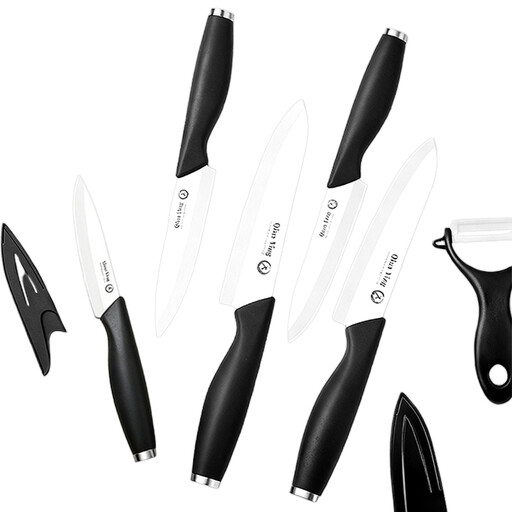
Why this product suits this profile: The set includes five ceramic knives and a peeler, covering essential cutting tasks in a small household kitchen.
The number of pieces is complemented by clearly named knives and a peeler. However, please note that ceramic blades are not suitable for bones, frozen foods or levering movements.
Zirconium oxide blades, low weight and a peeler included in the set. Hand washing is recommended for care.
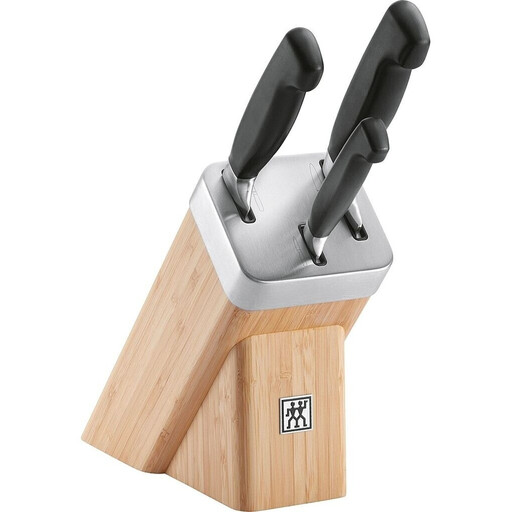
Why this product suits this profile: The 4-piece set contains a 20 cm chef’s knife, a 16 cm slicing knife, a 10 cm paring knife and a bamboo block with KiS sharpening modules.
The block’s functions are clearly specified. The ceramic modules may only be used with the knives intended for them; the set is not dishwasher-safe.
FRIODUR ice-hardened specialist steel, a stated hardness range of HRC 55–58 and an integrated sharpening system.

Why this product suits this profile: This kitchen knife set combines a paring knife, utility knife, chef’s knife, bread knife, kitchen scissors, honing steel and wooden block.
The seven pieces are assigned to different tasks. This makes the set’s versatility clear not only from the number of knives, but also from the specific uses they support.
FRIODUR ice-hardened specialist steel, SIGMAFORGE construction according to the product description, and accessories for bread, herbs, meat and vegetables.
We have put together a complete, regularly updated list of products that fully meet these strict selection criteria and the safety regulations applicable in the EU.
For an average household, three to five different knives are often sufficient. A chef’s knife, paring knife and bread knife cover many tasks. If you cook frequently, a utility knife, Santoku knife, kitchen scissors and honing steel may also be useful.
A wooden or bamboo block can be used if it is stored dry and cleaned regularly. Knives should be completely dry before being inserted. Do not place the block in water or keep it permanently next to the sink, as moisture can damage the material.
The lifespan of an edge depends on the blade material, edge finish, cutting surface, frequency of use and care. With suitable steel knives, a honing steel can realign the cutting edge during everyday use. Ceramic knives do not require a conventional honing steel, but they are more sensitive to impacts and lateral pressure.