
Lieferung heute & morgen

Qualitätsgarantie

Willkommens-Angebote freischalten: KOSTENLOSE Lieferung | Bis zu 80 % RABATT | Kostenlose 30-Tage-JoyPlus-Testphase
App herunterladen
A blunt kitchen knife makes cutting, chopping and filleting more difficult. Many households therefore reach for a knife sharpener without checking its design, sharpening angle or suitability for different blades. This can lead to common buying mistakes: the device is not suitable for the knife, the grip slips or an aggressive sharpening stage is used on a blade that is only slightly blunt.
This selection guide from the Joybuy Product Recommendation Officer explains what keen home cooks and households in Germany should look out for. The focus is on clear product features rather than sweeping advertising claims.
A 4-stage knife sharpener can cover several tasks, but it is not automatically suitable for every blade. Coarse sharpening stages remove more material and are mainly used for visibly damaged or very blunt edges. For regular maintenance, a finer stage is often sufficient.
The type of blade is also important. Many manual devices are designed for knives with a smooth edge. Serrated knives, very thin blades or special Japanese knives may require a different sharpening method.
A knife sharpener with a suction cup or non-slip base can make handling easier. However, its grip depends on the surface of the worktop. On rough, dusty, damp or uneven surfaces, a suction cup may not hold as reliably.
Before use, the surface should be clean, dry and stable. The knife should be drawn through the designated guide in a controlled manner; sideways pressure and rapid movements increase the risk of injury.
A manual knife sharpener is easy to use when its construction sets the sharpening angle. Even so, the blade should not be forced through the sharpening slot. Several short passes in accordance with the instructions are usually easier to control than applying heavy pressure.
Look for clear information about the sharpening material, angle, suitable blades and cleaning. If this information is missing, it is difficult to assess the device’s actual suitability.
A knife sharpener with sharpening wheels often uses steel, ceramic or other abrasive elements. Steel wheels may be intended for a coarser correction stage, while ceramic wheels are often used for finer honing or smoothing the cutting edge. The material alone is not the only deciding factor: the combination of material, angle and application stage is what matters.
Check the following before buying:
A device with three or four stages can be practical if your household uses knives with different maintenance needs as well as kitchen scissors. However, each slot should only be used for its intended purpose.
The sharpening angle affects how the blade is guided across the sharpening elements. A preset angle reduces the effort required, but it does not replace checking the product description. For example, the ZWILLING TWINSHARP is specified as having a preset angle of approximately 35°. According to the product description, the model is designed for knives with a smooth edge and for coarse and fine sharpening.
If you own knives with different geometry, pay particular attention to the manufacturer’s specifications. A supposedly universal device can produce an uneven edge when used with unsuitable blades.
A safety grip, non-slip base or suction cup are practical features. It is equally important that the knife sharpener feels comfortable in your hand and has enough space on your available worktop.
After use, sharpening dust and metal particles should be removed as instructed. Clean the knives before sharpening and wipe them afterwards. Damaged blades or loose handles should no longer be used.
The following products cover a range of requirements, from a simple kitchen knife sharpener to a complete knife block with sharpening tool.
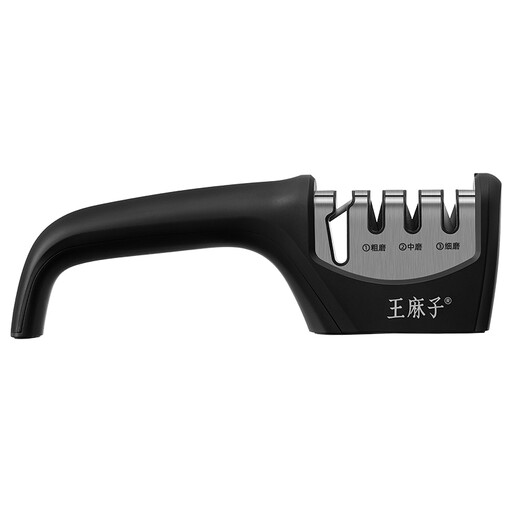
Why this product suits this profile: With four functions, this model is aimed at households looking for several sharpening or maintenance options in one compact device.
The division of functions makes it clear before purchase that this is not just a single sharpening slot. Nevertheless, check that it is suitable for your knives.
Four-function design and manual operation; suitable for users who prefer a versatile household device.
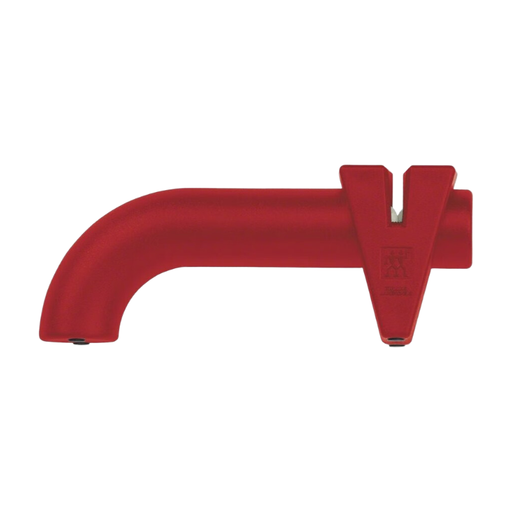
Why this product suits this profile: This 17 cm device combines steel and ceramic wheels with a preset angle of approximately 35°.
The coarse and fine stages are clearly labelled. This makes it easier to adapt use to the condition of the smooth blade.
ABS plastic housing, steel and ceramic wheels, plus a preset angle guide.
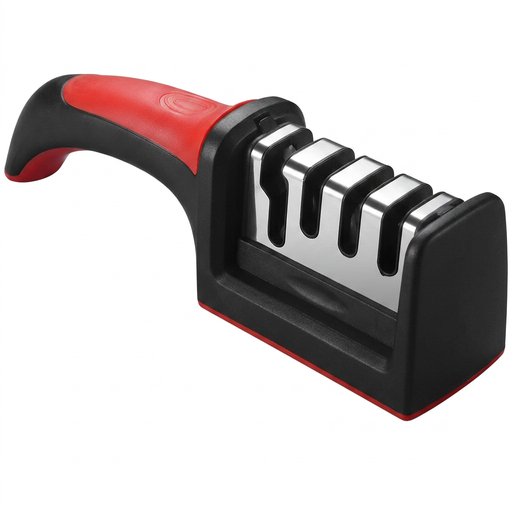
Why this product suits this profile: According to the product description, the four designated areas include coarse and fine sharpening, a scissors-sharpening slot and a polishing stage.
The separate stages prevent every blade from being treated with the same sharpening grade by default. The scissors slot is clearly identified separately.
Four sharpening or maintenance areas and a design for secure stability on the worktop.
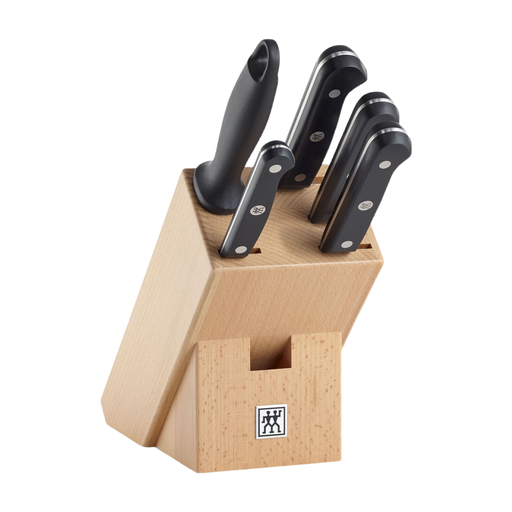
Why this product suits this profile: The set contains four knives, a honing steel and a knife block. It is suitable for households looking to buy knives and maintenance accessories together.
The knives included are divided according to their intended use. The block provides fixed storage spaces, while the honing steel is designed for ongoing maintenance.
Four knives, a honing steel and a beechwood block; the product details state that the blades are FRIODUR-hardened and recommend hand washing for care.
A honing steel realigns an existing cutting edge in many cases, but it does not replace every sharpening method. In the case of chips, severely damaged blades or high-quality knives, professional restoration may be the better option.
We have put together a complete, regularly updated list of products that fully meet these strict selection criteria and the safety regulations applicable in the EU.
This depends on the knife, how often it is used and the sharpening method. A manual knife sharpener should not routinely be used on the coarse stage. For kitchen knives used regularly, checking cutting performance is more useful than following a fixed schedule.
No. Many models are designed for smooth edges. Serrated edges, very thin blades and specialist knives may have different requirements. Before buying, check the information on the blade type and sharpening angle.
The worktop must be clean, dry and level. Before drawing the blade through, check that the device is stable. If the suction cup does not hold securely, do not start sharpening.