
Lieferung heute & morgen

Qualitätsgarantie

Willkommens-Angebote freischalten: KOSTENLOSE Lieferung | Bis zu 80 % RABATT | Kostenlose 30-Tage-JoyPlus-Testphase
App herunterladen
A blunt kitchen knife is harder to use, requires more pressure and is therefore more likely to slip. The right knife sharpener can help you touch up the cutting edge at home. However, sharpening systems vary considerably in their design, ease of use and suitability for different knives. If you focus only on claims such as ‘quick’, ‘multifunctional’ or ‘extra sharp’, you could miss important details.
A knife sharpener with several stages can combine different steps. This is useful if you need coarse sharpening, fine honing and perhaps a polishing stage. For kitchen knives that are only slightly blunt, though, a simple fine stage is often enough. Using coarse stages too often can remove material from the blade.
A preset angle makes a sharpener easier to use, but it won’t necessarily suit every knife. Before buying, check whether the system is designed for straight-edged knives. Serrated knives, ceramic blades and blades with specialist cutting geometries may need different care. So check claims such as ‘for all knives’ against the specific product description.
With a manual knife sharpener, a stable base, comfortable grip and controlled movement are essential. If it has no non-slip base or is awkward to hold, sharpening can be uncomfortable. Cleaning matters too: remove sharpening dust and metal particles after use, if the manufacturer recommends doing so.
A knife sharpener with ceramic and steel discs combines different sharpening properties. Depending on their design, steel discs can be used for coarser sharpening, while ceramic is often intended for finer finishing. According to its product description, the ZWILLING TWINSHARP Knife Sharpener uses stainless steel and ceramic components for coarse and fine sharpening.
If you’re choosing a manual knife sharpener with two or more stages, the order of use should be clearly explained. A coarse stage is generally better suited to more worn blades, while a fine stage is for finishing. Not every knife needs both.
The angle affects how the cutting edge is guided. According to the product information, the TWINSHARP uses a preset angle of around 35 degrees and is described as suitable for straight-edged knives. Check that this is compatible with the kitchen knives you own.
Blade shape also matters when choosing a knife sharpener for kitchen knives. Check:
A stable base reduces the risk of the sharpener slipping as you draw the knife through it. The dimensions matter if you plan to store it in a drawer. It should also be easy to clean. Plastic housings can often be wiped with a cloth; whether individual parts can be washed depends on the product information.
If you’re looking for a scissor sharpener, you’ll need a sharpening slot specifically designed for scissors. A standard knife-sharpening slot isn’t automatically suitable for scissors. If several people will use the sharpener regularly, clearly labelled stages and a wide base can make it easier to handle.
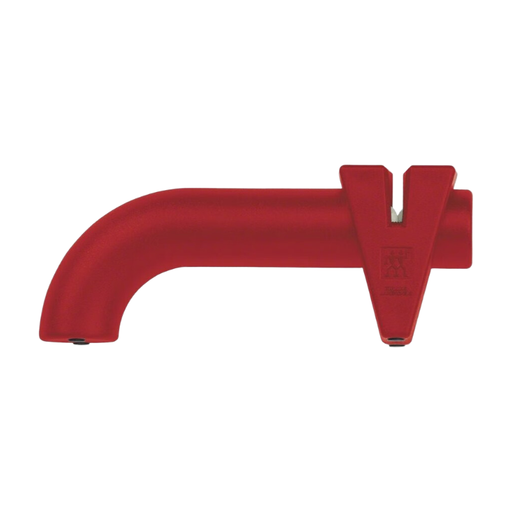
Why it suits this profile: This compact system is ideal for households looking for a straightforward way to sharpen straight-edged kitchen knives. It is 17 cm long and, according to the product information, has an ABS plastic housing.
The preset angle means you don’t need to maintain the sharpening angle yourself. The product description lists separate components for coarse and fine sharpening.
Stainless steel and ceramic discs, a preset angle of around 35 degrees and a weight of 0.131 kg.
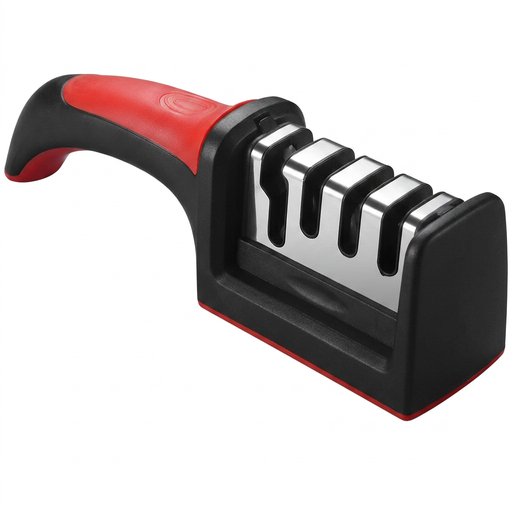
Why it suits this profile: This model is designed for people who need several functions in one device, including a slot for scissors and multiple sharpening stages.
The four separate slots make each function clearer than a system with no distinct stages. Check that the sharpener is suitable for your blade before use.
Four stages according to the product description: coarse sharpening, fine sharpening, scissor sharpening and polishing.
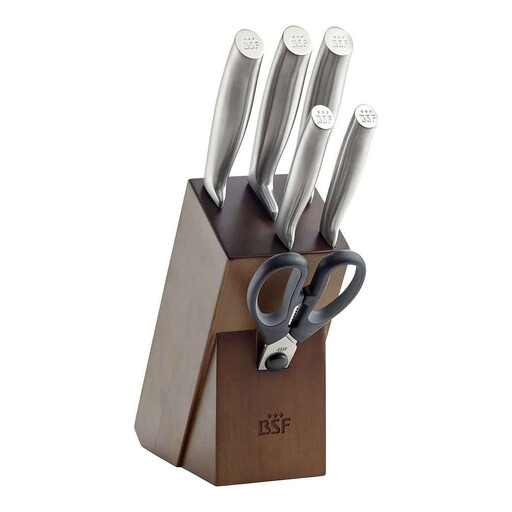
Why it suits this profile: If you’re updating your kitchen essentials, this knife block comes with knives, scissors and several blade types for different cutting tasks.
The contents are clearly listed: five knives, a multi-purpose pair of scissors and a block with six slots. This makes it easy to check exactly what’s included before you buy.
The set includes a bread knife, chef’s knife, utility knife, paring knife and carving knife, as well as scissors. According to the product information, the block is made of birch wood.
We’ve put together a complete, regularly updated list of products that meet these strict selection criteria and fully comply with the safety regulations in force in the EU.
A knife sharpener is no substitute for checking damaged blades. Don’t try to repair chipped or badly bent edges by repeatedly drawing them through the sharpener.
It depends on how often you use your knives, the steel they’re made from and the type of cutting surface. If you only cook occasionally, sharpening when you notice a drop in cutting performance is often enough. Avoid using a coarse stage as part of your regular routine, as it can remove more material.
No. The type of edge, blade material and sharpening angle all matter. Many manual systems are designed for straight-edged kitchen knives sharpened on both sides. Serrated or ceramic blades may need a sharpener designed specifically for them.
A guided knife sharpener is usually easier to use because the angle is preset or partially guided. A sharpening stone gives you more control, but requires confident handling and the ability to maintain the right angle. The best choice depends on your experience, how much time you have and the type of knife.