Photographers with a fixed hat set-up
If you always use the same tripod position, first check whether the self-timer or a compatible wired remote will do the job. Nikon describes the MC-DC2 as suitable for certain DSLR cameras, not every model.


For repeated hat photos with your camera on a fixed tripod, start with the camera’s self-timer or an app supported by your model. If you want to take the shot straight away or stay by the subject while arranging it, choose a compatible wired or wireless remote. A wired remote needs the right connection, while a wireless one must be explicitly supported by your camera. Canon and Nikon offer model-specific options, and Canon says Camera Connect works with many, but not all, Canon cameras. None of these ways of taking a photo can replace even lighting and an adjusted white balance: Nikon recommends adjusting it when lighting conditions change.
If you always use the same tripod position, first check whether the self-timer or a compatible wired remote will do the job. Nikon describes the MC-DC2 as suitable for certain DSLR cameras, not every model.
If you adjust the shape of the hat or the lighting around your subject, a supported wireless remote can let you take the shot from where you’re working. Canon and Sony offer model-specific options.
If you also want to control supported settings on your mobile phone, check the features available for your camera model. Canon says Camera Connect works with many Canon cameras.
A good fit if: you take individual shots from a fixed tripod position and the delay works for your set-up.
Bear in mind: Timer settings vary by camera model, and the shutter won’t release as soon as you press a button.
A good fit if: you want to take repeated shots close to your tripod and the connector matches your full camera model.
Bear in mind: Cable length and routing limit how freely you can move. Fujifilm says certain cameras need an additional adapter for the RR-100.
A good fit if: you arrange the hats or lighting from beside the subject and your camera supports that specific remote.
Bear in mind: Compatibility and set-up depend on the camera model. Sony says the RMT-P1BT uses the built-in Bluetooth receiver in supported cameras.
A good fit if: your camera supports remote shooting and you want to take the shot or control available settings on your mobile phone.
Bear in mind: Check which remote-control features are available for your specific camera model.
First, check your camera model and the available ways to release the shutter. Then decide whether immediate shooting, freedom to move or smartphone control matters most for your set-up.
| Priority | What to check before buying | Who is it most important to? |
|---|---|---|
| Connection and compatibility | Check the full camera model and connector against the manufacturer’s information. Canon specifies an E3 2.5 mm connector for the RS-80E3 and an N3 interface for the RS-80N3. | If I want to avoid buying the wrong product, I check the camera model, connector and whether an adapter is needed. Around 33% of consumers put compatibility first. |
| Taking photos with a fixed set-up | Check whether the self-timer is enough or if a wired remote fits the accessory port. Also consider the cable length you need. | If I want to leave the camera on the tripod, I need to take the shot without touching it. Around 25% of consumers prioritise taking photos without touching the camera when it’s in a fixed position. |
| Freedom to move around your set | Check that your camera model supports the specific wireless remote. Don’t assume range figures apply to other models. | If I arrange hats or lighting beside the subject, I don’t want to go back to the camera for every shot. Around 25% of consumers put freedom to move around the set first. |
| Smartphone control | Check that your camera model supports remote shooting and the app features you need. | If I want to take the shot or adjust settings on my mobile phone, I first check what my camera can do. Around 17% of consumers prioritise smartphone control. |
The brand alone doesn’t guarantee that a remote will fit. For example, Canon has different E3 and N3 connectors. According to Fujifilm, certain cameras need an additional adapter to use the RR-100.
Before buying, check the full camera model name, connector and required contents against the manufacturer’s information.
The wireless remotes described here are options for supported cameras, not universal shutter releases.
Check explicitly whether your camera supports the exact remote model.
Changing how you release the shutter won’t correct the lighting or white balance. Nikon notes that you can adjust the white balance when lighting conditions change.
Keep the lighting as even as possible throughout a series of photos, and check the white balance if the lighting changes.
Canon offers model-specific wired and wireless remotes, as well as Camera Connect as a possible app alternative for supported cameras.
The MC-DC2 is a wired option for certain Nikon DSLR cameras, for example, when taking photos from a tripod.
The RMT-P1BT is a Bluetooth remote for cameras that support this model.
The RR-100 is a wired remote for the X and GFX cameras listed by Fujifilm.
The LUMIX DMW-RS2E is a wired option for a compatible camera set-up.
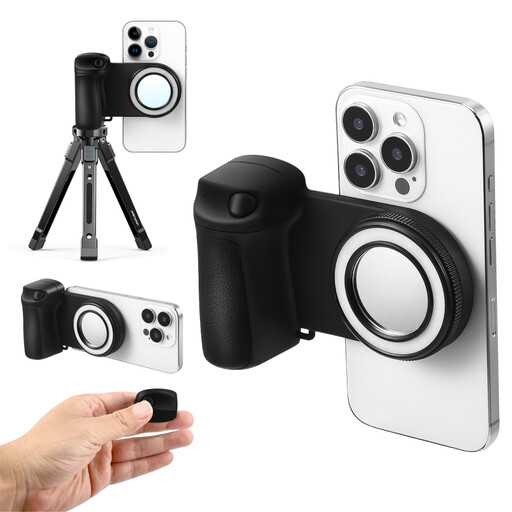
This selection is for smartphone photography using a detachable remote on a tripod, not for wired camera shutter releases.
 No image available
For taking smartphone photos from a tripod when you want to release the shutter from a little further away. The product description lists a detachable Bluetooth remote and a 1/4-inch tripod thread; the product is described as a smartphone grip.
Not necessarily. Check whether your camera’s built-in self-timer or a supported remote-shooting feature in its app suits your needs. Canon says Camera Connect works with many, but not all, Canon cameras.
First, check your camera model and remote connector against the compatibility information, then plan how to route the cable around your set-up. Canon lists an 80 cm operating range for the RS-80E3. Certain Fujifilm cameras need an additional adapter to use the RR-100.
No. A remote lets you control the camera from a distance, but white balance also affects how natural the colours look. Nikon recommends adjusting it when lighting conditions change.
For wireless models, check what power supply they need. For different connector options, check whether an adapter is required. Germany’s consumer advice centre distinguishes the statutory guarantee from a voluntary warranty, and says consumers generally have a 14-day right to cancel online purchases. The period starts when the contract is made or the goods are received.
For electrical and radio products within its remit, the German Federal Network Agency lists requirements including CE marking, correct manufacturer information and instructions in German. Check the details for the specific product; these do not, in themselves, confirm that the remote is compatible with your camera.