People stocking up on lactose-free foods
If you make your own porridge or muesli, plain oats let you check the ingredients in your base and any liquid you add separately. For your store cupboard, also consider a suitable pack size and dry storage.


For a lactose-free store cupboard, products whose ingredient list contains only oats are a straightforward place to start; always check the details on the specific pack, though. Jumbo oats give you a heartier texture, while fine or melting oats make a smoother porridge. If you also need to follow a gluten-free diet, look for an explicit gluten-free label, regardless of the ingredients list.
If you make your own porridge or muesli, plain oats let you check the ingredients in your base and any liquid you add separately. For your store cupboard, also consider a suitable pack size and dry storage.
If you want oats that soak quickly or stir easily into a smooth porridge, fine or melting oats are worth considering. REWE describes its fine oats as quicker to soak, while Alnatura says its melting oats dissolve instantly.
If you need to avoid gluten as well as milk ingredients, you’ll need to check the oats separately. If you have coeliac disease, look for an explicit gluten-free label on the specific pack; a short ingredients list alone isn’t enough.
For a lactose-free store cupboard, start by checking the ingredients on the specific pack. Then choose a pack size and type of oats to suit your consumption and preferred texture. Check separately for an explicit gluten-free label if you need one.
| What matters | What to check | Who it matters to |
|---|---|---|
| Milk ingredients | Check the current ingredients list and any highlighted allergens. If you have a milk allergy, also consider possible traces and your individual requirements. | If I’m putting together a lactose-free breakfast base, I want to be able to identify added milk ingredients from the pack. This is the main consideration for around 40% of consumers. |
| Store-cupboard storage | Choose a pack size and best-before date that suit your consumption. Once opened, store the oats in a dry, airtight container. | A larger pack is only useful if I can use it in time and store it safely. Planning how to store the oats is the main consideration for around 30% of consumers. |
| Type of oats | Choose jumbo oats for a heartier bite, fine oats for quicker soaking or melting oats for a smooth porridge. | Whether I like my muesli crunchy or prefer a smooth porridge determines which oats I’ll actually use. Texture is the priority for around 20% of consumers. |
| Gluten-free requirements | If you also need to avoid gluten, look for an explicit gluten-free label on the specific pack of oats. | If I need to buy gluten-free as well as lactose-free, “oats” as the only ingredient isn’t enough. This additional requirement is decisive for around 10% of consumers. |
Lactose is milk sugar, while a milk allergy is a reaction to milk protein. Lebensmittelklarheit explains that intentionally added allergenic ingredients must be labelled, but warnings about possible traces are voluntary. So the absence of a trace warning does not prove that there has been no cross-contact.
If you have a milk allergy, check the specific pack and, if necessary, ask the manufacturer about possible traces rather than relying on a lactose-free label alone.
Alnatura’s plain oats contain wholegrain oat flakes only. A mix can contain other ingredients; Seitenbacher, for example, offers lactose-free mueslis with chocolate. The labelling for plain oats cannot be applied to these mixes.
Check the full ingredients list and allergen labelling for every mix. If you want to choose your own extras, start with a pack of oats that is labelled accordingly.
A pack for your store cupboard should suit how much you actually use. Verbraucherzentrale recommends airtight containers for dry foods. If stored poorly, oats can lose quality and turn rancid.
Compare the best-before date with how quickly you’ll use the oats. Once opened, keep them dry, away from light and in an airtight container.
If you don’t use up an opened large pack, you risk creating avoidable food waste.
A lactose-free option is not automatically gluten-free. Kölln says its gluten-free fine oats are made using a process designed to protect them from contamination with cereals containing gluten. This does not mean ordinary oats have the same properties.
If you need to follow a gluten-free diet, check for an explicit gluten-free label on your chosen variety as well as reading its ingredients.
The details below relate to specific product ranges or manufacturer information. Always check the information on the pack you choose when shopping.
Kölln offers a gluten-free fine oat option for people who also need to avoid gluten.
Alnatura offers jumbo oats in a 1 kg pack and melting oats in a 250 g pack, among other products.
An EDEKA organic option is an example of plain fine oats that you can stock up on.
REWE’s ja! product page describes fine wholegrain oats in a 500 g pack.
Seitenbacher describes its lactose-free mueslis as an alternative if you’re looking for a breakfast mix rather than plain oats.
Brüggen describes itself as a manufacturer of cereal flakes and own-label products.
This selection includes hearty and fine oats in different pack sizes, as well as varieties whose product names describe them as gluten-free. For each pack, check the ingredients, allergen warnings and best-before date against your requirements.
 No image available
An option if you’re looking for hearty oats and also need a gluten-free label. The product name states 500 g. Check the current pack labelling against your requirements, particularly if you have a milk allergy.
 No image available
An option if you prefer fine to hearty oats and also shop gluten-free. The product name states 500 g. For gluten-free and allergen requirements, always rely on the labelling on the specific pack.
 No image available
Fine oats for putting together your own breakfast base. The product name states that the pack contains 500 g. Before using the oats as part of your lactose-free choices, check the ingredients and allergen information on the current pack.
 No image available
Fine oats in a 400 g pack if this size better suits how much you use. Check the best-before date and current pack labelling. If you have a milk allergy, also check for possible traces.
 No image available
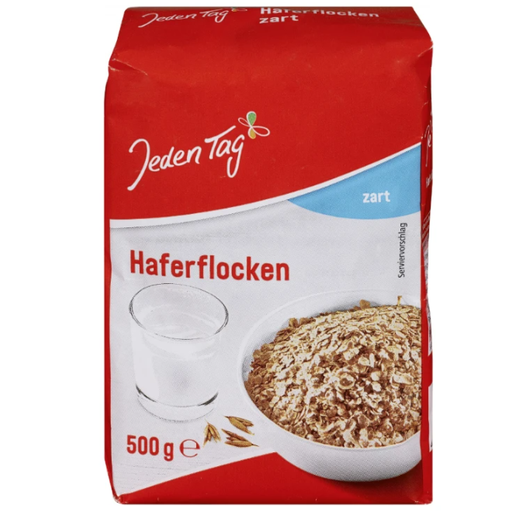
The product name describes a 500 g pack of fine oats. However, the accompanying description also calls them oat flour, so check the pack before buying to make sure you’re getting flakes rather than flour. Check the allergen information too.
An ingredients list containing only oats does not list any added milk ingredients, but this does not apply to every oat product or breakfast mix. Check the ingredients and highlighted allergens on the specific pack, and choose your added liquid accordingly too.
No. The absence of a trace warning does not guarantee that there has been no cross-contact. Lebensmittelklarheit explains that in Germany, intentionally added allergenic ingredients must be labelled, but trace warnings are voluntary. Check the specific pack and ask the manufacturer about possible traces if you have any questions.
Store oats in a dry place, away from light, and seal them tightly after opening. Choose a pack size that suits how much you use and the best-before date. Verbraucherzentrale explains that the best-before date applies to unopened products stored correctly; it is not a use-by date.
No. Lactose-free and gluten-free are separate requirements. If you also need to avoid gluten because of coeliac disease or another medical need for a gluten-free diet, look for an explicit gluten-free label on the pack of oats. An ingredients list containing only oats does not answer this question.