
Lieferung heute & morgen

Qualitätsgarantie

Willkommens-Angebote freischalten: KOSTENLOSE Lieferung | Bis zu 80 % RABATT | Kostenlose 30-Tage-JoyPlus-Testphase
App herunterladen
Choosing the right lighting can transform a room, but the path to the perfect lamp is often paved with unexpected hurdles. From incompatible bulbs to misleading quality claims, many buyers invest in products that cause frustration shortly after purchase. This guide will help you identify the most common pitfalls and make an informed decision for your lamps & lighting.
Before you add a new living room lamp or bedside lamp to your cart, you should be aware of these common problems that often only become apparent after unboxing.
To avoid these mistakes, focus on three objective criteria. These will help you correctly assess the functionality and quality of a light fixture.
The socket is the heart of any lamp. The most common types in UK households are:
Always check the maximum wattage specified by the manufacturer. With an LED lamp, this value is rarely an issue due to low consumption, but for older halogen or incandescent bulbs, it is a critical safety feature.
The atmosphere of a room is significantly determined by the light colour. Use the Kelvin scale as a guide:
Making a lamp dimmable offers maximum flexibility. You can adjust the light from bright task lighting to a soft ambient glow. Ensure that both the fixture and the bulb used are explicitly marked as dimmable.
Modern lights offer more than just illumination. A night light with a motion sensor in the hallway or children's room automatically provides light when needed, increasing safety and comfort without disturbing sleep. Such smart features are not gimmicks but solve real-world, everyday problems.
We have selected a few products based on their objective features and suitability for different user profiles.
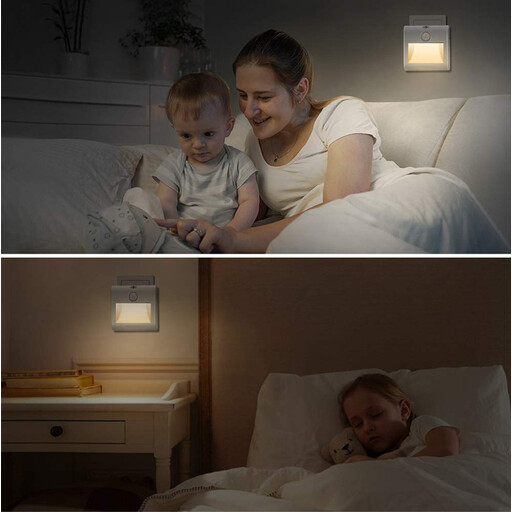
Why This Fits Their Persona: Ideal for families or anyone who wants to navigate dark hallways, staircases, or bathrooms at night without fumbling for a light switch. A hassle-free, plug-and-play solution.
This night light bypasses the compatibility trap by being an all-in-one solution. It provides a defined, eye-friendly light colour at 4000-4500K, thus avoiding vague quality claims.
Stepless touch dimming with a memory function and an intelligent motion sensor that only activates in darkness (≤20 LUX) to save energy.

Why This Fits Their Persona: Perfect for those who want to create a warm, cosy atmosphere with natural materials. The design complements both modern and traditional decor styles, making it suitable as a bedside or living room lamp.
This lamp avoids the material trap by using a tripod made of solid wood. It also solves the compatibility issue, as a matching E27 LED lamp is already included in the box.
The linen lampshade ensures soft, glare-free light distribution. Assembly is completed in minutes without any tools.

Why This Fits Their Persona: For anyone looking for a statement piece to serve as a central focal point in the living or dining room. The design is ideal for lovers of industrial or mid-century styles who want to customise their lighting.
The fixture is crafted from metal, avoiding the trap of inferior materials. It uses standard E27 sockets, giving the user complete freedom in choosing bulbs (LED, Edison, smart home) and minimising compatibility issues.
The six arms can be rotated 180 degrees horizontally, allowing for a flexible and personalised lighting arrangement. The fixture is designed for rooms of 10–15 m?.
We have compiled a complete, up-to-date list of products that fully meet these strict selection criteria and German safety regulations.
1. How many lumens do I need for a living room? The required brightness depends on the room size and the desired atmosphere. As a rule of thumb, aim for about 100 to 300 lumens per square metre. For a 20 m? living room, this means a total requirement of 2,000 to 6,000 lumens. It is advisable to distribute this brightness across multiple light sources, such as a central ceiling light supplemented by a table lamp and a floor lamp. A dimmable lamp offers the greatest flexibility here.
2. What is the difference between an E27 and an E14 socket? The number indicates the diameter of the screw base in millimetres. The E27 socket (27 mm) is the common standard for most general-purpose lights. The E14 socket (14 mm) is smaller and is often used as a "candelabra" base for decorative lights or a bedside lamp. Always check the specification in your lamp's product details before buying a new bulb.
3. Can I put an LED bulb in any lamp? In most cases, yes, as long as the socket type (e.g., E27) matches. Since an LED lamp consumes significantly less power than traditional incandescent bulbs, the maximum wattage of the fixture is rarely a problem. One exception is older dimmer switches: they are often not compatible with modern, dimmable LEDs and can cause flickering. In this case, the dimmer itself may need to be replaced.