
Lieferung heute & morgen

Qualitätsgarantie

Willkommens-Angebote freischalten: KOSTENLOSE Lieferung | Bis zu 80 % RABATT | Kostenlose 30-Tage-JoyPlus-Testphase
App herunterladen
The right lighting can determine whether a room is practical to use, pleasantly bright or styled with decorative flair. However, lamps and lights come with many offers whose important details only become apparent at second glance. A low price may, for example, be offset by a bulb not being included, complicated installation or ongoing battery costs.
This guide explains which details you should check before buying and which lights are suitable for different living situations in Germany.
Colour temperature, measured in Kelvin, describes whether light appears warm or cool. Warm white lighting is usually around 2,700 to 3,300 Kelvin and is often used in living rooms or bedrooms. A specification of 6,500 Kelvin, by contrast, indicates noticeably cooler, whiter light.
However, colour temperature alone does not indicate how bright a lamp is. Lumens are the key measure here. A small light producing 20 to 40 lumens may be sufficient as an orientation light, but it cannot replace room lighting.
With a light featuring an E27 fitting or E14 fitting, the bulb is often not included. Before ordering, you should therefore check the fitting, maximum wattage and desired light colour together. With permanently integrated LEDs, the light source cannot be replaced like a conventional bulb. The advantage is that there is no need to purchase a separate light source.
An indoor wall light generally requires secure wall mounting and usually an existing power connection. A pendant light must be safely attached to the ceiling and should not hang so low that it obstructs a passageway. A pure IP20 light is not intended for damp rooms or outdoor areas. This protection rating is suitable for dry indoor spaces.
For example, a 24-watt LED ceiling light producing 2,300 lumens can illuminate a room much more strongly than a small 0.3-watt LED night light producing 20 lumens. The two products therefore serve different purposes.
A night light with a motion sensor switches on when movement is detected. A model with a dusk or light sensor, by contrast, responds to the brightness of its surroundings. This is practical for hallways, stairwells and children's bedrooms when the light should activate automatically in the dark.
A dimmable lamp should be explicitly labelled as dimmable. With lights featuring replaceable fittings, you must also check whether the bulb and dimmer being used are compatible. A non-dimmable LED ceiling light cannot be adapted with just any wall dimmer.
Before buying, it is advisable to compare the light with the space where it will be installed:
Material specifications can help you assess a product, but they do not replace a safety check. Glass can have a decorative effect, but requires a stable location. Rattan or bamboo elements create a filtered lighting effect, but may block more light than an open glass shade.
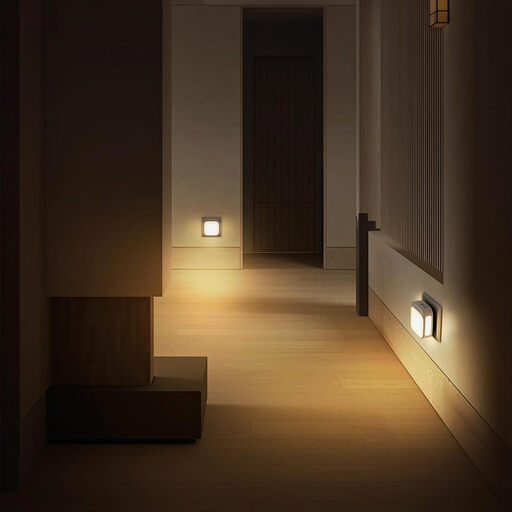
Why this product suits this profile: This two-piece set is suitable for hallways, children's bedrooms or the route to the bathroom. The automatic light sensor switches the lights on and off without batteries.
The specifications state 0.3 watts, 2,800–3,000 Kelvin, 20 lumens and dimming from 10 to 100 per cent. This makes the power requirements and light characteristics easy to understand.
Two lights, an automatic light sensor, warm white light and continuously adjustable brightness.
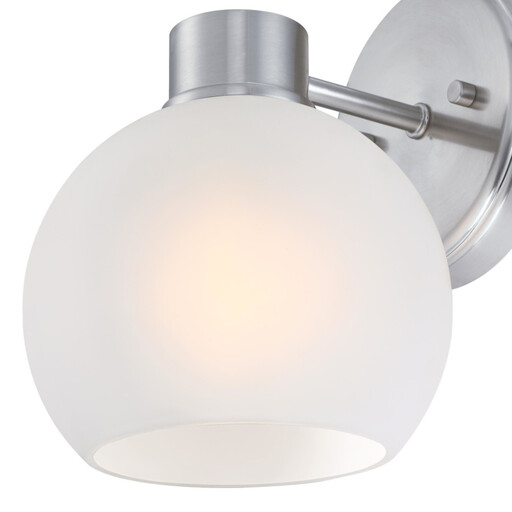
Why this product suits this profile: This wall light combines a metal finish with an opal glass shade, making it suitable for planned fixed lighting in hallways, bedrooms or living rooms.
The light uses a replaceable E27 bulb rated up to a maximum of 60 watts. The listing also points out that the bulb must be purchased separately.
Opal glass, brushed nickel finish, a height of 23 centimetres and installation with the shade facing upwards or downwards.
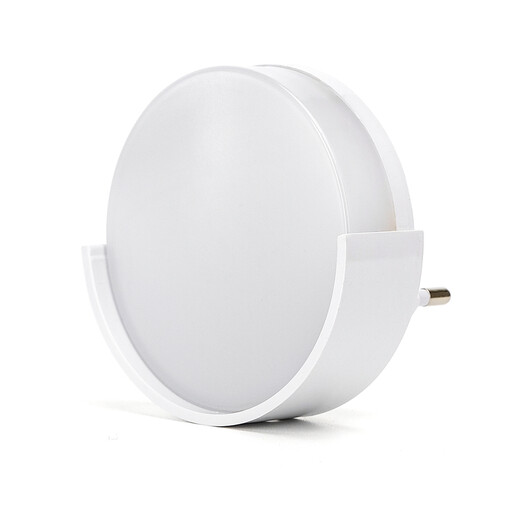
Why this product suits this profile: This compact plug-in light is designed for passageways, stairs and children's bedrooms where automatic guidance in the dark is all that is needed.
The technical data specifies 1 watt, 40 lumens, 6,500 Kelvin, IP20 and automatic switching below 20 lux. This clearly limits its use to dry indoor spaces and orientation lighting.
Plug-in use without batteries, a 120-degree beam angle and a stated lifespan of 25,000 hours.
For general lighting in the living room or bedroom, a ceiling light, LED ceiling light or pendant light may be suitable. A pendant light or hanging lamp can showcase the dining table, but its height, cable routing and bulb should be checked. For example, the Lameke Dome Pendant Light has an E27 fitting and is designed for a maximum power of 60 watts; the bulb must be purchased separately.
A light with bamboo shades, such as the Atmosphera Lio Ceiling Light, uses three E14 fittings and adjustable spotlights. The shades made from FSC-certified bamboo affect the distribution of light and can create a warm, filtered lighting effect. A decorative table lamp, a rattan lamp or a small LED mushroom lamp are also suitable for decorative accents. With battery-powered models, you should consider the batteries, available surface space and moisture protection.
If you are looking for smart LED lighting or RGB lighting, check app compatibility, Wi-Fi requirements, voice control and the available mounting area. One offer comprising six smart light strips lists Smart Life app support, a remote control, Alexa and Google Assistant compatibility, as well as a range of colour scenes. These products are mainly intended for indirect lighting, gaming areas or decorative wall design, rather than automatically serving as a room's only source of lighting.
We have put together a complete, regularly updated list of products that fully meet these strict selection criteria and the safety regulations applicable in the EU.
That depends on the size of the room, how it is used and the existing light sources. For general guidance, lumens are more informative than watts. A central ceiling light can be combined with additional table or wall lights, so the entire room does not have to be illuminated to the same brightness.
The manufacturer states the lifespan in operating hours. For example, the Aigostar LED Night Light is specified as lasting 25,000 hours. The actual service life depends, among other things, on operating time, heat generation, mains quality and proper use.
You can estimate the cost using this formula: wattage divided by 1,000, multiplied by operating hours and your personal electricity price. A 0.3-watt night light operated for 10 hours a day uses significantly less energy than a 24-watt ceiling light. For an accurate calculation, use current electricity tariffs and the actual operating time.