Speakers recording long takes
If you want to record an introduction without interruptions to charge or free up storage, check the battery life and recording medium for the length of each take. RØDE, Zoom and DJI provide model-specific details.


For a long exhibition introduction, a wired lavalier is a good choice if you’re staying in one place and your recording device has a compatible microphone input. If you’ll be moving around, consider a wireless kit with local transmitter recording or a lavalier with a body-worn recorder. You’ll need to plan for power, recording time and syncing the files later to suit your workflow.
If you want to record an introduction without interruptions to charge or free up storage, check the battery life and recording medium for the length of each take. RØDE, Zoom and DJI provide model-specific details.
If you’ll be moving around during the introduction, consider freedom of movement, how the microphone is secured and how to handle potential wireless dropouts. RØDE, Hollyland and the German Federal Network Agency provide relevant product and wireless information.
If you’re recording with a camera, smartphone or recorder, check the exact microphone input and the complete signal path in advance. RØDE and DJI describe different connection options and kit configurations.
Suitable if: you’ll be speaking mainly in one place and your recording device has a compatible microphone input that supplies power.
Trade-off: The microphone doesn’t need its own wireless connection, but the cable run and actual connection compatibility will limit how freely you can move.
Suitable if: you’ll be moving around the exhibition and want a local recording on the transmitter as well as audio transmitted to your recording device. RØDE Wireless PRO offers this feature; check the exact configuration for other models.
Trade-off: The transmitter and receiver need power. RØDE notes that 32-bit float on the Wireless PRO applies to transmitter recordings, not automatically to the camera audio. Wireless signals may also be affected at your location.
Suitable if: you want to record a single voice locally, without transmitting audio to the camera, and can sync the audio file with the footage later. The Zoom F2 records to microSD.
Trade-off: The camera audio won’t automatically come from the recorder file, so starting the recording and syncing it later need to be part of your workflow.
| Requirement | What to check before buying | Who should pay particular attention |
|---|---|---|
| Long, uninterrupted take | Check the battery life of each active device and the available recording time separately against your planned take length. | If I need to record without stopping to charge or free up storage, I check both limits separately. Around 33% of consumers prioritise uninterrupted recording. |
| Clear speech on location | Test the microphone position and attachment with the actual clothing you’ll be wearing and in a similar level of background noise. | If speech needs to remain clear despite clothing and ambient noise, it’s important to test the complete setup. Around 27% of consumers prioritise speech clarity. |
| Connection to the recording device | Check the device model, microphone input and power requirements. The RØDE Lavalier GO is designed for a 3.5 mm TRS input with plug-in power. | If I want to keep using my existing device, I first check the entire connection path. Around 20% of consumers put device connectivity first. |
| Freedom of movement | Test your planned route with the attachment and recording setup. Don’t assume a stated open-field range will apply indoors. | If I’m moving around during the introduction, the recording setup needs to suit both my movements and the wireless conditions. Around 20% of consumers prioritise freedom of movement. |
Storage capacity and battery life are separate limits. With a wireless kit, the battery life of all the devices you need must also cover your planned take.
Check the transmitter and receiver battery life, as well as the recording time available in your chosen format, separately against your planned recording length.
The RØDE Lavalier GO needs a suitable 3.5 mm TRS microphone input with plug-in power. The plug alone doesn’t confirm that a particular smartphone or camera will power the microphone correctly.
Before buying, check the exact recording device, input, power requirements and kit configuration.
For the Wireless PRO, RØDE’s 32-bit float specification refers to local recording on the transmitter. It doesn’t mean that the camera records the same audio in this format.
Decide which file you’ll use later, and test exporting and syncing it before the event.
A range quoted for clear, unobstructed conditions doesn’t automatically describe wireless performance indoors. The German Federal Network Agency doesn’t guarantee interference-free wireless operation.
Test the connection along your planned route inside the building. For important takes, also consider whether a suitable local recording option would work for you.
RØDE offers a wired lavalier for compatible 3.5 mm TRS inputs, as well as wireless kits with local transmitter recording.
DJI offers compact wireless kits such as Mic Mini, as well as Mic 2, which features internal transmitter recording.
The Zoom F2 is a body-worn lavalier recorder that records locally to microSD.
The LARK MAX 2 is a wireless option with internal transmitter recording; features vary by kit configuration.
This selection includes lavalier microphones and wireless kits with different connection options, for recording with either a fixed or mobile setup.
 No product image available
A wireless kit for recording setups that use both a transmitter and receiver.
Kit configuration with two transmitters, one receiver and a charging case.
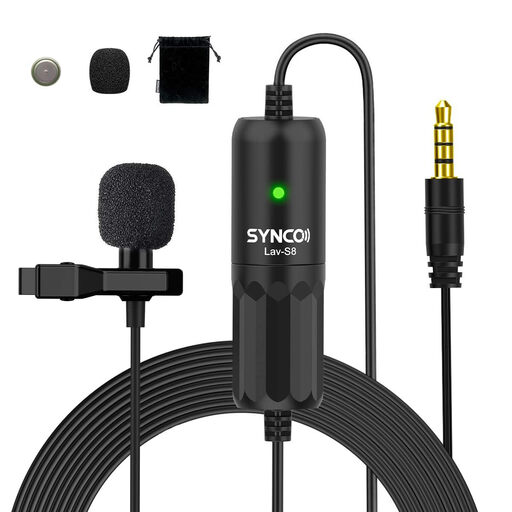 No product image available
The product name lists smartphones, PCs, laptops and cameras as compatible devices. Check the connection against your specific recording device.
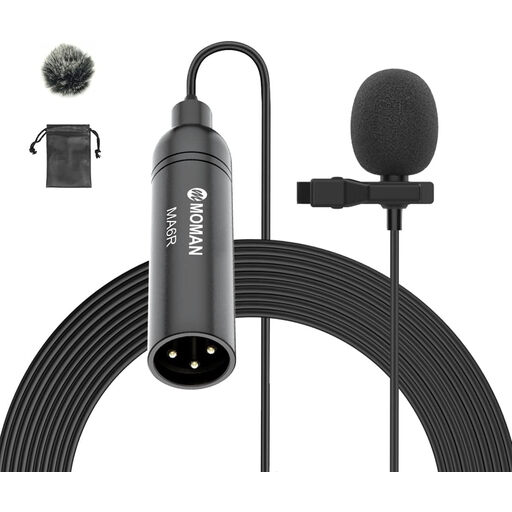 No product image available
A wired lavalier for setups where the stated cable length suits the distance between the speaker and recording device.
Specifications listed in the product name: 6 m, 3.5 mm connection and omnidirectional pickup.
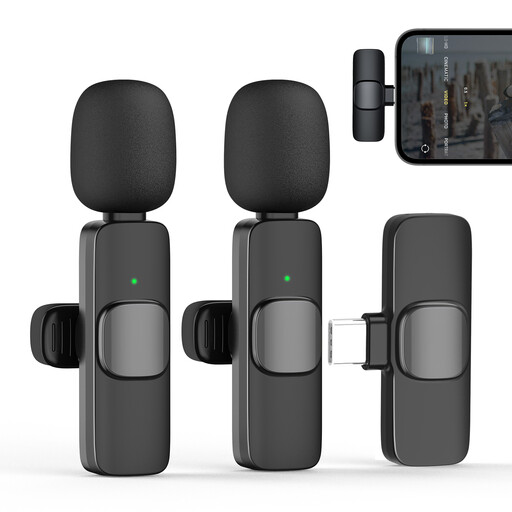 No product image available
A wireless kit for a compatible Type-C recording device. Check the connection suits your device before buying.
Specifications listed in the product name: 2.4 GHz, one transmitter and one receiver.
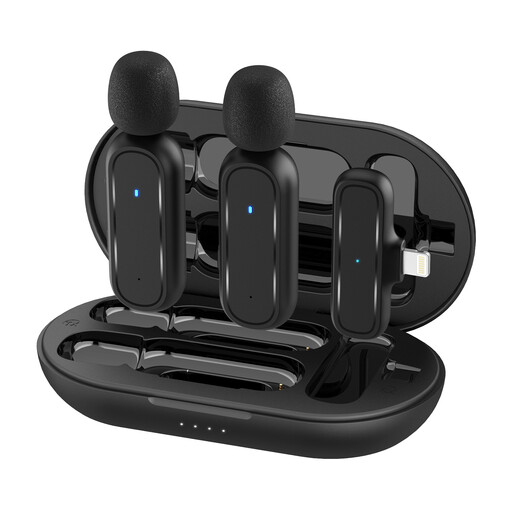 No product image available
A wireless lavalier for a compatible USB-C smartphone. Check that the connection suits your specific device.
Specifications listed in the product name: 2.4 GHz, one transmitter and one receiver.
No. Recording time and battery life are separate limits. RØDE says the Wireless PRO can create transmitter recordings of over 40 hours, but the transmitter and receiver each offer up to seven hours’ use per full charge. So plan your take around whichever relevant limit is shorter for your recording setup.
Attach the lavalier to a suitable edge of your clothing, secure the cable to prevent strain and test the movements you’ll make during the introduction. If your device records locally, also check that recording is running before you start.
With the Zoom F2, your recording plan needs to include two AAA batteries and recording to microSD. The local audio file must then be transferred and synced with the footage. Zoom quotes up to 15 hours for the F2 and up to 14 hours for the F2-BT using two AAA batteries.
A product description alone doesn’t confirm that a device is authorised for use. The German Federal Network Agency publishes general frequency assignments with conditions that depend on the frequency and device. Before use, check the frequency band, device documentation and current assignment. The Agency notes that Vfg. 91/2025 replaces earlier separate assignments, and doesn’t guarantee interference-free wireless operation.
There’s no blanket answer without details about where and why you’re recording, and whether individuals are identifiable. Check the recording conditions at the venue and, if people are identifiable, assess the specific data protection implications. In its short paper No. 15, the Data Protection Conference discusses video surveillance; this doesn’t establish blanket permission for every exhibition recording.