If you simply need a suitable connection for wired headphones, start by looking at a compact, USB-powered DAC/headphone amplifier. A desktop unit may be a better fit if you need extra connections, an easy-to-reach volume control or clearly specified output power. Bear in mind the space it takes up, the cables and, where applicable, a separate power supply. For headset calls, microphone support must also be explicitly stated.
Who are the different form factors suited to?
Space-conscious laptop listeners
If there’s hardly any room on your desk for another device, consider a small USB DAC or dongle. iFi describes the uno as a compact desktop unit with USB-C for audio and power; Creative says the Sound Blaster PLAY! 4 is powered via USB.
Listeners with more demanding headphones
If you want to match the headphone connection and power specifications to your headphones, check the figures for the specific output and stated load. FiiO lists different figures for the K11 depending on the headphone output and load.
Laptop users with a headset
If you also want to speak through a wired headset, look for an explicitly supported microphone input and the correct plug wiring. Creative lists a 4-pole CTIA connection with microphone input for the Sound Blaster PLAY! 4.
What should you look for when buying?
Small USB dongle
A good fit if: you need to save desk space and a simple headphone connection is all you need.
The trade-off: A headphone output alone doesn’t mean that a microphone is supported or that every pair of headphones can be driven adequately.
Compact USB desktop DAC
A good fit if: you’d like an easy-to-reach volume control or an additional line output, but would rather not have a separate power supply.
The trade-off: Even a compact desktop unit needs room for its casing and connected cables. Also check the operating system and driver information.
Desktop unit with extra connections
A good fit if: you need specific headphone connections, multiple inputs or power ratings that meet your requirements.
The trade-off: Allow space for the unit, cables and power supply. Higher rated power is no reason to listen at unnecessarily high volumes.
| What you need |
What to check when buying |
Who is this particularly important to? |
| Compact footprint and simple power |
Overall dimensions, including room for cables; a suitable USB audio connection; and USB or separate power. |
If I want to save space and avoid extra power cables on a small desk, the whole setup matters. Around 40% of shoppers prioritise saving space and simple power as their main concern. |
| Suitable headphone connection and drive |
Plug type, output and power rating at the appropriate load; compare figures only when the conditions are comparable. |
If I want to use my existing headphones, the connection and specified power need to suit them. Around 30% of shoppers prioritise driving their headphones as their main concern. |
| Microphone and headset calls |
Check for an explicit microphone input, plug wiring, operating system support and any software features you need. |
If I want to make calls on my laptop with a wired headset, I need a suitable microphone path, not just a headphone output. Around 20% of shoppers prioritise headset calls as their main concern. |
| Extra outputs for active speakers |
Check the type of line output and whether it matches your speakers’ inputs; a line output isn’t automatically a volume-controlled headphone output. |
If I want to connect active speakers as well as headphones, I need a suitable additional output. Around 10% of shoppers prioritise extra audio connections as their main concern. |
Avoid common buying mistakes
-
Comparing power ratings without checking the output and headphone load
A figure on its own doesn’t tell you how much power is available from the output you’ll actually use, or at your headphones’ load. For the K11, FiiO lists different power ratings for the 6.35 mm and 4.4 mm outputs at 32 Ω and THD+N below 1%.
First check your headphones’ plug, then compare only figures that specify the output, an appropriate load and comparable test conditions.
-
Assuming a headphone output will work with a headset
A headphone output doesn’t confirm that a headset microphone is supported too. Creative explicitly lists a 4-pole CTIA connection with microphone input for the Sound Blaster PLAY! 4.
If you make phone or video calls, check for a microphone input, the plug wiring and support for your laptop’s operating system.
-
Looking only at the unit’s dimensions, not the complete setup
A separate power supply and connected cables need extra room. The FiiO K11 is powered by a separate 12-V/2-A power supply.
Measure the usable desk space and allow room for the power supply and connected cables before choosing a dongle or desktop unit.
Key brands at a glance
FiiO
The K11 is a desktop DAC/headphone amplifier with multiple inputs and different headphone outputs.
- FiiO lists 6.35 mm and 4.4 mm outputs, as well as three gain settings.
- The unit needs a separate 12-V/2-A power supply. Each power rating applies to the stated output and load.
iFi audio
The uno combines a compact USB DAC/headphone amplifier with RCA line outputs.
- According to iFi’s manual, audio and power run over USB-C. The unit has a 3.5 mm headphone output and a volume control. iFi also lists RCA line outputs.
- The manual notes that a driver is required for PC use. Before buying, check compatibility with your operating system and current driver availability.
Creative
The Sound Blaster PLAY! 4 is a small USB DAC for wired headsets and laptop calls.
- Creative lists a 4-pole CTIA connection and microphone input. The specifications give a supported headphone impedance range of 16 to 150 Ω.
- SmartComms features are claims made by the manufacturer, and Creative links them to Windows communications. Check that they suit your operating system and needs.
Pro-Ject Audio Systems
The Head Box S2 Digital is a desktop DAC/headphone amplifier with USB-B, optical and coaxial digital inputs.
- Pro-Ject lists a 6.3 mm headphone output, an RCA pre-out and dimensions of 103 × 37 × 122 mm, including the control and connections.
- The power ratings vary between 32 Ω and 600 Ω. An older user manual doesn’t confirm current driver compatibility.
Fosi Audio
The K7 is a desktop DAC/headphone amplifier with controls and additional features.
- Fosi Audio lists USB-C, a microphone input and two controls.
- Manufacturer claims about sound, gaming benefits or suitability for all headphones are not independent test results.
Joybuy product selection
This selection includes a USB DAC/headphone amplifier for laptop playback, with additional audio features.
 No image available
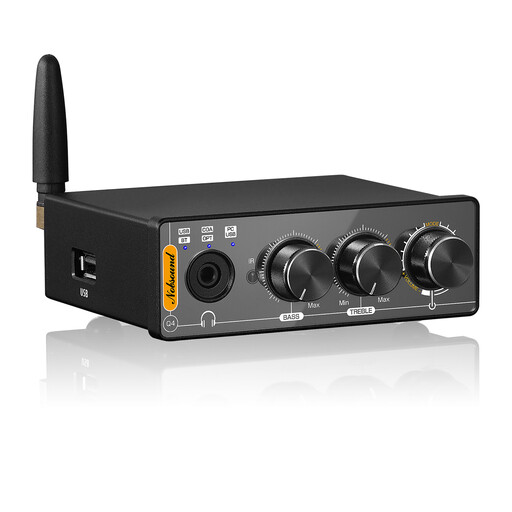
Nobsound Q4 USB Audio Gaming DAC
Could be worth considering if you’re looking for a USB DAC/headphone amplifier for PC audio with additional audio features.
The product name lists an optical input, Bluetooth, a remote control, and treble and depth controls. According to the product information, an external DC power adapter is required; use the appropriate power supply.
View at Joybuy
Frequently asked questions
Do I need a separate amplifier for every pair of wired headphones?
No, not necessarily. First check whether your laptop’s connection, volume and controls meet your needs. An additional device may be useful if you’re missing a suitable connection or a feature you need; a high sample rate alone doesn’t prove there’ll be an audible benefit.
How do I connect a USB DAC and keep my desk tidy?
Connect the USB audio input to a suitable port on your laptop and plug your headphones into the designated output. If needed, select the USB audio device as your playback source. Allow room for plugs and power: the FiiO K11 needs a separate 12-V/2-A power supply, while the iFi uno is powered via USB-C according to its manual.
How can I use a powerful amplifier without damaging my hearing?
After connecting the device or changing a gain setting, start with the volume turned down. The World Health Organization (WHO) gives 80 dB for up to 40 hours per week as an example of a safe listening level. Without measuring it, the position of the volume control doesn’t tell you the sound pressure level at your ear.
What are my rights if I buy a faulty product?
According to EU consumer information, when you buy goods from a trader in the EU, you have a legal guarantee of at least two years against the seller, starting from when you receive the goods. This is separate from any additional manufacturer’s warranty.
Can I put an old headphone amplifier in household rubbish?
No. The German Environment Agency notes that waste electrical and electronic equipment must not be put in household rubbish. Find out about local collection points and possible take-back options at retailers, which are subject to specific conditions.


