
Lieferung heute & morgen

Qualitätsgarantie

Willkommens-Angebote freischalten: KOSTENLOSE Lieferung | Bis zu 80 % RABATT | Kostenlose 30-Tage-JoyPlus-Testphase
App herunterladen
As a Joybuy Product Recommendation Officer, I analyse market information to provide you with objective and practical buying advice. The goal is to help you find the right mobile charging solution for your needs without falling for exaggerated marketing claims.
For professionals, students, or travellers, a dead laptop battery is more than just an annoyance—it can interrupt your workflow or sever crucial connections. A high-performance laptop power bank promises a solution, but the market is flooded with products whose advertised features often fail to deliver in practice. Before you make a purchasing decision, you should know the three most common pitfalls that lead to disappointment and bad investments.
To avoid a bad purchase, focus on three core technical parameters. These determine whether a power bank is suitable for your needs or not.
The most important metric for charging capacity is the watt-hour (Wh). It is calculated from the nominal capacity (mAh) and the battery voltage (V). This value is especially relevant for air travel, as most airlines limit batteries in carry-on luggage to 100 Wh. A 25000mAh power bank, typically rated at 90 Wh, fits perfectly within this limit, offering high capacity that is approved for travel. It can fully charge an average laptop (e.g., a MacBook Air with an approx. 50 Wh battery) about 1.5 times.
A laptop requires high charging power. Check if the USB C power bank supports the Power Delivery (PD 3.0 or 3.1) standard and delivers an output of at least 65W per port. For high-performance devices like a MacBook Pro, a 100W power bank is the recommended choice to achieve charging speeds comparable to the original power adapter. Lower power output will result in extremely long charging times or cause the battery to continue draining despite being connected to the power bank.
Pay attention to the number and type of ports. Multiple USB-C ports allow for simultaneous charging of several devices, like a laptop and a smartphone. A power bank with an integrated cable is a significant practical advantage. It ensures you always have a suitable, high-power certified cable on hand and reduces clutter in your bag. Retractable cables offer particular convenience here.
Here are some models that represent a considered choice for different user profiles based on their objective specifications.
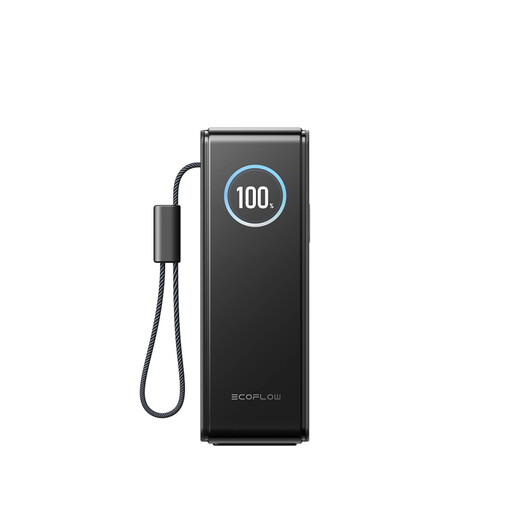
Why This Fits Their Persona: Ideal for users who need maximum performance and flexibility. With 170W total output and four charging options, it can simultaneously charge a laptop, a tablet, and other devices at high speed—perfect for on the go or at workstations without a power outlet.
This model clearly states the capacity as 90 Wh, specifies 100W PD power per USB-C port, and solves the cable problem with two integrated, high-performance USB-C cables.
High total output of 170W; 25,000 mAh (90 Wh) capacity for air travel; two integrated 100W USB-C cables.
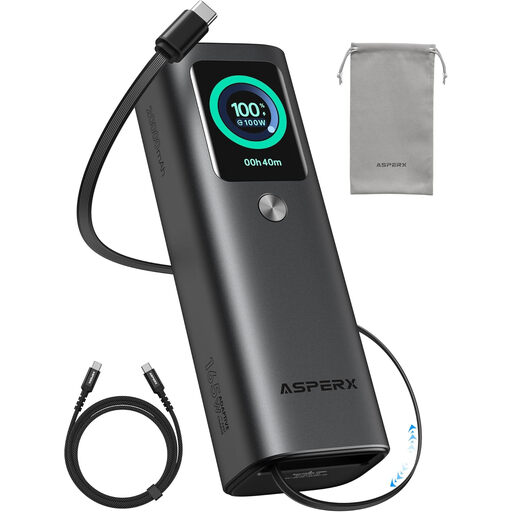
Why This Fits Their Persona: Perfect for business travellers looking for a reliable, flight-friendly solution with smart features. The 74 Wh capacity is hassle-free in carry-on luggage, and the power is sufficient to supply two laptops simultaneously (100W + 65W).
The TFT display provides transparent, real-time data on charging power and remaining runtime, making vague 'fast-charging' claims obsolete. The retractable cable ensures a tidy workspace.
Intelligent TFT display for performance monitoring; 165W total output; integrated, retractable 60 cm USB-C cable.
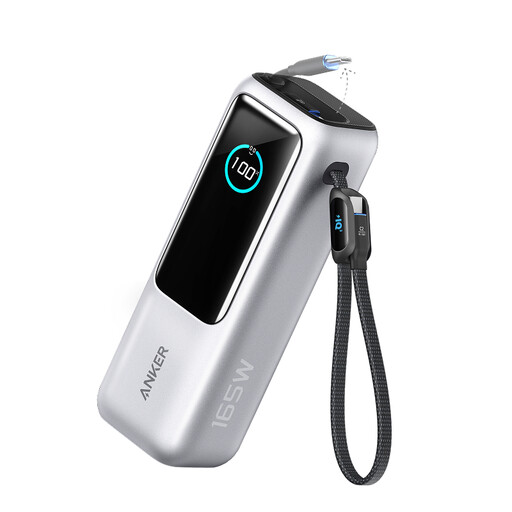
Why This Fits Their Persona: A solid all-around solution for long days at university. The high capacity can power a laptop through several lectures, while the high total output can also charge a tablet and smartphone simultaneously. Anker offers a proven balance of performance and reliability here.
The model delivers the specified high power across multiple ports and integrates two practical USB-C cables, which prevents buying incompatible cables or losing them.
High 25,000 mAh capacity; 165W total output for up to four devices; two integrated USB-C cables for on-the-go use.
We have compiled a complete, up-to-date list of products that fully meet these strict selection criteria and German safety regulations.
The number of charge cycles depends on your laptop's battery capacity, which is measured in watt-hours (Wh). A 25,000 mAh power bank typically has an energy capacity of about 90 Wh. A MacBook Air with an approx. 50 Wh battery can be charged about 1.5 times with it. A larger MacBook Pro 16" (approx. 100 Wh) can be charged to about 80–90% of its capacity. Keep in mind that energy losses always occur during the charging process.
No. A USB C power bank must support the Power Delivery (PD) charging standard and deliver a sufficiently high power output (in watts). Most laptops require at least 65 watts. Standard USB-C ports with 18W or 20W, designed for smartphones, cannot effectively charge a laptop. Always check the maximum output power of the USB-C port before purchasing.
Most airlines and aviation authorities (like the EASA) restrict lithium-ion batteries in carry-on luggage to a capacity of 100 watt-hours (Wh). Power banks with a capacity of up to 27,000 mAh (which corresponds to approx. 100 Wh) are generally permitted. Larger power banks (100–160 Wh) often require airline approval. Carrying them in checked luggage is strictly prohibited. It is recommended to check the current regulations with the respective airline before each trip.