
Lieferung heute & morgen

Qualitätsgarantie

Willkommens-Angebote freischalten: KOSTENLOSE Lieferung | Bis zu 80 % RABATT | Kostenlose 30-Tage-JoyPlus-Testphase
App herunterladen
A large 7-day pill organiser is designed to store medicines, vitamins, fish oil or food supplements neatly for an entire week. In practice, however, not every pill box is suitable for this purpose. Compartments that are too small, stiff closures or unclear day labels can quickly make storing medication impractical.
It is therefore worth taking a close look at compartment size, material, closure and suitability for travel before buying. The following tips will help adults, older people and carers choose a suitable weekly pill box.
Many pill boxes look spacious in product images but actually have narrow compartments. Large vitamins, fish oil capsules or several daily supplements may then only fit if pushed in. This can place additional strain on the lids and hinges and makes it harder to check the contents.
So look for specific information about compartment capacity and internal dimensions, where these are provided. A pill box with large compartments is particularly useful if you need to store several capsules per day.
A lid can close securely and still be difficult to open. For people with limited finger mobility or arthritis, a snap closure that is too tight may be impractical. Conversely, loose lids can open inside a bag.
Clearly labelled daily compartments with a closure that stays shut but can also be operated without applying much force are a sensible choice.
Stuck-on labels can come loose due to friction, moisture or frequent cleaning. Faded markings increase the risk of mix-ups. Durable or abrasion-resistant day markings are therefore more helpful for regular use than purely decorative prints.
A large 7-day pill organiser should have at least seven clearly separated daily compartments. For people who take medication at several times during the day, a medication box divided into four daily time slots may be more suitable. However, if you only take supplements in the morning and evening, you do not necessarily need a complicated layout.
Also check:
A weekly box for vitamins and food supplements should not be overfilled. Medicines and food supplements should also only be stored according to the relevant product information. Sensitive products may have specific requirements regarding temperature, light or moisture.
For plastic boxes, specifications such as BPA-free or food-safe are relevant. These claims should come from the product description or supplier and should not be inferred from the appearance of the material alone. The VVM model featured here is stated to be made from BPA-free plastic.
For daily care, a damp cloth is sufficient for many models. The compartments should be completely dry before filling. Harsh cleaning products can affect the plastic, labels or closures.
For a travel pill box, low weight, a closed casing and a shape that fits in hand luggage, a bag or a drawer are important. Descriptions such as “moisture-resistant” refer to the product description and do not automatically mean that the box is completely waterproof.
If you are looking for a pill box for older people, pay particular attention to easy-grip lids, clearly visible labels and low operating force. For prescription medicines, it is advisable to keep the original packaging, information leaflet and, where applicable, medication plan as well.
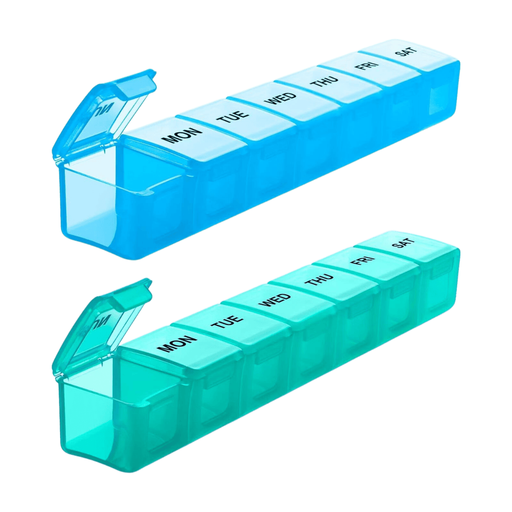
Why this product suits this profile: The two weekly organisers are suitable for simply dividing up supplies at home, on the go or between two people. Seven individual compartments organise your medication throughout the week.
According to the product description, each compartment holds up to 12 fish oil capsules or 13 large vitamins. The day labels are specified as wear-resistant.
BPA-free plastic, seven daily compartments and a stated travel size of approximately 9,1 × 1,3 × 1,1 inches.
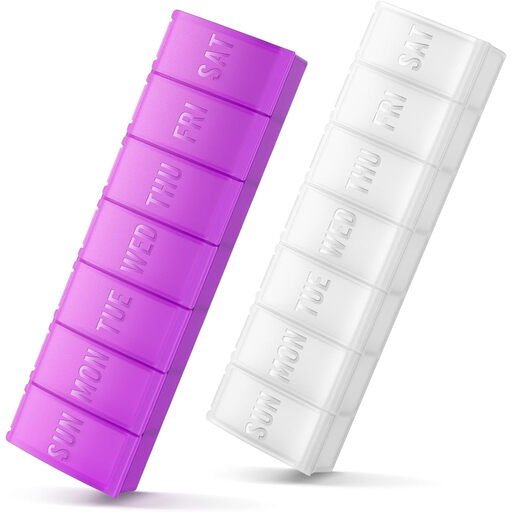
Why this product suits this profile: This model is aimed at users who want to combine large compartments, easy-open lids and clearly visible labels in a compact weekly box.
The product description specifies permanently engraved day markings and ergonomically designed lids. This should make the labels less prone to coming away.
BPA-free medical-grade plastic according to the product information, large compartments and a 2-pack in white and violet.
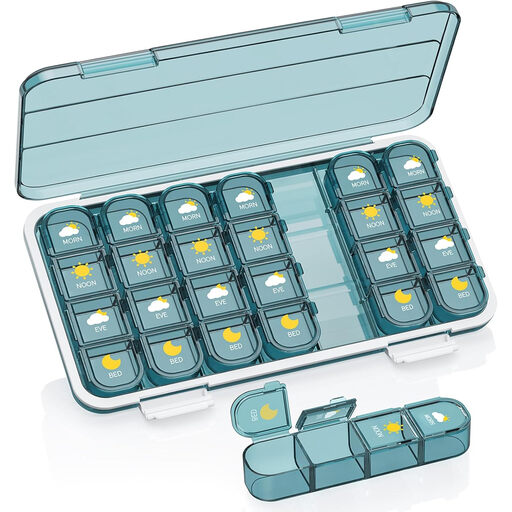
Why this product suits this profile: The separate layout for four medication times is useful for people taking several daily preparations or for carers providing support.
The four daily compartments reduce the need to mix different medication times in a single compartment.
Seven days with four time periods and separate compartments for vitamins, fish oil and food supplements according to the product name.
We have put together a complete, regularly updated list of products that fully meet these strict selection criteria and the safety regulations applicable in the EU.
Fill the box on a set day each week wherever possible and compare the contents with your medication plan. Medicines should not be removed from their original packaging if the information leaflet specifies different storage conditions. If you are unsure about organising or splitting tablets, ask a pharmacist or your treating practice.
The box should be kept dry and clean and out of children’s reach. A damaged hinge, a lid that no longer closes or illegible markings are all reasons to replace the organiser.
That depends on the number and size of the preparations. Large daily compartments are useful for several vitamins, fish oil capsules or large food supplements. The actual internal compartments are what matter, not just the external dimensions.
It is not possible to give a fixed lifespan that applies in every case. It depends on the material, hinges, number of opening cycles, cleaning and level of use. Check regularly that the lids, labels and closures are still working properly.
No. BPA-free plastic describes the stated material, but does not mean that every medicine may be stored outside its original packaging. Always follow the packaging information and any specific instructions relating to light, moisture and temperature.