
Lieferung heute & morgen

Qualitätsgarantie

Willkommens-Angebote freischalten: KOSTENLOSE Lieferung | Bis zu 80 % RABATT | Kostenlose 30-Tage-JoyPlus-Testphase
App herunterladen
For indoor cats, especially large breeds or multi-cat households, a large cat tree is far more than just a toy. It's a vertical playground, a safe retreat, and an essential tool for claw maintenance that saves your furniture. But the market is overwhelming, and not every model that looks impressive meets the standards for stability and durability. Many buyers discover only a few months later that their expensive purchase is wobbling, the fabric is tearing, or the sisal posts are already worn out.
As your Joybuy Product Recommendation Officer, I'm here to help you avoid the common pitfalls. We'll focus on the objective features that distinguish a good cat tree from an unsuitable one, so you can make an informed decision.
Before we turn to the solutions, it's important to understand the three most common problems that arise when choosing a large cat tree:
To avoid these problems, you should focus your attention on three core parameters. These define the quality and functionality of a model.
Stability is the most important criterion, especially for a tall cat tree. Look for the following features:
The quality of the materials determines how long you and your cat will enjoy the cat tree.
A cat tree for large cats or a cat tree for multiple cats must offer more than just height.
Based on the criteria above, we have identified some models that are suitable for specific needs and households.
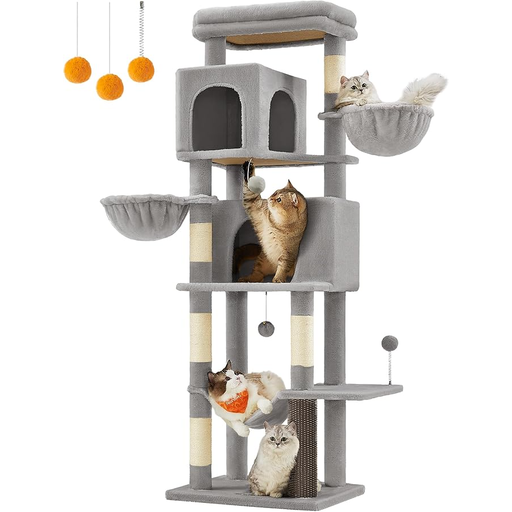
Why This Fits Their Persona: This model is equipped with two condos, two lounging cradles, a hammock, and a large viewing platform. The variety of resting and observation spots on different levels helps minimize conflicts in a multi-cat household, as each cat can claim its own area.
The problem of a poorly thought-out design is avoided here through a clear separation of active and passive zones. The distribution of perches across multiple levels ensures that cats don't get in each other's way.
Features an included anti-tip kit for increased safety. The particleboard construction and numerous sisal posts provide a solid base for both play and rest.
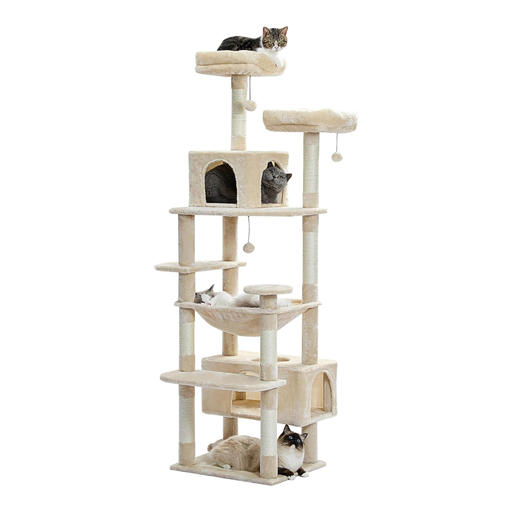
Why This Fits Their Persona: According to the manufacturer, this model has been specifically optimized for large cat breeds up to 10 kg. It features oversized perches and a robust construction with a reinforced particleboard and a wide base to withstand the weight and force of breeds like Ragdolls or Norwegian Forest Cats.
Directly addresses the problem of instability with a reinforced, wide base plate and a sturdy overall construction. The perches are explicitly designed for large cats and are not undersized.
The 8-level structure at a height of 184 cm offers an excellent vertical climbing landscape. The use of 100% natural sisal rope supports long-lasting claw care.
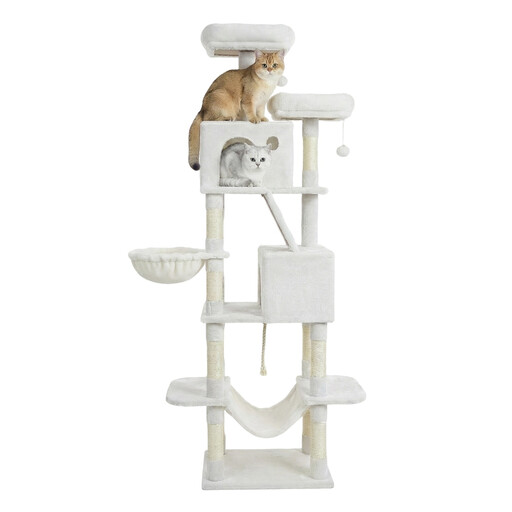
Why This Fits Their Persona: For cat owners who want to make the most of their home's vertical space, this **XXL cat tree** at 206 cm tall offers an impressive climbing landscape. It is ideal for very active cats that love to climb high and provides an excellent vantage point from the top platform.
At this height, stability is crucial. The model addresses this risk with a reinforced base and a mandatory anti-tip kit, which ensures secure anchoring to the wall.
With 13 sisal posts, two condos, a hammock, and a basket, it offers an enormous variety of activities. The total static load capacity of up to 75 kg (according to the manufacturer) also makes it suitable for multiple cats.
We have compiled a complete, up-to-date list of products that fully meet these strict selection criteria and rigorous safety standards.
First, place the new cat tree next to the old one, if applicable. Place treats or your cat's favorite toy on the different levels to encourage them to explore. You can also rub some catnip on the sisal posts to spark their interest in scratching. Give your cat time and don't force them.
The most important step is to use the included anti-tip kit to anchor the cat tree to a solid wall. Always place the cat tree on a level, solid surface. In the first few weeks after assembly, regularly check all screw connections and retighten them if necessary.
The lifespan of a sisal post depends on the thickness of the rope and the scratching activity of your cat(s). With a high-quality cat tree featuring thick sisal posts (over 6 mm), you can expect it to last for several years with average use. With heavy use by multiple cats, individual posts may need to be replaced sooner. Many manufacturers offer replacement posts.