
Lieferung heute & morgen

Qualitätsgarantie

Willkommens-Angebote freischalten: KOSTENLOSE Lieferung | Bis zu 80 % RABATT | Kostenlose 30-Tage-JoyPlus-Testphase
App herunterladen
A large cat tree is more than just a piece of furniture; it's a vertical playground, a secure haven, and an essential tool for your cat's claw care. But the market is flooded with models that look impressive at first glance but quickly prove to be unstable or impractical. As your Joybuy Product Recommendation Officer, I'll help you navigate the common pitfalls and make an informed decision that will bring long-term satisfaction to both you and your cat(s).
Many cat owners invest in an XXL cat tree hoping to give their furniture a break, only to find the new purchase sitting unused in a corner or already wobbling after just a few months. Watch out for these three widespread problems:
large cat tree must withstand the weight and energy of one or more cats. Many models skimp on the foundation—a base plate that is too small or light will inevitably cause the tower to sway dangerously with every jump.cat tree for large cats must also offer appropriately sized elements.To avoid a bad purchase, you should check three core parameters. These determine whether a large cat tree will be a durable investment or a short-term disappointment.
Stability is the most important criterion, especially for a cat tree for multiple cats or very active animals. Making a cat tree stable depends on several factors:
floor-to-ceiling cat tree or models over 150 cm tall, a wall anchor is essential. Reputable manufacturers include a suitable anti-tip kit. Check if it's included before you buy.The longevity of a cat climbing tree is determined by the quality of its components.
A cat tree with a cave and hammock offers variety, but the layout is crucial. The levels should be designed so that even older or less agile cats can reach them safely. For large breeds like Maine Coons or Norwegian Forest Cats, generous lounging beds and platforms (e.g., 50 x 40 cm or larger) are necessary for them to stretch out comfortably. In a multi-cat household, multiple dens and lookout platforms are important to avoid conflicts over the most popular spots.
Here are some models that are well-suited for the specific needs of cat owners in the UK, based on objective features.
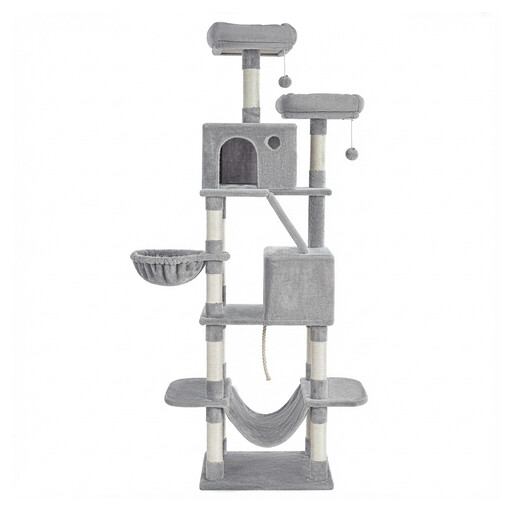
Why This Fits Their Persona: With its impressive height of 206 cm, two dens, two lookout platforms, a basket, and a hammock, this tower provides enough separate zones to minimise territorial disputes in a multi-cat household.
The reinforced base plate and included anti-tip kit directly address the problem of instability. The high static load capacity of 75 kg (according to the manufacturer) is designed for the rough-and-tumble play of multiple cats.
13 posts wrapped in natural sisal and an additional scratching ramp offer numerous opportunities for claw care, thus protecting your furniture. The enormous variety of lounging and play options keeps cats engaged.
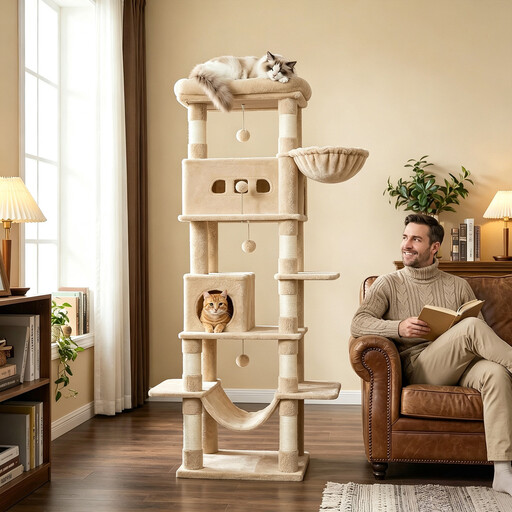
Why This Fits Their Persona: Large cats like Maine Coons need an above-average amount of space. This model offers a widened 60x40 cm viewing platform where even large animals can stretch out comfortably.
The problem of poor design is solved here by the generous lounging surfaces and the scientifically designed spacing between levels, which allow even large cats to ascend and descend easily.
The thickened boards and the widened, reinforced base provide the necessary stability, even when a heavy cat leaps onto the tower. The removable cushions make cleaning significantly easier.
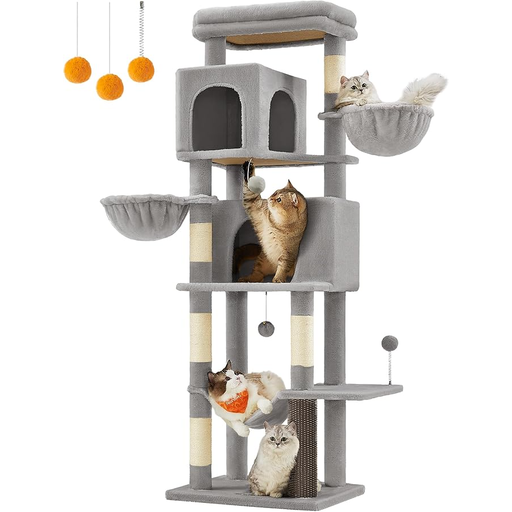
Why This Fits Their Persona: This model combines a considerable height with a relatively small footprint. The simple, dove-grey design blends discreetly into modern living spaces without appearing bulky.
Despite its slim design, stability is ensured by an included anti-tip kit. It offers a full suite of features (two dens, two baskets, a hammock), thus avoiding the compromise between aesthetics and functionality.
The vertical arrangement of the elements makes optimal use of the space. The integrated grooming brush at the base provides an additional incentive for cats to use the tree.
We have compiled a complete, up-to-date list of products that fully meet these strict selection criteria and UK safety regulations.
1. How do I properly secure a tall cat tree? Always place the cat tree on a level, solid surface. For all models over 150 cm in height, it is strongly recommended to use the included anti-tip kit. This usually consists of a strap that attaches to the cat tree and the wall to prevent it from tipping over under heavy use.
2. How do I get my cat used to the new climbing tree? Place the cat tree in an area where the family often gathers. Make it more appealing by placing treats or toys on the different levels. You can also rub some catnip on the sisal posts to specifically direct their scratching instinct there. Be patient; some cats need time to get used to new furniture.
3. How do I clean a large cat tree? The plush surfaces are best cleaned regularly of hair and dust with a vacuum cleaner using a brush attachment. Stains can be spot-treated with a damp cloth and a mild detergent. Models with removable cushions offer the advantage that they can be washed separately, which greatly simplifies deep cleaning.