
Lieferung heute & morgen

Qualitätsgarantie

Willkommens-Angebote freischalten: KOSTENLOSE Lieferung | Bis zu 80 % RABATT | Kostenlose 30-Tage-JoyPlus-Testphase
App herunterladen
Owners of large cat breeds like Maine Coons, or those in multi-cat households, know the problem: conventional cat trees are often too small, unstable, and not built to handle the demands of active or heavy pets. A wobbly tower or perches that are too cramped can quickly lead to your expensive new purchase being ignored.
This article serves as your guide. It highlights the key features to look for when choosing a large cat tree and presents a selection of models renowned for their stability and functionality. Our goal is to provide you with an informed basis for your decision, so you can find a durable and cat-friendly solution for your home.
Before making a decision, it's important to consider a few functional criteria. The right cat tree is more than just a piece of furniture; it's a central part of your cat's living space.
A stable cat tree is essential for safety, especially when large or multiple cats use it at the same time. Look for a wide and heavy base plate that serves as a solid foundation. A high overall weight prevents the tree from wobbling or tipping over during jumps or vigorous play. Many high-quality models also include an anti-tip kit, allowing you to anchor the cat tree to the wall for extra security. This feature is highly recommended for any cat tree for large cats.
The height and features must meet the needs of your cat(s). Choosing a tall cat tree is a smart move, as cats naturally seek out elevated vantage points. For a cat tree for multiple cats, various levels with ample perches, condos, and hammocks are important to prevent competition and give each cat its own retreat. A cat tree with a condo and hammock combines sheltered sleeping spots with relaxing lounging areas. The perches should be large enough for a fully grown Norwegian Forest Cat to stretch out comfortably.
The scratching posts are the most heavily used components. Their durability depends on two factors: the diameter of the posts and the quality of the sisal. Thicker posts offer more resistance and stability. The sisal rope should be wrapped tightly and seamlessly around the post to prevent premature fraying. Sturdy construction ensures your cats can enjoy sharpening their claws for a long time.
Based on the criteria mentioned, we have compiled a selection of models that are well-suited for demanding cat households due to their construction and features.
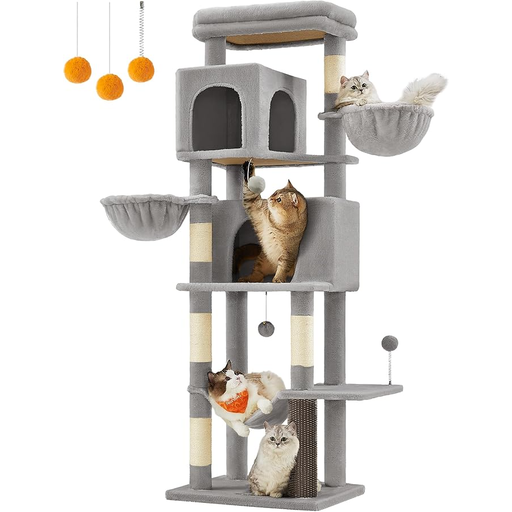
Why It Stands Out: This 175 cm tall model is designed as a versatile play and rest centre. It combines numerous features across multiple levels, including two enclosed condos, two open cradles, and a hammock. A special detail is the self-grooming brush attached to the base. Stability is enhanced by the included anti-tip kit for wall mounting.
Pros:
Who It's For: This model is an excellent choice for multi-cat households or for owners looking for a multifunctional climbing structure with various rest and play options that has a small footprint.
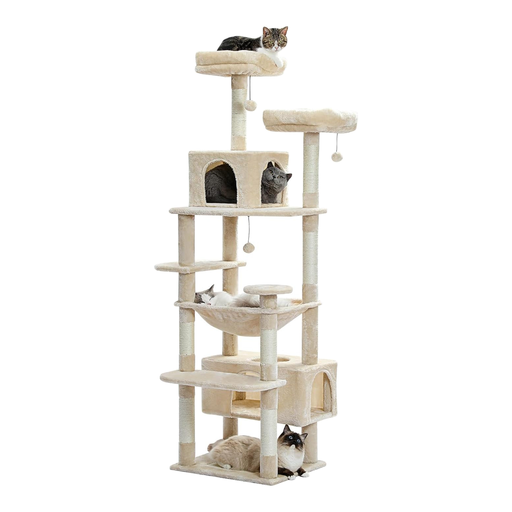
Why It Stands Out: At 184 cm tall with a structure spanning eight levels, this cat tree offers maximum vertical space. It was specifically designed for large cat breeds up to 10 kg, which is reflected in its oversized perches and reinforced particleboard construction. The wide base plate and seven sisal posts underscore its focus on stability.
Pros:
Who It's For: Ideal for owners of particularly large and heavy cat breeds who need an extremely sturdy and tall cat tree that can withstand intensive use.
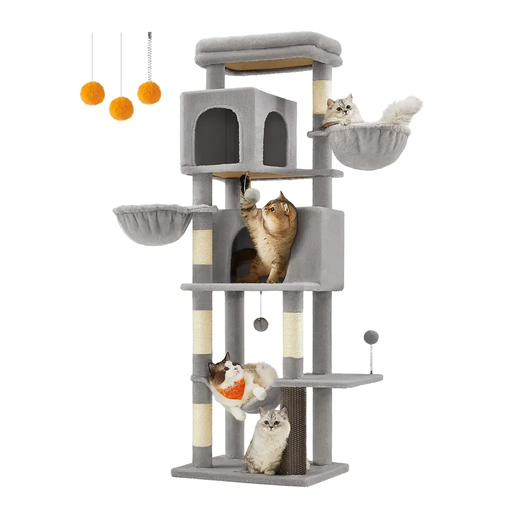
Why It Stands Out: As the tallest model in this selection, this XXL cat tree is an impressive structure at 190.7 cm. It offers a comprehensive set of features tailored specifically to the needs of multi-cat households. With two condos, two cradles, a hammock, and a large viewing platform at the top, it leaves nothing to be desired. The stable particleboard construction is also supplemented with an anti-tip kit.
Pros:
Who It's For: Perfect for multi-cat households or for owners who want to provide their pets with an especially large and varied landscape for climbing and playing.
If the models presented don't exactly match what you're looking for, or if you prefer a different colour, there are numerous other designs available. A well-equipped cat tree is an investment in your cat's well-being.
Explore our entire selection of Grey Cat Furniture to find the perfect model for your home and your cat.
A stable cat tree is distinguished by several features: a wide and heavy base plate that acts as a counterbalance to its height, posts with a large diameter, and a high overall weight. A crucial quality indicator is an included anti-tip kit for securing it to the wall, which provides extra safety for tall models.
For large and active cats, a minimum height of 150 cm is recommended to provide sufficient vertical climbing space. Models between 170 cm and 190 cm are often ideal, as they allow for multiple levels and high viewing platforms, which cats instinctively prefer.
Place the new cat tree in a central location where the family often gathers. Make it appealing by sprinkling catnip on the surfaces, placing treats on the different levels, or playing with a toy on it. Avoid forcing your cat onto it. Patience is key; most cats will explore new furniture at their own pace.