First, measure the humidity and find out where it’s coming from. A dehumidifier can help regulate humid indoor air, but it won’t replace regular ventilation or fix the cause of damp. For a large, heated living room, consider the room size, the test conditions behind the litres-per-day rating, operating noise and drainage together when choosing a compressor dehumidifier. A desiccant dehumidifier may be worth considering separately if the room is genuinely cold and the specific model is designed for those conditions.
Who might need a dehumidifier in a large living room?
Households with a persistently damp living room
If a large, heated living room keeps getting damp, choosing a suitably sized appliance and investigating the cause of the moisture are both important. The Verbraucherzentrale and the Federal Environment Agency offer guidance on ventilation and moisture in the home.
People who use the room while the appliance is running
If you want to run the appliance while reading, watching TV or spending time with others, check the noise rating and operating modes of the specific model. Meaco and Wood’s highlight noise levels or features for living spaces on certain models.
Households with regular spikes in humidity
If you have plants, dry laundry indoors or often have a full living room, ventilation, adjustable operation and condensate management are important factors to consider. The Verbraucherzentrale and Pro Breeze provide guidance and describe features on specific appliances.
What should you look for when buying?
Compressor dehumidifier
A good fit if: your large living room is heated and keeps getting damp despite adequate ventilation. Check that the stated room size is suitable for your space.
Things to weigh up: Emptying the tank or setting up suitable drainage, as well as noise and power consumption, should all factor into your choice.
Electric desiccant dehumidifier
A good fit if: the room is genuinely cold and the specific model is expressly designed for that temperature and room size.
Things to weigh up: Check the size and power consumption of the appliance you choose. This is not a blanket recommendation for normally heated living rooms.
Ventilate and identify the cause of damp
A good fit if: temporary sources of moisture or damp building materials may be contributing. Regular ventilation remains important even if you use a dehumidifier.
Things to weigh up: An appliance that regulates indoor air cannot fix leaks or building materials that are damp for other reasons.
| Buying priority |
What to check before buying |
Who may find this particularly important |
| Room size and moisture load |
Compare the floor area, ceiling height, humidity levels and stated room size. Consider litres-per-day figures in light of their test conditions. |
If my large living room keeps getting damp despite ventilation, I want to find a model whose specifications suit the room and its humidity conditions. For around 36% of consumers, choosing the right level of dehumidification for the room and moisture load is the top priority. |
| Noise in the living room |
Check the noise rating and operating mode of the specific model, and consider when you plan to run it. |
If I read, watch TV or have people over while it’s running, the noise rating for the appropriate operating mode matters to me. For around 29% of consumers, quiet operation in a living space they use is the priority. |
| Power consumption with regular use |
Consider the specific model’s power consumption, humidistat and expected running time. Costs will also depend on your electricity tariff. |
If the appliance is going to run regularly, I want to be able to assess its power consumption and running time for my everyday needs. For around 21% of consumers, ongoing electricity costs are the main buying priority. |
| Tank, drainage and maintenance |
Check that the tank is easy to access and that the appliance switches off when it’s full. If you plan to connect a hose, make sure the drainage point and where you intend to place the appliance are compatible. |
If I don’t want to empty the tank often, I look for suitable drainage and easy appliance maintenance. For around 14% of consumers, keeping effort to a minimum is the top priority. |
Avoid common buying mistakes
-
Assuming 25 l per day is guaranteed in your own living room
According to De’Longhi, the 25 l/24 h figure quoted for the De’Longhi Tasciugo AriaDry Multi DDSX225 is measured at 30 °C and 80% relative humidity. Conditions in your living room may differ, making it harder to achieve this rated figure.
Compare the test conditions with those in your room, and also take room size and humidity levels into account.
-
Tackling humid air without checking the cause
The Federal Environment Agency points out that when mould is present, the cause of the excess moisture must be identified and dealt with. A dehumidifier is no substitute for investigating the problem.
Measure the humidity, ventilate regularly and get the cause investigated if you notice anything unusual on the walls.
-
Assuming you can use continuous drainage anywhere
A hose connection is only useful if there’s a suitable drain within reach of the place where you plan to position the appliance. Wood’s lists a hose connection for the MRD20GW; the actual drainage route will depend on where you put it.
Before buying, check the location, drainage route and whether the specific model comes with the accessories you need.
Brands to consider
Meaco
The Arete One models are compressor dehumidifiers for larger areas, while the DD8L range offers a separate desiccant option.
- Meaco states that the Arete One 25L covers up to 125 m², with a capacity of 25 l/day and a noise level of 40/42 dB. These are manufacturer’s figures, not a guarantee for every living room.
- The Arete One 20L was reported to have limited availability for orders for a time. Check the current availability of the specific model.
Wood’s
According to Wood’s, the MRD20GW is designed for heated living rooms and bedrooms. It may be worth considering if you’re looking for app control and a hose connection.
- Wood’s lists a capacity of 20 l/day, a 3.8-l tank, a hose connection and Wi-Fi for the MRD20GW.
- A hose connection requires a suitable drain at the location you choose.
De’Longhi
The Tasciugo AriaDry Multi DDSX225 is a compressor dehumidifier with an adjustable humidistat and continuous drainage.
- For the DDSX225, De’Longhi lists 25 l/24 h at 30 °C and 80% relative humidity, 42–47 dB(A) and 490 W.
- These capacity and noise figures apply to this specific model. The dehumidification capacity is based on the test conditions stated.
Pro Breeze
The manufacturer’s help page describes compressor and desiccant dehumidifiers for different temperature ranges.
- For the PB-08, Pro Breeze describes an automatic shut-off when the tank is full, and standby mode when the target humidity is reached in normal mode.
- This information alone doesn’t show whether the appliance is suitable for a specific large living room. Check the specifications for the model you’re considering.
Dehumidifiers at Joybuy
The Joybuy products below are dehumidifiers for living spaces. Check that the stated room size and the test conditions behind the dehumidification capacity are suitable for your living room.
 No image available
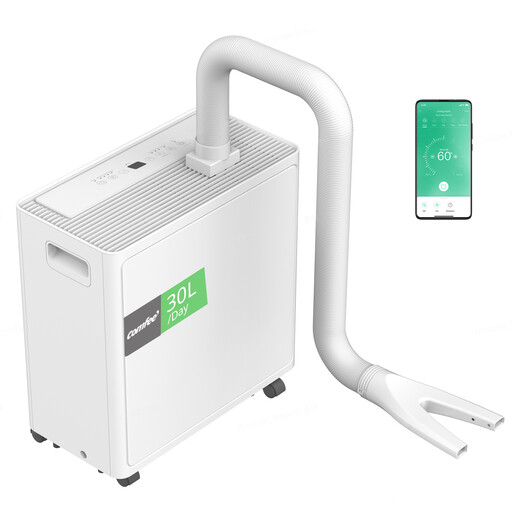
Comfee MDDA-30DEN7-SD
May be worth considering for a living room within the stated floor area. Check the room-size figure against your floor plan.
Specifications include coverage of up to 73 m², 30 l/24 h at 30 °C and 80% relative humidity, a 3.2-l tank, continuous drainage and 45.3–47 dB(A). For drainage, the hose must be connected correctly and positioned lower than the appliance.
View at Joybuy
 No image available
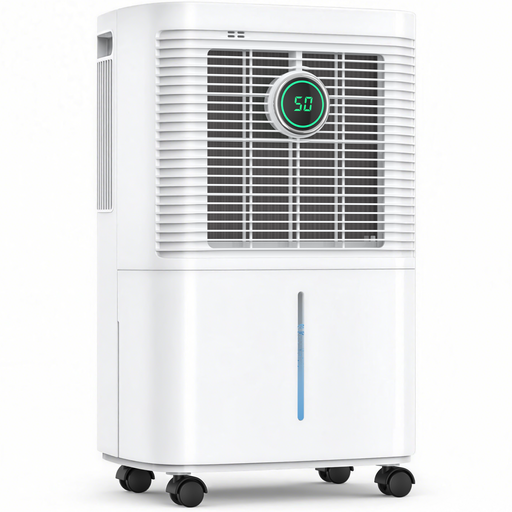
Ateroll dehumidifier with automatic humidity control
May appeal if you’re looking for automatic humidity control and a sleep mode.
Specifications include a capacity of up to 16 l/day at 35 °C and 90% relative humidity, and a sleep mode with a noise level of 36 dB.
View at Joybuy
 No image available
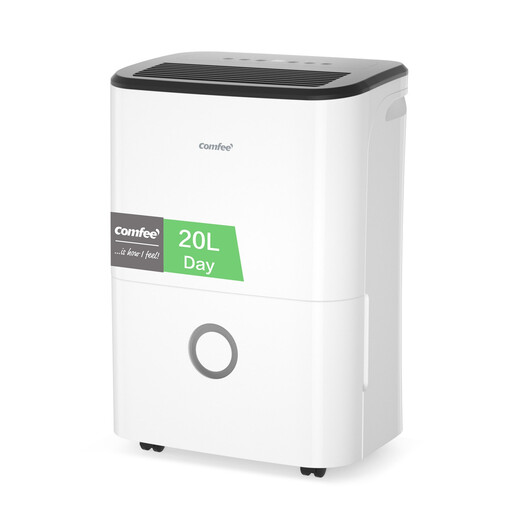
Comfee MDDF-20DEN7
May be suitable for a living room within the stated floor area. Check that the room-size figure matches your floor plan.
Specifications include coverage of up to 40 m², 20 l/24 h, a 3-l tank and a noise level of 46 dB. According to the product description, the hose for continuous drainage is not included.
View at Joybuy
 No image available
CONOPU CS10B
May be suitable for a room within the stated floor area. Consider the sleep mode if you plan to run the appliance while doing quiet activities.
Specifications include coverage of up to 60 m², a capacity of up to 16 l/day, a 2.5-l tank and a sleep mode with a noise level of 30 dB. The noise figure applies to sleep mode.
View at Joybuy
 No image available
TRULIVA AP10-2012EE
May be worth considering if you regularly have damp or dry laundry indoors. Check the stated room size against your living room.
Specifications include coverage of around 32 m², a capacity of up to 25 l/day at 95 °F and 90% relative humidity, a 2.8-l tank and a hose for continuous drainage.
View at Joybuy
Frequently asked questions
What humidity level should I aim for in my living room?
The Verbraucherzentrale suggests around 40–60% relative humidity as a guide to a comfortable indoor climate and recommends using a thermo-hygrometer. Take measurements over a period of time; conditions near cold walls can differ from those in the middle of the room.
Do I still need to ventilate if I use a dehumidifier?
Yes. The Federal Environment Agency recommends ventilating regularly in the living room to remove moisture. Ventilation can be particularly important if you have plants, damp laundry or several people in the room. A dehumidifier is no substitute for exchanging the air.
Can I take the stated litres-per-day capacity as the amount it will remove from my living room each day?
No, not without taking the test conditions into account. According to De’Longhi, the 25 l/24 h figure quoted for the De’Longhi Tasciugo AriaDry Multi DDSX225 applies at 30 °C and 80% relative humidity. Conditions in your room may be different.
What should I check about the tank and continuous drainage?
Check that you can easily remove the tank where you plan to position the appliance, and that there’s a suitable drain within reach for a hose. Wood’s lists a hose connection for the MRD20GW. For other models, check what’s included with the specific appliance.
Will a dehumidifier alone help with visible mould or damp walls?
No. According to the Federal Environment Agency, if there’s mould, you need to identify and tackle the cause of the moisture, as well as clean or remove affected materials. An appliance that regulates indoor air is no substitute for these steps.


