
Lieferung heute & morgen

Qualitätsgarantie

Willkommens-Angebote freischalten: KOSTENLOSE Lieferung | Bis zu 80 % RABATT | Kostenlose 30-Tage-JoyPlus-Testphase
App herunterladen
As the owner of a large cat or multiple feline friends, you know that a standard cat tree often isn't enough. However, the search for a model that is genuinely large and sturdy can quickly become overwhelming. Many products promise more than they can deliver, turning out to be wobbly structures that pose a safety hazard to your pets.
This guide will help you navigate the common pitfalls of buying a cat tree. We'll focus on the crucial features that define a durable and safe climbing tree for your cat, so you can make an informed decision and invest your money wisely.
Many cat owners invest in a large model, only to find that it can't withstand the strain after just a few months. Watch out for these three common flaws to avoid disappointment:
To avoid the problems mentioned above, you should carefully check three technical parameters before buying. These define whether a cat tree for large cats or a multi-cat household is truly suitable.
A sturdy cat tree starts from the ground up. The most important feature is a heavy, wide, and ideally double-layered base plate. It lowers the entire structure's centre of gravity and ensures solid stability, even when things get lively.
Also, pay attention to the diameter of the posts. For large or very active cats, posts with a diameter of at least 9 cm are recommended. For added safety, especially with a floor-to-ceiling cat tree, an included anti-tip kit for wall mounting is a great feature.
The quality of the materials determines the lifespan of your cat tree.
An XXL cat tree must meet the needs of its users.
Based on the criteria above, we have identified a few models that are well-suited for specific requirement profiles.
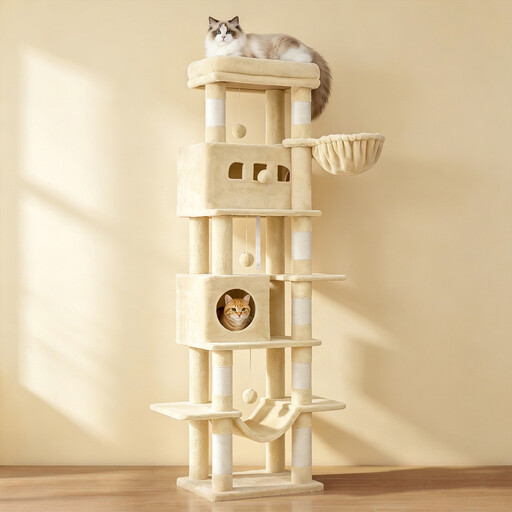
Why This Fits Their Persona: With a height of 212.5 cm and six levels, this climbing tree offers enough vertical space to minimise conflicts in a multi-cat household. Each cat can find its own lookout or resting spot.
The double-layered, integrated base plate and the built-in anti-tip kit directly counteract the problem of instability. Eight dense sisal posts ensure long-lasting scratching fun and prevent rapid wear and tear.
Two separate cat condos, a basket, and a hammock offer a variety of retreats. According to the manufacturer, the structure is designed for up to 6 cats (each under 6.8 kg).
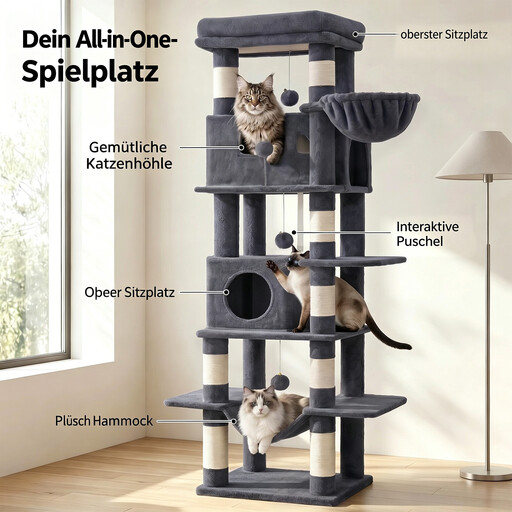
Why This Fits Their Persona: With a height of 170 cm and extra-spacious rest areas, like the 50x40 cm cat condo, this model is specifically designed for the needs of large cat breeds that require more room to stretch out and relax.
The widened, double-reinforced base plus an anti-tip kit prevents wobbling, even when a heavy cat jumps to the top level. The generous dimensions of the condos and platforms solve the problem of impractical designs for large pets.
The combination of stability and extra-large rest areas is ideal for large breeds. Removable and washable cushions make cleaning significantly easier.
We have compiled a complete, up-to-date list of products that fully meet these strict selection criteria and safety requirements.
The lifespan of a cat tree depends heavily on the material quality and the intensity of use. A high-quality, stable model with thick, firmly glued sisal posts can last for several years. Models with replaceable elements like scratching posts or toys can further extend its lifespan. A replacement is necessary when the stability deteriorates or the scratching surfaces are completely worn out.
Place the new cat tree in an attractive spot, for example, near a window or in a place where the family often gathers. To spark curiosity, you can rub catnip on the different levels, place favourite toys on it, or hide treats on the platforms. Praise your cat when it explores the tree.
Not necessarily. A floor-to-ceiling cat tree gets its stability from the tension between the floor and the ceiling. If this is not done correctly, it can wobble. A freestanding model can be just as secure, provided it has a heavy, wide base plate and ideally an additional wall mount. Ultimately, stability depends on the overall construction, not just the height.