Which preparation method suits you?

Latte with as few preparation steps as possible

If you want to add your beans, water and chilled milk, then do as little measuring or frothing as possible yourself, check the milk-drink function on the specific bean-to-cup machine. Philips lists this feature for the EP3347/90 with LatteGo; the milk system must be cleaned after every use.

Control the espresso and milk froth yourself

If you want to make espresso with a portafilter machine and control the texture of the milk, a model with an assisted steam wand could suit your routine. Sage lists three settings each for milk temperature and texture on the Bambino Plus; making the espresso remains a manual process.

The occasional single serving

If you only make latte occasionally, a capsule machine with a separate milk frother may be enough. Krups describes the Essenza Mini with Aeroccino 3 as this kind of combination; you prepare the espresso and milk using two separate appliances.

What should you consider when choosing?

Bean-to-cup machine with a milk system

A good fit if: you make latte often and want to do as little frothing yourself as possible once the ingredients are ready.

The trade-off: Automatic preparation doesn’t mean there’s no maintenance. Philips recommends rinsing LatteGo after every use.

Portafilter machine with a steam wand

A good fit if: you want to control the espresso and milk texture yourself, and don’t mind a few extra steps.

The trade-off: The steam wand on the Sage Bambino Plus helps with the milk, but you still make the espresso using the portafilter.

Capsule machine with a milk frother

A good fit if: you make individual servings and want to prepare the espresso and milk separately.

The trade-off: The milk is prepared separately. A 2025 consumer advice centre market comparison ranks capsule coffee as a more expensive coffee option than ground coffee.

What matters to you What to check before buying Who is this especially relevant to?
Fewer steps Whether the specific model makes milk drinks; the steps involved from filling it to dispensing the drink. If I don’t want to froth the milk myself after getting the ingredients ready, the right drink function matters. This is the main priority for around 33 % of consumers who want to keep preparation steps to a minimum.
Milk-system care Whether milk-contact parts can be removed, and what cleaning is required after each use. If I prepare milk, I also want to know how to store it and how to clean the system afterwards. Milk-system care is the main priority for around 27 % of consumers.
Control over the espresso and froth Whether the espresso and milk are prepared manually, with assistance or automatically, and what settings the specific model offers. If I want to control the coffee grounds, espresso preparation and froth texture myself, I’m more willing to put in some extra work. Around 20 % of consumers make this kind of control their priority.
Consumables and extra appliances What type of coffee and accessories the chosen preparation method requires. If I’m planning for the coffee and any extra appliances as well as the machine, the whole process matters. Around 20 % of consumers pay particular attention to these requirements.

Which assumptions should I avoid?

  • Having the ingredients ready doesn’t mean the latte needs no attention afterwards

    Even an automatic milk system may need cleaning after dispensing a drink. For LatteGo on the EP3347/90, Philips recommends rinsing the parts after every use or putting them in the dishwasher in line with the manufacturer’s instructions.

    Before deciding, check the process for the specific model, from pouring in the chilled milk to cleaning the machine.

  • A capsule machine with a frother isn’t an all-in-one milk preparation system

    In the Essenza Mini combination described by Krups, the Aeroccino prepares the milk separately from the espresso. That means an extra preparation step and another appliance.

    Check whether preparing the two separately suits how often you plan to make latte.

  • Similar model names don’t guarantee a suitable power supply

    A Joybuy listing for the Philips EP5547/90 specified 120 V. The VDE says that 230 V at 50 Hz is standard in German households; these details alone don’t confirm that a specific appliance is suitable.

    Check the full model variant, rated voltage, mains frequency and plug on the specific appliance before connecting it.

Which brands are worth considering?

Philips

The EP3347/90 bean-to-cup machine is listed with the two-part LatteGo milk system.

  • Philips says you can adjust the coffee strength and milk froth.
  • Philips recommends rinsing LatteGo after every use or putting the parts in the dishwasher in line with the manufacturer’s instructions.

De’Longhi

According to the manufacturer’s range overview, the Magnifica series includes variants with LatteCrema and models with a manual frother.

  • De’Longhi lists Caffè Latte among the drinks available on the Magnifica Duo ECAM330.80.TXB.
  • The name Magnifica alone doesn’t tell you what kind of milk preparation a model offers.

Sage

The Bambino Plus SES500BSS4EEU1 combines portafilter espresso with an adjustable automatic steam wand.

  • Sage lists three settings each for milk temperature and texture.
  • Making espresso with the portafilter remains part of the manual process.

Krups

The Essenza Mini with Aeroccino 3 is a capsule machine with a separate milk frother.

  • Krups lists programmable espresso and lungo buttons.
  • For latte, the espresso and milk are prepared using separate appliances.

Nivona

According to its specification sheet, the NIVO 8117 is a bean-to-cup machine with OneTouch-SPUMATORE DUOplus and a compartment for one portion of pre-ground coffee.

  • The specification sheet lists a removable brewing unit and automatic care programmes.
  • These listed features don’t tell you how much cleaning the machine actually needs, and they don’t necessarily apply to other NIVO models.

Joybuy products for making latte

The products below include bean-to-cup machines with milk systems, as well as a 3-in-1 machine with integrated coffee and milk preparation.
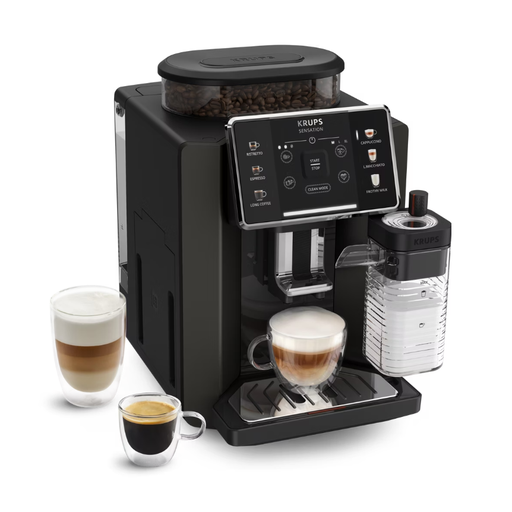
Krups Sensation Milk EA9129 bean-to-cup coffee machine, black

Krups Sensation Milk EA9129, black

For making latte with ingredients ready to go, if you want to select a milk drink on your bean-to-cup machine.

The description lists six coffee and milk specialities at the touch of a button, as well as a removable, dishwasher-safe milk container.

Automatic cleaning programmes and adjustable drink volume and froth are also listed.

View at Joybuy

De’Longhi Magnifica Evo ECAM290.61.SB bean-to-cup coffee machine, silver

De’Longhi Magnifica Evo ECAM290.61.SB, silver

For automatically preparing milk drinks with the LatteCrema and MyLatte functions listed in the description.

The product description lists seven drink options and 13 grind settings.

A removable milk container and automatic cleaning of the milk system are also listed.

View at Joybuy
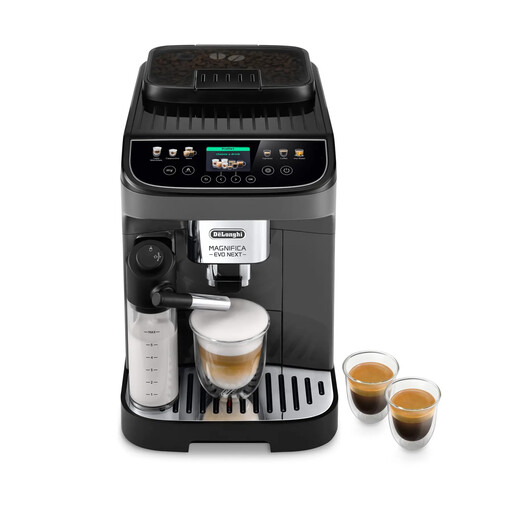
De’Longhi Evo Next ECAM310.60.GB bean-to-cup coffee machine, grey and black

De’Longhi Evo Next ECAM310.60.GB, grey and black

For making consistent milk drinks once your ingredients are ready, with saved recipes and adjustable drink settings.

The description lists ten recipes, three temperature settings and a removable milk container.

Automatic cleaning of the milk container and adjustable aroma and drink-size settings are also listed.

View at Joybuy
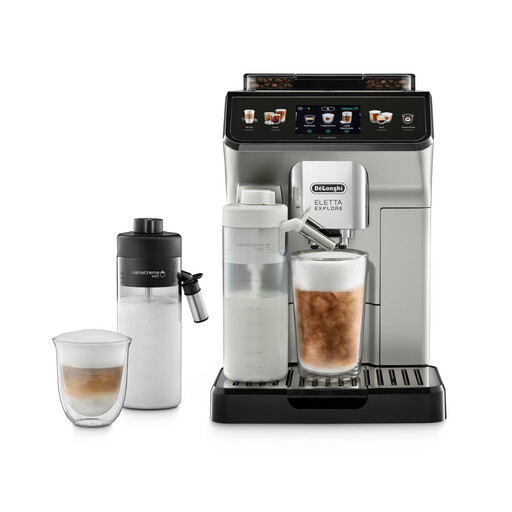
De’Longhi Eletta Explore ECAM450.55.S bean-to-cup coffee machine, silver

De’Longhi Eletta Explore ECAM450.55.S, silver

For choosing hot or cold milk drinks with the LatteCrema Hot & Cool function described.

The product description lists 40 recipes and two milk carafes.

The description says the parts are dishwasher-safe; automatic cleaning, rinsing and descaling programmes are also listed.

View at Joybuy

Ninja Luxe Premier 3-in-1 ES601EU coffee machine with grinder and milk frother

Ninja Luxe Premier 3-in-1 ES601EU

For making espresso and milk froth using integrated appliances, if you’re happy to operate the coffee and milk functions separately.

The description lists an integrated grinder with 25 settings and integrated scales.

Four froth presets are listed. To prepare the milk, pour it into the frothing jug and select a preset.

View at Joybuy

Frequently asked questions

Can I have the milk ready before making my latte?

Yes, as long as you store it correctly: the German Federal Centre for Nutrition recommends keeping fresh milk chilled; opened UHT milk should also be kept in the fridge. Don’t leave milk unrefrigerated just because the machine has a container.

Does an automatically made latte mean I don’t need to clean the milk system?

No. For LatteGo, Philips recommends rinsing the parts under running water after every use or cleaning the two parts in the dishwasher. For other milk systems, follow the manufacturer’s instructions.

What should I allow for when buying coffee and extra accessories?

Check whether your chosen preparation method requires capsules, beans or ground coffee, as well as a separate grinder or milk frother. A 2025 consumer advice centre market comparison looked at coffee products and found ground coffee to be cheaper than capsules; it doesn’t give an overall cost for making a latte.

Who should I contact if a fault develops after buying in Germany?

For a consumer purchase, the seller is generally responsible for the statutory guarantee, not automatically the manufacturer. The consumer advice centre says this generally lasts for two years from delivery; a voluntary warranty is separate.

What should I check when buying an electrical appliance for the German market?

Before use, check the rated voltage, mains frequency and plug on the specific appliance against your power supply. According to the VDE, 230 V and 50 Hz are standard in German households. Electrical equipment covered by the EU Low Voltage Directive must meet its safety and conformity requirements; the CE marking is a manufacturer’s declaration, not an independent EU test mark.