What should you look for when buying?
For a book discussion with a fan running, the key considerations are how close the microphones are to the speakers, how many people you need to record and whether the connection is compatible.
Wired lavalier for a fixed position
Best for: one person who will mostly be speaking from the same spot, with a compatible microphone input available.
The trade-off: The signal travels through a cable, which limits movement. You’ll need to plan for additional microphones or inputs if you want to record two speakers.
Wireless set with two transmitters
Best for: two people who need separate microphones or want to move around during the conversation.
The trade-off: Both transmitters and the receiver need to be ready to use. A noise-cancelling feature doesn’t guarantee that fan noise will disappear.
Lavalier with a body-worn recorder
Best for: when recording directly to a device worn by the speaker matters more than sending audio wirelessly to a central recording device.
The trade-off: The Zoom F2 records locally in 32-bit float; if you’re recording several people, you’ll need to combine the files afterwards. This type of recording doesn’t remove background noise.
| What you need |
What to check before buying |
Who it matters most to |
| Speech intelligibility |
Attach the microphone close to the speaker; consider the airflow and distance from the fan. |
When the fan is running, I want to capture voices close to the microphone and keep airflow away from the capsule. Speech intelligibility is a priority for around 36% of consumers. |
| Multiple speakers |
Count the microphones or transmitters included and check how both audio signals are recorded. |
For a two-person discussion, I want to make sure each voice is captured with its own microphone. Recording multiple speakers in full is the main concern for around 29% of consumers. |
| Device connection |
Match TRS, TRRS or USB-C to the recording device’s input; check the entire signal path if needed. |
I want to keep using the recording device I already have and find out in advance which connection I need. Connection compatibility is a key consideration for around 21% of consumers. |
| Recording setup |
Choose between a cable, wireless connection or body-worn recorder. With a wireless system, plan for the transmitters and receiver; with local recording, plan to transfer the files afterwards. |
If we want to move around during the discussion or record separately, I want to decide on the right recording setup in advance. Freedom to move or a local recording setup is the main concern for around 14% of consumers. |
Wireless sets for two speakers
The wireless lavalier systems below are designed to record two people talking. Connection options and specific features vary by model.
 No image available
DJI Mic Mini 2S (2 TX + 1 RX + Charging Case)
With two transmitters, so each of two speakers can have their own microphone.
The product name lists two transmitters, one receiver and a charging case.
View at Joybuy
 No image available
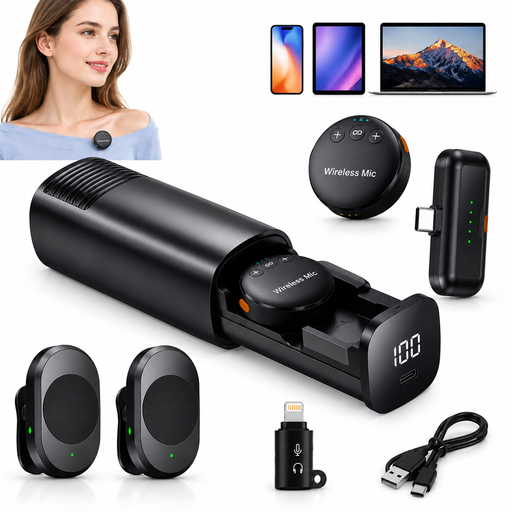
Wireless Lavalier Set with 2 Transmitters
The two transmitters are designed to give each speaker their own microphone.
The title lists USB-C and Lightning as connection options; check which one matches your recording device.
View at Joybuy
 No image available
Moman M1CXT Wireless Lavalier Microphone (USB-C, 2TX+1RX)
The two transmitters are suitable for giving each of two speakers their own microphone.
The product name lists USB-C and 2 TX + 1 RX; check that the connection matches your recording device.
View at Joybuy
 No image available
SYNCO P2ST Wireless Lavalier Microphone (USB-C, Dual Mic)
The set includes two microphones and is designed to record two speakers.
Features listed include USB-C, 2.4 GHz and a charging case. Check that the connection is compatible with your recording device before buying.
View at Joybuy
 No image available
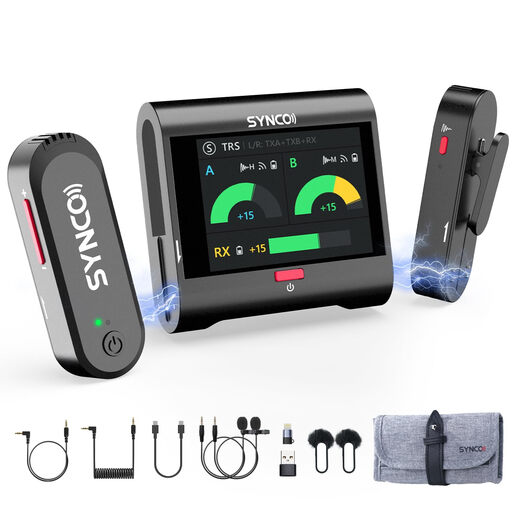
SYNCO G3PRO Wireless Lavalier Microphone System (Dual Lapel Mics)
The two lavalier microphones are designed to mic up both speakers.
The product name lists a wireless 2.4 GHz system with two lavalier microphones.
View at Joybuy
Frequently asked questions
Will noise cancellation remove the fan from my recording?
You shouldn’t rely on it to. If possible, turn the fan down or move it further away, keep the airflow off the microphone capsule and listen to a test recording with both speakers.
How should I attach a lavalier microphone for a longer discussion?
Attach the microphone so your clothing doesn’t rub against the capsule, and listen to a test recording before you start. Shure’s guide recommends positioning the MVL 15–25 cm from your mouth and using a foam windscreen. This recommendation applies to this model, not every lavalier microphone.
Is one clip-on microphone enough for two speakers?
A single microphone worn by one person won’t pick up the second voice in the same way. Check whether your chosen set includes two microphones or transmitters, and whether your recording device can handle both signals.
How can I check whether a lavalier microphone is compatible with my device?
Compare the microphone connection with your recording device’s input, and check any adapters and the recording function if needed. TRS, TRRS and USB-C are different connection types, so don’t choose based on plug size alone.
Can I record a private book discussion without the other people knowing?
Section 201 of the German Criminal Code (StGB) makes it a criminal offence to record another person’s non-public spoken words without authorisation. Get everyone’s consent before recording. Whether a particular event is non-public and what rules apply if you share the recording depend on the circumstances.


