Who these recording options suit

Speakers with a dedicated recording spot

If you’re reading your script into a smartphone, computer or recorder, first check the connection and whether the device can power the microphone correctly. That way, you can focus on making your voice clear and easy to understand.

Speakers without a desk-based device

A body-worn recorder lets you record locally without a recording app running. Remember to plan for batteries, a memory card and transferring the file afterwards.

Speakers who need to move around

If you walk around while recording or move away from your recording device, freedom of movement can be a good reason to buy. Check that the receiver and set variant are compatible with your recording device.

What to consider when choosing

Wired directly to your recording device

A good fit if: you usually speak from the same spot and your device supports the microphone connection and the power supply it needs.

The trade-off: you don’t need a wireless link, but you do need to check the connection, wiring and cable routing.

Lavalier mic with a recorder

A good fit if: you want to speak without a recording app running or record independently of a desk-based device.

The trade-off: batteries, a memory card and transferring the file are all part of the recording process. A recorder won’t prevent clothing noise or room echo.

Wireless set with a receiver

A good fit if: you want to move around while recording and the receiver variant is compatible with your recording device.

The trade-off: the transmitter, receiver and wireless connection all need to work properly. You should also check the specific conditions for wireless use in Germany.

What matters What to check before buying Who this matters most to
Clear speech Position the microphone close to your voice and make sure your clothes don’t rub against the capsule or cable. A test recording in the booth will show whether the attachment works for the way you speak. If clear speech matters more to me than extra features, I want to listen back to a recording wearing my usual clothes and speaking in my usual way. Around 33% of consumers put speech clarity first.
The right device connection Check the microphone input, wiring, required power supply and any adapters on the actual device. Also check that it works with the recording app you use. If I want to keep using my existing smartphone, computer or recorder, every part of the signal chain needs to be compatible. Around 27% of consumers say device compatibility is their top priority.
A secure fit without rustling Check the clip and cable routing with the clothes you’ll actually wear while recording. Make sure the fabric doesn’t touch the capsule. If my clothes move as I speak, I want to attach the microphone so that the fabric doesn’t rub against it. Around 20% of consumers put a secure, noise-free fit first.
Recording without an app running With a recorder, starting the recording, using batteries and a memory card, and transferring the file afterwards are all part of the process. Check that the storage medium is ready before you start recording. If I don’t want to use a smartphone or computer during a take, recording independently is essential for me. Around 13% of consumers prioritise this kind of recording process.
Freedom of movement Compare a wireless set with a receiver against a local recording on a recorder. With a wireless set, the variant and receiver need to be compatible with your recording device. If I want to stand up while recording or move away from my desk-based device, I don’t want a cable to restrict me. Around 7% of consumers put freedom of movement first.

Common buying mistakes

  • Only checking the jack plug diameter

    A plug of the right size doesn’t prove that the microphone, input and power supply are compatible. The Shure MVL and RØDE Lavalier GO are described for different connection types. The Lavalier GO requires a suitable TRS input with plug-in power.

    Before buying, check the microphone input on the specific device, the wiring, the power supply and any adapters you need.

    Depending on your device, you may need a suitable adapter or a different recording device.

  • Assuming wireless or 32-bit float will fix every poor-sounding booth recording

    These features change how audio is transmitted or recorded; they don’t change the contact between the fabric and microphone capsule. Clothing noise may still be audible, even if you use a different recording system.

    Make a test recording at the actual recording location, wearing the clothes you plan to use and moving as you normally would. Only then decide whether you need a different way to record.

    Extra equipment can’t rule out retakes if the microphone is still rubbing against your clothes.

  • Choosing a wireless set by model name alone

    The Hollyland LARK M2 is available in different mobile and camera versions. Choosing the wrong receiver variant could prevent you from connecting it to your recording device as planned.

    Check the full set name and make sure the receiver included is compatible with your smartphone or camera.

Key brands at a glance

Shure

The MVL is a wired option for voice recording on compatible mobile devices.

  • According to Shure, the MVL comes with a clip and windscreen.
  • For mobile devices without a suitable 3.5 mm socket, check that there’s a compatible CTIA-compliant connection. This connection information won’t necessarily apply to every smartphone.

RØDE

The Lavalier GO is designed for devices with a suitable TRS microphone input; the smartLav+ is a separate range for TRRS smartphone connections.

  • According to RØDE, the Lavalier GO comes with a clip and pop filter.
  • The Lavalier GO needs plug-in power from a suitable TRS input. The plugs used by the two ranges aren’t directly interchangeable.

Deity

The V.Lav is a wired option if you switch between devices with a 3.5 mm microphone input.

  • Deity specifies a self-configuring plug and a 5 m cable.
  • The manufacturer’s information about compatible inputs doesn’t guarantee compatibility with every device. You’ll also need batteries to use it.

Zoom

The F2 combines an included lavalier microphone with a body-worn recorder for local voice recording.

  • Zoom specifies a locking microphone connection, local recording and 32-bit float technology.
  • Compared with recording directly on your existing device, you’ll also need batteries and a memory card, and you’ll have to transfer the file afterwards.

Hollyland

The LARK M2 is a wireless option if you need freedom of movement. Choose the USB-C, Lightning or camera version to suit your recording device.

  • The different receiver variants let you choose one to suit the device you plan to use.
  • The manufacturer’s claims about battery life, range and noise cancellation don’t prove how well it will sound in a small booth. Also check the current conditions for wireless use in Germany.

Joybuy products for recording a script

This selection includes wired lavalier microphones for recording on an existing device, as well as wireless sets for compatible devices and greater freedom of movement.

SYNCO S8 lavalier microphone for smartphone and PC

SYNCO S8 lavalier microphone

For wired script recording on an existing device. Check beforehand that the connection and signal chain are compatible.

The product name describes it as a microphone for smartphones, PCs, laptops and cameras.

View at Joybuy
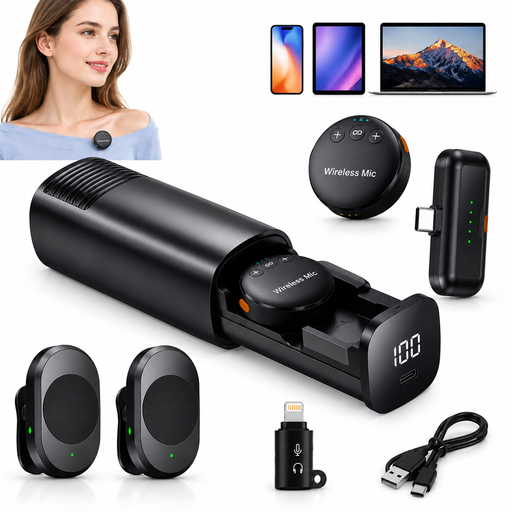
Wireless lavalier microphone set with two transmitters, 2.4 GHz, USB-C and Lightning

Wireless lavalier microphone set with two transmitters

For recording speech with greater freedom of movement, provided the receiver and recording device are compatible.

The product name specifies two transmitters, 2.4 GHz, and USB-C and Lightning connections.

View at Joybuy

Moman M1CXT wireless lavalier microphone with USB-C and 2TX+1RX

Moman M1CXT, USB-C, 2TX+1RX

For wireless recording with a USB-C device. Check the connection on the receiver you plan to use.

The product name specifies USB-C and the 2TX+1RX configuration.

View at Joybuy
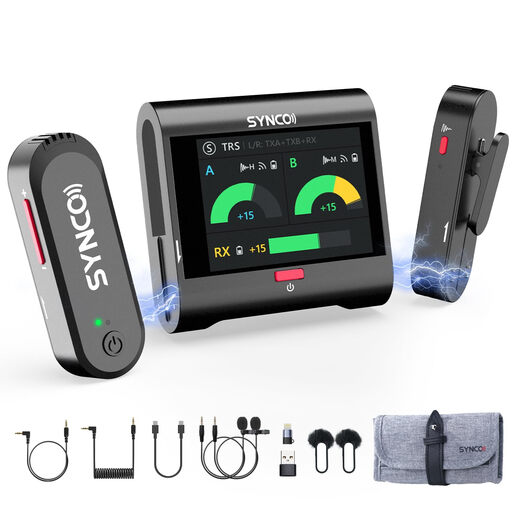
SYNCO G3PRO wireless lavalier microphone system with two microphones, 2.4 GHz

SYNCO G3PRO, 2.4 GHz, two lavalier microphones

For wireless voice recording, provided the system’s connections are compatible with your recording device.

The product name specifies two wireless lavalier microphones and 2.4 GHz.

View at Joybuy

SYNCO P1XT wireless USB-C microphone

SYNCO P1XT, USB-C

For wireless recording with a compatible USB-C device. According to the product information, Android devices need to support OTG.

The product name describes it as a USB-C wireless microphone.

View at Joybuy

Frequently asked questions

How do I attach a lavalier microphone for recording a script?

Attach it securely close to your voice, keeping fabric away from the capsule and cable. RØDE’s general guide suggests starting at around 20–30 cm from your mouth, but this isn’t a rule for every model. Listen back to a test recording wearing your usual clothes and speaking and moving as you normally would.

Will a 3.5 mm clip-on microphone automatically work with my smartphone?

No. Plug size alone isn’t enough to check compatibility. The Shure MVL is described for compatible mobile connections or a suitable CTIA adapter; the RØDE Lavalier GO needs a compatible TRS microphone input that supplies power. Check your device, adapter and recording app as one complete signal chain.

Can I record other people in the booth in Germany?

Under Section 201(1) of the German Criminal Code (StGB), recording another person’s non-public spoken words without authorisation is a criminal offence. If anyone else might be audible, check that you have permission before recording. The law does not automatically make recording your own script unlawful.

Can I use any wireless lavalier microphone in Germany?

There’s no blanket answer without details of the specific wireless system and its frequency and power specifications. In its decision 37/2026, the German Federal Network Agency (Bundesnetzagentur) lists permitted frequency bands and the conditions that apply to each, and states that any use causing interference must be stopped. This decision replaces the previous General Allocation 109/2025, so don’t assume its conditions are still current without checking.