On your own at a fixed desk
If you record short updates at the same desk, clear speech and straightforward set-up are what matter. Sennheiser and RØDE offer different connection and cable options for this kind of solo recording.


For a single announcement from a fixed position, a wired microphone with the right connection and enough cable length is a practical choice, with no transmitter battery to worry about. If two people need to speak at the same time, or a cable would get in the way, a wireless set with the required number of transmitters could be a better fit, although you’ll need to check charging, connections and wireless conditions. Recording a test at your actual desk can help you assess microphone placement and any distracting background noise.
If you record short updates at the same desk, clear speech and straightforward set-up are what matter. Sennheiser and RØDE offer different connection and cable options for this kind of solo recording.
If you switch between a computer, mobile phone or camera, check the connection, input and any adapters you may need for each device. Sennheiser, RØDE and Deity models differ in their connection types and cable arrangements.
If both of you need to speak in the same recording, the number of transmitters actually included is key. DJI describes a Mic Mini 2S configuration with two transmitters and one receiver.
A good fit if: one person records from a fixed position and the device has a suitable USB-C microphone input.
The trade-off: No transmitter battery to charge, but cable length and moving around the desk limit your flexibility.
A good fit if: the recording device has exactly the TRS or TRRS microphone input you need.
The trade-off: Plug types aren’t interchangeable; depending on your device, you may need a suitable adapter.
A good fit if: two people are recording at the same time, or a cable would get in the way at the desk.
The trade-off: The transmitters and receiver must be compatible with your device, charged and checked against the applicable wireless conditions before use.
| What you need | What to check before buying | Who should pay particular attention? |
|---|---|---|
| Clear solo speech | As a rule of thumb, RØDE recommends clipping the microphone at chest height, about 20–30 cm from your mouth. A test recording will show you how it sounds at your desk. | If I’m speaking on my own, I want my announcement to be easy to understand without assuming that other voices will be filtered out. Around 36% of consumers put speech intelligibility first. |
| The right connection for your device | Sennheiser offers a USB-C model; RØDE’s smartLav+ uses TRRS, while the Lavalier GO uses TRS with plug-in power. Check the input and any adapters required for the device you’ll be using. | If you switch between a mobile phone, computer and camera, you’ll want to know before buying whether the microphone and recording device are actually compatible. Around 29% of consumers prioritise device compatibility. |
| Recording two voices at once | Check the number of transmitters, the receiver and the product version: DJI lists two transmitters and one receiver for one Mic Mini 2S configuration. | If we’re both speaking in the same recording, each of us needs to be able to use a microphone. Around 21% of consumers prioritise recording two speakers. |
| Cable management and freedom of movement | Consider the cable route across your desk. With a wireless set, check the battery charge, device connection and reception before recording. | If a cable gets in the way when I switch speakers or disrupts my workflow, I want more freedom to move around. Around 14% of consumers prioritise a cable-free set-up. |
TRS and TRRS refer to different connection types. RØDE specifies a TRS microphone input with plug-in power for the Lavalier GO; the smartLav+ uses TRRS.
Before ordering, check the plug wiring, microphone input, power supply and any adapters required for the specific recording device.
Depending on your device, you may also need a suitable adapter.
Wireless products within the same model range may come in different versions, with different numbers of transmitters and receivers. A single transmitter isn’t enough for two people to have separate microphones.
Check the exact version and what’s included before relying on it for a two-person recording.
A lavalier microphone with an omnidirectional polar pattern doesn’t pick up only the voice of the person wearing it. Good positioning also doesn’t remove the need to be considerate of other conversations at a shared desk.
Listen to a test recording in the actual room and arrange your set-up so other people’s conversations aren’t accidentally recorded.
According to Sennheiser, the XS Lav USB-C is designed for one person using a compatible USB-C recording device.
RØDE offers the smartLav+ and Lavalier GO for different analogue connection set-ups.
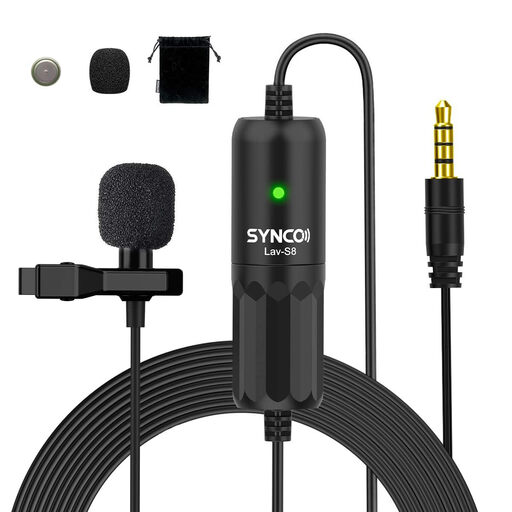
The V.Lav is a wired analogue microphone for a suitable 3.5 mm input and a longer cable run.
The Mic Mini 2S is a wireless option to consider; if two people need to speak at the same time, look for a version with two transmitters.
The MOTIV MVL is designed for compatible mobile devices with a 3.5 mm connection or a suitable CTIA-compliant adapter.
The products below include wireless lavalier options for one or two people, as well as a wired analogue lapel microphone. For each model, check that the connection and number of transmitters suit your recording device and set-up.
 No image available
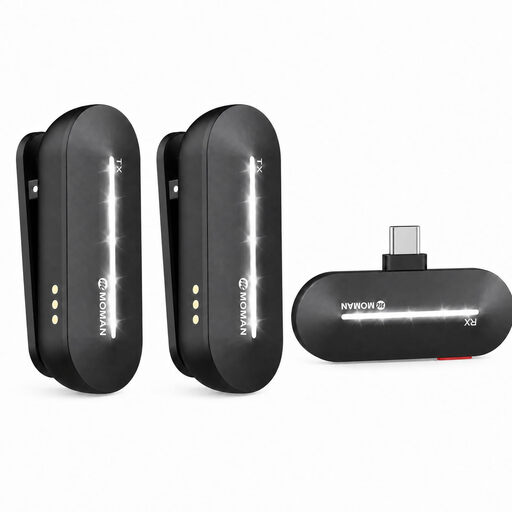
For two people, provided both transmitters are included in the version you choose and are used.
Configuration stated in the product name: 2 TX + 1 RX, with charging case.
 No image available
For a single announcement using one of the listed devices, provided its microphone input is compatible with the microphone.
 No image available
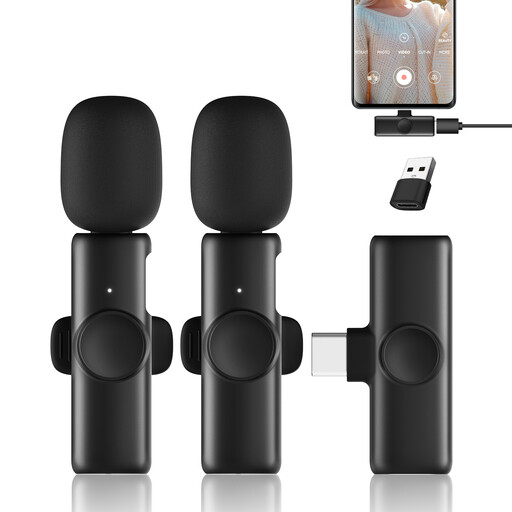
For two speakers, provided the USB-C recording device is compatible with the receiver and both transmitters are used.
Product specification: USB-C, 2TX+1RX.
Before using it wirelessly in Germany, check the frequency and device configuration against the applicable allocation conditions.
 No image available
For two speakers using a compatible USB-C Android phone, provided the specific device and wireless configuration are suitable.
Product specification: 2.4 GHz, 2TX&1RX.
Before using it wirelessly in Germany, check the frequency and device configuration against the applicable allocation conditions.
 No image available
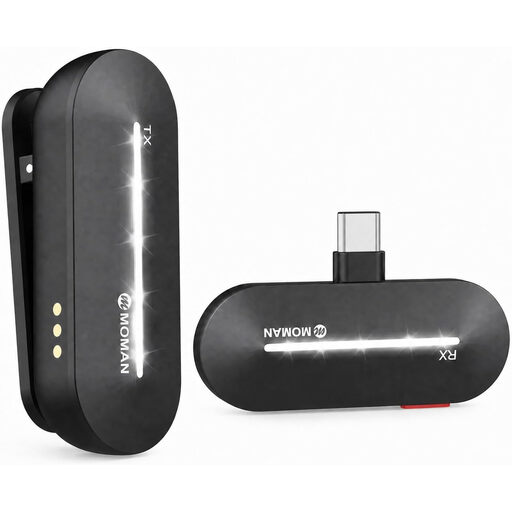
For a single announcement with a compatible USB-C recording device; one transmitter won’t cover two people with separate microphones.
Product specification: USB-C, 1TX+1RX.
Before using it wirelessly in Germany, check the frequency and device configuration against the applicable allocation conditions.
As a general rule of thumb, RØDE recommends positioning it at chest height, about 20–30 cm from your mouth. Avoid clothing rubbing against the microphone and listen to a test recording. The manufacturer’s recommendation doesn’t guarantee a clear recording at a shared desk.
Not necessarily. For use with Wireless GO, RØDE specifically recommends a TRRS-to-TRS adapter for the smartLav+. Check the plug wiring and required power supply for your own recording device, rather than relying on the socket diameter alone.
Depending on your recording device, you may need a suitable adapter. Deity specifies two LR41 or AG3 batteries for the V.Lav; a wireless set needs its transmitter and receiver charged. Check these requirements against your exact device combination.
You shouldn’t assume that you can: § 201(1) StGB covers, among other things, the unauthorised recording of another person’s privately spoken words. Whether a particular recording falls within its scope depends on the circumstances. Set up your recording and workflow so that other people’s conversations aren’t captured accidentally, and get clarification in advance if you intend to record them.
No, you can’t tell from the product name alone. For wireless microphones, the Bundesnetzagentur’s Verfügung 37/2026 lists frequency bands and their technical and operational conditions; Verfügung 91/2025 covers frequencies for short-range devices. Check the frequency and device specifications for the particular set against the conditions that apply to it.