People recording long talks
If you want to record a tour or exhibition text with as few interruptions as possible, check the battery life of the entire recording setup—not just the stated storage time.


For talks where you’ll be mostly stationary, a wired lavalier microphone is a sensible choice, provided it’s compatible with your recording device’s connection and power supply. For guided walks, a wireless kit or a body-worn recorder gives you more freedom to move. Check the battery life of every device you need, make sure the input is compatible and record a test to check for clothing rustle. Internal storage doesn’t make up for insufficient battery life.
If you want to record a tour or exhibition text with as few interruptions as possible, check the battery life of the entire recording setup—not just the stated storage time.
If you’re planning a simple setup with your smartphone, the connection, adapter and recording device all need to be compatible. USB-C, TRS and TRRS aren’t interchangeable just because their plugs are a similar size.
If you’ll be walking between rooms as you speak, weigh up the restriction of a cable against the extra batteries and wireless connection needed for a wireless kit, or the file transfer required with a body-worn recorder.
For long museum talks, choose a recording setup that suits the planned duration, the device you already own and whether you’ll be moving around as you record.
A good fit if: you’ll mostly be speaking in one place and your recording device has a compatible input.
Trade-off: There’s no separate wireless connection to manage, but your movement is limited by the cable; battery life still depends on the recording device.
A good fit if: you want to move freely and the transmitter, receiver and recording device can all run for the planned recording time.
Trade-off: The transmitter and receiver need to be charged. The wireless connection may behave differently in museum rooms than it does outdoors.
A good fit if: you want to move around and record the audio directly on your person, rather than sending it wirelessly to a separate device.
Trade-off: You’ll need to plan for batteries and a memory card, then transfer the file afterwards.
| Buying priority | What to look for when buying | Who this matters to |
|---|---|---|
| Long recording | Compare the planned duration with the battery life of every device you need; consider battery life and internal storage separately. | If I want to record a tour without interruption, I plan for the battery life of the complete setup. Around 36% of consumers prioritise long, uninterrupted recording. |
| Compatible connection | Check your device and input type; record and listen back to a test file before use. | I want to get started with my existing recording device without unsuitable adapters if possible, so I check the specific input. Around 29% of consumers prioritise compatibility between the connection, setup and their device. |
| Clear speech | Attach the microphone to the clothing you’ll actually be wearing and listen to a test recording while moving as you normally would. | If I want my voice to come through clearly during a tour, I want to spot distracting clothing rustle early. Around 21% of consumers prioritise speech clarity. |
| Freedom to move | Test the setup on a real tour; don’t assume the stated open-field range will apply indoors. | If I’m moving between exhibits, I don’t want a long cable to the recording device to restrict me. Around 14% of consumers prioritise freedom of movement. |
RØDE states that the Wireless PRO has over 40 hours of internal recording capacity per transmitter. That doesn’t mean the transmitter can run for as long on a single charge.
Compare the running time of every device you need with the planned uninterrupted recording time, and check storage capacity separately.
The RØDE Lavalier GO is designed for a compatible TRS microphone input with plug-in power. The Shure MVL is intended for compatible smartphone TRRS connections or a suitable adapter.
Check the input, power supply and any adapters needed for your specific recording device, rather than choosing by the 3.5-mm plug alone.
The range DJI specifies for open, unobstructed areas doesn’t automatically describe the wireless connection between exhibition rooms.
Test the connection on the actual route you’ll be taking. For important recordings, you can also check whether a model with documented internal recording suits your workflow.
The XS Lav USB-C is designed for use with a compatible mobile device or computer, making it suited to talks where you’ll be mostly stationary.
The Lavalier GO is designed for compatible TRS inputs; the Wireless PRO is a wireless kit with two Lavalier II microphones and internal recording.
The Mic Mini is a compact wireless setup; selected Mic 2 kits have documented internal recording.
The F2 and F2-BT are body-worn recorders supplied with a lavalier microphone, for recording without a wireless connection to a separate device.
The MVL is a wired lavalier microphone for compatible smartphones or tablets with a TRRS connection or a suitable adapter.
This selection includes a wired SYNCO lavalier microphone for a range of recording devices, as well as wireless kits, mostly for USB-C devices. Before recording long takes, check compatibility and the stated battery life of the kit you choose.
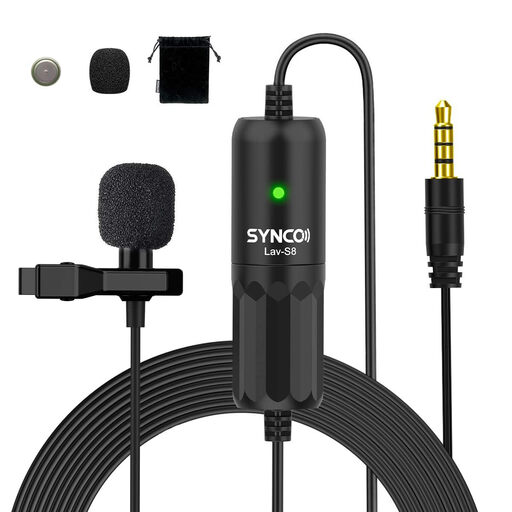 Image unavailable
For a wired setup with a compatible recording device. The title lists smartphones, PCs/laptops and cameras as supported devices.
Has a 3.5-mm connection; according to the product description, an adapter kit, clip and windscreen are included. Check the connection and adapters against your specific device.
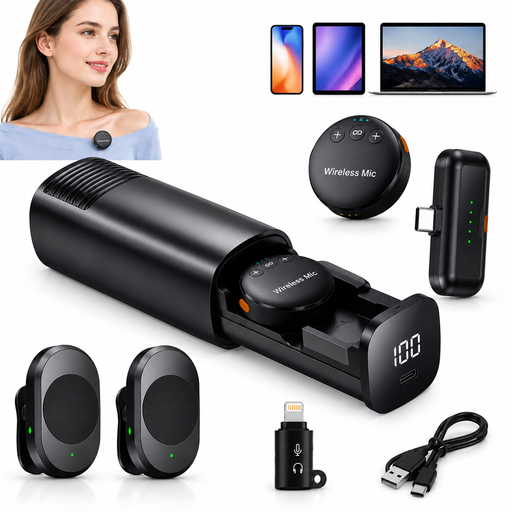 Image unavailable
For a compatible smartphone or camera when you need two transmitters. The title lists USB-C and Lightning connections.
The product information states up to 6 hours of use per transmitter and up to 18 hours of total operating time with the charging case. The extra time with the case isn’t stated as the battery life for one uninterrupted take; check your recording device’s connections too.
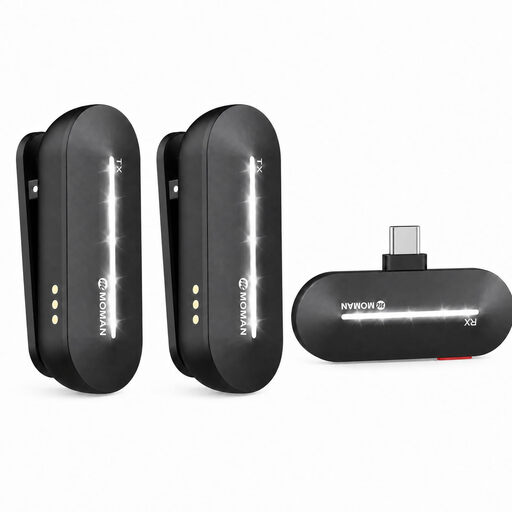 Image unavailable
For a compatible USB-C device and recordings with two transmitters. The product description states up to 6 hours of continuous battery life per transmitter.
This stated battery life doesn’t cover a longer uninterrupted take. Check compatibility with your recording device in advance.
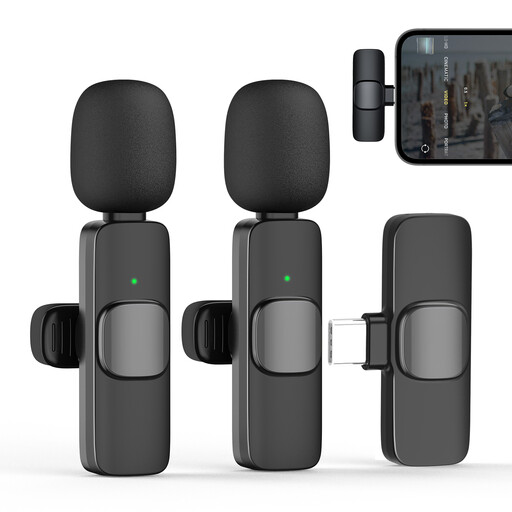 Image unavailable
For a compatible USB-C device when one transmitter is enough. The title and product description state up to 5 hours of continuous recording on a single charge.
This stated battery life doesn’t cover longer uninterrupted takes; check that the connection is compatible with your recording device.
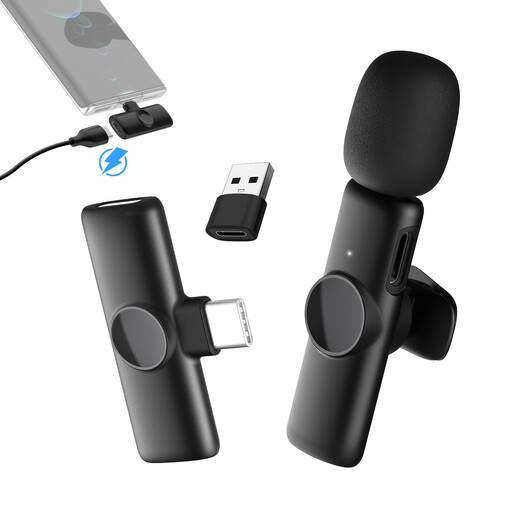 Image unavailable
For a compatible USB-C smartphone and recording with one transmitter. The product description states up to 8 hours of continuous recording per charge.
Check that the stated battery life suits the length of your planned take and that the connection works with your recording device.
According to the manufacturer, the Sennheiser XS Lav USB-C can be connected by cable to a compatible mobile device or computer and doesn’t need its own battery. Even so, check that your device recognises the microphone and can power it for the entire recording.
Attach the microphone to the clothes you’ll actually be wearing and listen to a test recording with typical movements before starting a long take. This lets you adjust the position, although it can’t guarantee a noise-free recording.
The Zoom F2 needs two AAA batteries and a compatible memory card, so include these in your plans. With a wireless kit, check the battery life of the transmitter and receiver separately. Internal storage isn’t the same as battery life. Accessories and service terms depend on the model and offer you choose.
Under Section 201 of the German Criminal Code (StGB), recording another person’s privately spoken words without authorisation is not permitted. If identifiable voices are processed, the organisation responsible must also establish an appropriate legal basis under the GDPR; consent is one possible legal basis, but not the only one. Discuss any specific recording and publication plans with the museum too.
No. You can’t tell from the term “wireless microphone” alone. The German Federal Network Agency publishes general frequency assignments with conditions for radio applications. Check the frequency range of the specific device and make sure it’s the version intended for use in Germany or the EU.