For speaking practice in a fixed position, a wired lavalier microphone is usually sufficient, provided its connection and power supply are compatible with your recording device. Make a test recording to check the position, clothing noise and recording level. A wireless set is mainly worth considering if you move around or want to mic up two people separately.
Who are the different microphones suitable for?
Solo speakers in a fixed position
If you repeat pronunciation exercises in the same booth, clear speech and a consistent microphone position matter. A short test recording will show whether clothing is rubbing against the mic or the recording is too quiet or distorted.
Speakers using a smartphone or computer they already own
If you want to keep using a device you already have, make sure the connection, recording app and any adapters are compatible. USB-C, TRRS and TRS refer to different signal paths.
Speakers on the move or pairs practising together
If you move around while speaking or record a dialogue, freedom of movement and the number of transmitters included become important. Check that the set suits the number of people speaking.
What should you look for when choosing?
For a fixed practice position, finding the right connection is the first thing to consider. Wireless becomes more appealing when a cable would genuinely restrict your movement.
Wired with USB-C
A good fit if: Your smartphone or computer supports external microphones via USB-C and you mostly record in one place.
The trade-off: The cable limits how far you can move, and a USB-C port alone does not guarantee that your recording app will use the microphone.
Wired with 3.5 mm TRRS
A good fit if: Your device has a compatible headset microphone input or you use a suitable adapter.
The trade-off: The plug size alone does not confirm compatibility. RØDE states that the smartLav+ has a 1.2 m cable.
Wired with TRS or switchable modes
A good fit if: You have a suitable TRS microphone input with plug-in power, or a compatible smartphone and camera setup.
The trade-off: The RØDE Lavalier GO is not a wireless set on its own. When considering the BOYA BY-M1, check the operating mode and power supply for the specific model.
Wireless set
A good fit if: A cable gets in the way while you speak or you want two people to wear their own transmitters.
The trade-off: Check what is included, the receiver connection and charging requirements. DJI offers Mic Mini sets with either one or two transmitters.
The following figures relate to consumers choosing a lavalier microphone for speaking practice in a small booth.
| Criterion |
What to check before buying |
Who is this particularly important to? |
| Clear speech |
Attach the clip so that neither fabric nor the cable rubs against the capsule; listen to a speech test recorded in the booth. RØDE notes that clothing rustle can be audible, while Shure emphasises that a microphone does not improve room acoustics. |
If I want to assess pronunciation clearly, I look for a position free from interference and a clear recording. Around 36% of consumers say clear speech is their main priority. |
| Compatibility |
Check your device model, microphone input, plug wiring and any required adapter or plug-in power. Then select the external microphone in your recording app. |
If I want to keep using my smartphone, computer or recorder, the whole connection, right through to the app, needs to work. Around 29% of consumers prioritise device compatibility. |
| Repeatable setup |
Check that the cable reaches your recording device and that the clip stays in place. Test a quiet and a loud passage, and listen for distortion. |
If I repeat lots of exercises in the same place, I want to position the microphone and device without having to set everything up from scratch. Around 21% of consumers prioritise an easy, repeatable setup. |
| Freedom of movement |
For a wireless set, check the number of transmitters, the receiver connection and the charge level of the components you need. |
If I want to move around while speaking or record with someone else, a cable may get in the way. Around 14% of consumers prioritise freedom of movement. |
Common mistakes when choosing
-
Assuming the same 3.5 mm plug size means the same recording connection
TRRS and TRS are different types of connection. The Shure MVL uses TRRS; the RØDE Lavalier GO is designed for a suitable TRS input with plug-in power.
Check the entire connection, from the microphone to the recording app, not just the diameter of the plug.
You may need a suitable adapter for your existing input, or a microphone with the right connection.
-
Assuming a lavalier microphone is a complete wireless set
The RØDE Lavalier GO is a wired microphone that can be connected to a compatible transmitter; on its own, it does not provide a wireless connection to your recording device.
Before buying, check exactly what is included and whether you have the transmitter and receiver you need for your setup.
For a wireless connection, you would also need a compatible transmitter and, possibly, a receiver.
-
Expecting an omnidirectional pickup pattern to eliminate booth echo
A lavalier microphone does not fix room acoustics. Clothing can also rub against the capsule or cable, making unwanted noise audible.
Test the microphone position with the clothes you will actually wear, then listen to a recording made in the booth.
-
Assuming similarly named versions are identical
BOYA’s BY-M1 and BY-M1S differ in their power supply. DJI also offers Mic Mini sets with different numbers of transmitters.
Compare the full model name, operating mode, power supply and what is included in the set.
Depending on the version, you may need to allow for a battery or an additional connection component.
Key brands at a glance
Sennheiser
The XS Lav range includes wired versions for different connections.
- Sennheiser states that both the XS Lav USB-C and XS Lav Mobile have a 2 m cable, clip and windscreen.
- USB-C and 3.5 mm TRRS are found on different product versions; your device’s external microphone input needs to be compatible.
Shure
The MOTIV MVL is a wired lavalier microphone with a 3.5 mm TRRS connection.
- Shure lists a clip and windscreen, and says it works with most compatible Android and iOS devices or a suitable CTIA adapter.
- This manufacturer’s claim does not automatically apply to every smartphone. Shure also states that a microphone does not improve room acoustics.
RØDE
The smartLav+ and Lavalier GO use different connections: TRRS for compatible mobile devices, and TRS for suitable inputs or transmitters.
- RØDE states that the smartLav+ has a 1.2 m cable; the Lavalier GO needs plug-in power from a suitable TRS input.
- The Lavalier GO is not a complete wireless system on its own; manufacturer sound-quality claims are not an independent comparison.
BOYA
The BY-M1 is a wired option for compatible devices when you need a longer cable.
- BOYA lists a 6 m cable and switchable camera and smartphone modes for the BY-M1.
- The BY-M1 runs on an LR44 battery; the BY-M1S is a separate version with a different power supply.
DJI
The Mic Mini is a wireless option for mobile solo recordings or recordings with two people.
- DJI offers a set with one transmitter and one receiver, as well as a different bundle with two transmitters, a receiver and a charging case.
- DJI’s stated operating time for the one-transmitter/one-receiver setup is based on close-range conditions, with no interference and noise cancelling switched off.
Joybuy products for speaking practice
This selection includes wired and wireless lavalier microphones for speech recordings. Check that each product’s connection and set contents are suitable for your recording device.
 No image available
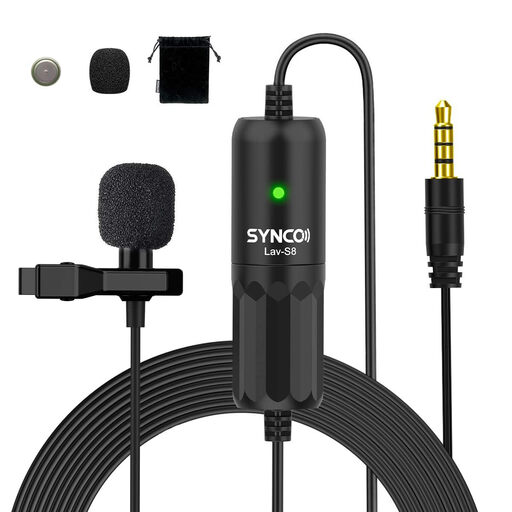
SYNCO S8 lavalier microphone for smartphone, PC, laptop and camera
For speech recordings in a fixed position, provided your recording device is compatible with the devices listed.
The description lists a clip and an adapter set.
View at Joybuy
 No image available
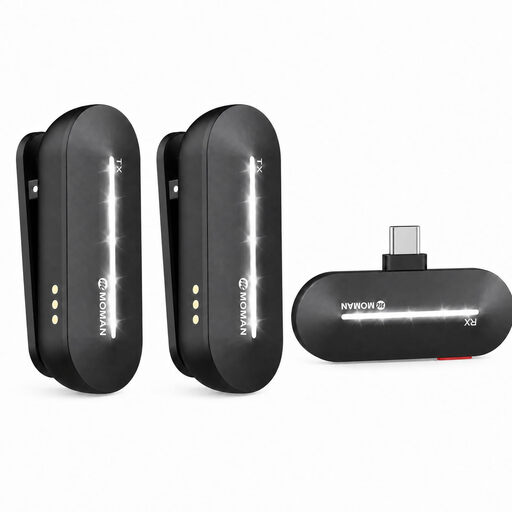
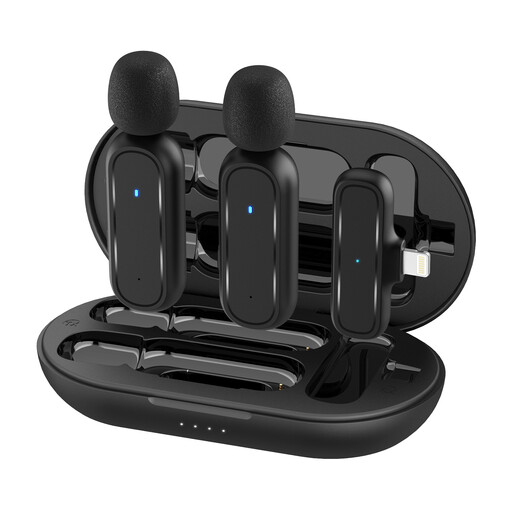
Moman M1CXT, USB-C, 2 transmitters and 1 receiver
For speech recordings with a USB-C device when your setup requires two transmitters.
The product name lists USB-C, 2 transmitters and 1 receiver, with a range of 150 m.
View at Joybuy
 No image available
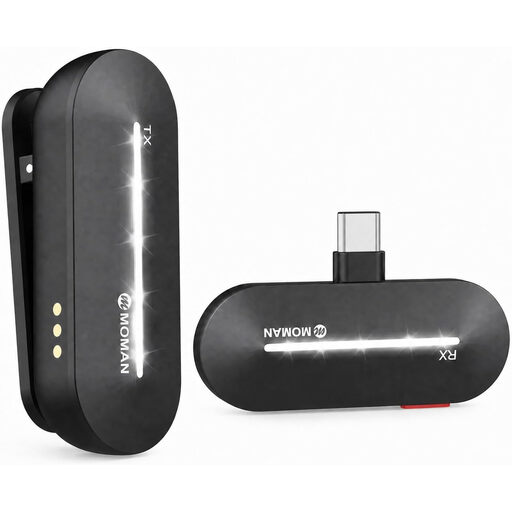
Moman M1CT, USB-C, 1 transmitter and 1 receiver
For one speaker using a compatible USB-C mobile device.
The product name lists USB-C, 1 transmitter and 1 receiver, with a range of 150 m.
View at Joybuy
 No image available
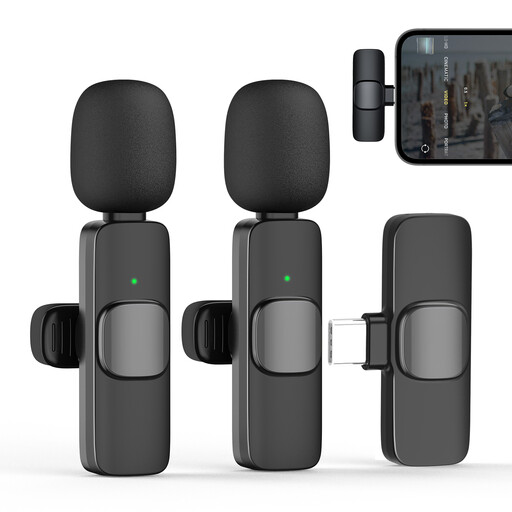
Moman CP1X(C), USB-C, 2.4 GHz
For speech recordings with a compatible USB-C device; the product name lists smartphones, tablets and laptops.
The product name lists the 1TX&1RX configuration.
View at Joybuy
 No image available
Moman MC1(C), USB-C, 1 transmitter and 1 receiver
For one speaker using a compatible USB-C phone.
The product name lists 2.4 GHz, 1 transmitter and 1 receiver.
View at Joybuy
Frequently asked questions
How should I attach the microphone for repeatable pronunciation practice?
Attach it close to your body, making sure the fabric does not touch the capsule or rub against the cable. RØDE gives a general positioning recommendation of around 20–30 cm from the mouth. Check the sound in a test recording while wearing the clothes you will actually use.
How can I check that quiet and stressed syllables are recorded clearly?
Say both in a short test recording, watch the recording level and listen back. Audacity recommends lowering the level and testing again if you can see that the recording is clipping.
Do I need two transmitters for two people?
If both people need to wear their own wireless microphone, look for a set with two transmitters and a compatible receiver. DJI specifically distinguishes between a solo version of the Mic Mini and a set with two transmitters.
Can I simply record someone else’s speaking practice?
Not without permission: section 201 of the German Criminal Code covers the unauthorised recording of another person’s private speech. Get the agreement of anyone else who will be speaking before recording them. This law is not a blanket restriction on recordings of your own voice alone.
Can I use any wireless microphone in Germany just because it is sold as a wireless model?
You cannot assume that this applies to every model. Germany’s Federal Network Agency publishes the current general frequency allocations. Check the frequency range and the applicable requirements for the specific wireless model.


