
Lieferung heute & morgen

Qualitätsgarantie

Willkommens-Angebote freischalten: KOSTENLOSE Lieferung | Bis zu 80 % RABATT | Kostenlose 30-Tage-JoyPlus-Testphase
App herunterladen
Toddlers want to discover the world and love to be right where the adults are—especially in the kitchen. A learning tower allows children to safely participate in the action at eye level. But the market can be overwhelming, and not every model lives up to its promises. Many parents invest in a product that quickly turns out to be impractical or even unsafe. This guide will show you what to look for to avoid common purchasing mistakes and make an informed decision.
Before you make a decision, you should be aware of the typical weaknesses that only become apparent in everyday use with many models:
To avoid these pitfalls, you should base your choice on objective criteria. The following three features are crucial for the safety and longevity of a learning tower.
The most important characteristic is stability. A safe step stool for kids must be designed to prevent tipping, even during movement. Look for a wide base that ideally extends beyond the tower's main footprint. Models with outrigger feet offer significantly enhanced tip-over resistance. The tower's own weight also contributes to stability—very lightweight models are often less stable. The maximum load capacity, often between 70 kg and 80 kg, is another indicator of a robust design.
A height-adjustable learning tower is a long-term, safe investment. Both the standing platform and the step should be adjustable to multiple levels to match your child's height. The ideal position is when the tower's top railing is at about your child's waist level. This prevents them from leaning out too far or falling. A model that grows with your child will accompany them for several years, from toddlerhood to preschool age.
The choice of material affects both durability and safety. A wooden discovery tower is often the preferred choice. Solid wood, such as beech or sustainable bamboo, is robust, durable, and splinter-free when properly finished. Look for certifications like FSC, which confirms that the wood comes from responsibly managed forests. For painted models, the finish should be explicitly designated as child-safe (in accordance with EN 71-3). Edges should always be rounded to prevent injuries.
Instead of presenting an overwhelming list, we have selected models that meet the specific needs of families and incorporate the critical features mentioned above.
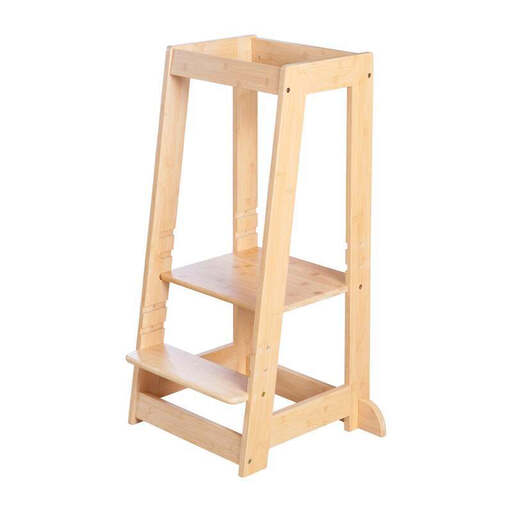
Why it's a good fit: This model is aimed at parents for whom safety and environmental responsibility go hand in hand. The FSC-certified bamboo is not only a fast-growing renewable resource but also extremely robust and durable.
The outrigger feet actively counteract the risk of tipping. The height adjustability of the platform and step ensures long-term, safe use, while the FSC-certified material addresses any concerns about quality.
The design is rated for a load capacity of up to 80 kg, which signals high stability and durability. The multi-level height adjustment allows for precise adaptation to the child's size.
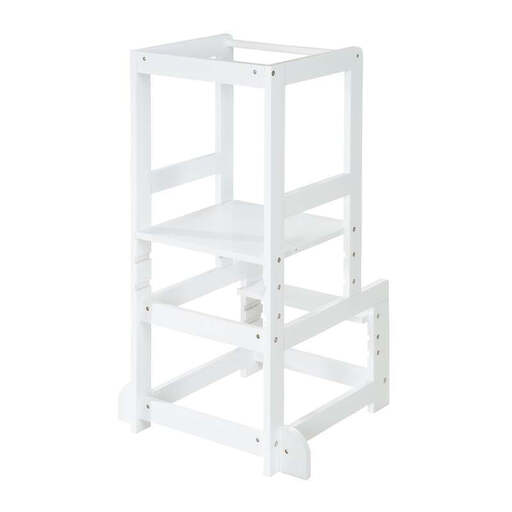
Why it's a good fit: For families who value a clean, modern aesthetic and want a hassle-free solution. The white finish blends seamlessly into bright, contemporary kitchens, and its pre-assembled delivery saves time and effort.
This model is also height-adjustable, thus avoiding the fixed-height design trap. The sturdy construction from wood composite, with a product weight of 8.1 kg, ensures a solid footing and prevents the instability of lighter models.
The biggest practical advantage is that no assembly is required. The learning tower is ready to use right out of the box. Its height adjustability also ensures a long service life.
We have compiled a comprehensive, up-to-date list of products that meet these strict selection criteria and safety standards.
A learning tower is generally useful once a child can stand independently and securely, which is usually between 12 and 18 months of age. It is crucial that you never leave your child unsupervised in the tower, especially in the beginning.
The primary safety comes from the tower's construction itself. Always place it on a level, solid surface. Regularly check all screw connections to ensure they are tight. However, the most important safety measure remains constant supervision by an adult, especially when hot pots or sharp objects are being used nearby.
A regular step stool is not a safe alternative to a Montessori learning tower. It lacks the surrounding safety rail that protects a child from falling, especially backwards or to the side. As a kitchen helper for kids, a learning tower is specifically designed to provide a secure, elevated standing position.