
Lieferung heute & morgen

Qualitätsgarantie

Willkommens-Angebote freischalten: KOSTENLOSE Lieferung | Bis zu 80 % RABATT | Kostenlose 30-Tage-JoyPlus-Testphase
App herunterladen
Learning toys for toddlers should keep them engaged while also suiting their age, abilities and daily routine. In practice, though, a large number of pieces, colourful packaging and terms such as “Montessori” do not automatically lead to a good buying decision. What matters is clear product information, an appropriate age recommendation and a way of playing that suits the child’s stage of development.
A baby activity centre with lights, music and several buttons may look appealing. But if everything makes a noise at once or only responds at the press of a button, there is little scope for free exploration. So check whether the toy can still be used meaningfully without batteries or pre-set melodies.
A toy labelled “from 1 year” is not automatically suitable for every 12-month-old child. Height, ability to grasp objects and experience with small parts vary considerably. For learning toys for children aged 2 and over, or magnetic building blocks, read the warnings particularly carefully. The age recommendation is safety and usage guidance, not a promise about development.
The CE marking is a legally required declaration of conformity made by the manufacturer; it is not an independent quality seal. Also look for:
Take particular care with magnetic products: even small magnets can be dangerous if swallowed. Magnetic toys should therefore be kept away from children below the stated age limit and checked regularly for damage.
For children aged around one and over, large pieces that are easy to grip are a good choice. A motor skills cube, shape puzzle or simple sorting game can help develop matching and grasping skills without requiring lots of loose small parts. If a product contains small parts, take the “Not suitable for children under 3 years” warning seriously.
A good toy offers a clear task without being overwhelming. For example:
For younger children, a few clearly differentiated features are usually more suitable than an overloaded activity board. For a baby activity centre, other relevant factors include volume control, stability and whether it can be used on the floor.
ABS plastic can usually be cleaned with a soft cloth. Wooden toys should have no visible splinters or sharp edges. Batteries are often not included with electronic educational toys, so check the power supply, volume and cleaning instructions.
Storage matters too: a set with 80 pieces needs more space than a compact shape puzzle. A storage box or bag included with the set can be handy for family life.
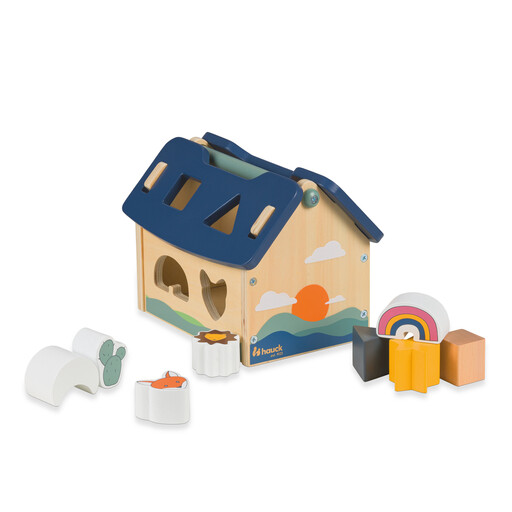
Why this product suits this profile: According to the product description, this wooden toy is designed for children aged 12 months and over. It combines sorting, stacking and storage in one compact house.
The task is clearly defined and requires no batteries or complicated controls. The pieces can be stored inside the playhouse after use.
Eight building blocks, a removable roof and rounded design, according to the product information.
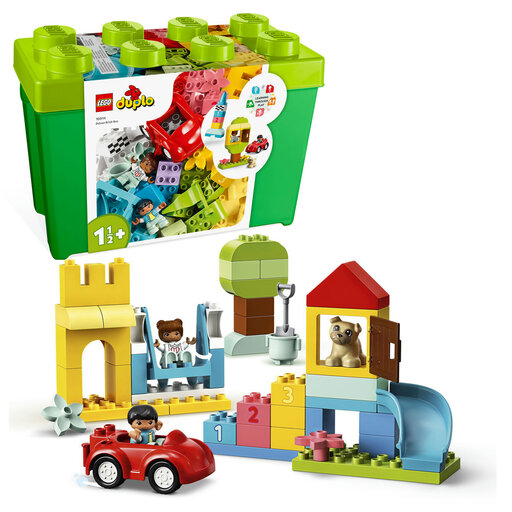
Why this product suits this profile: According to the manufacturer, the box contains 85 large pieces, including numbered bricks, figures and accessories for free building and role play.
The building blocks can be used creatively, not just according to the instructions. This keeps the play adaptable as children move through different stages of development.
A wide selection of building blocks, a storage box and, according to the product description, suitability from 1.5 years.

Why this product suits this profile: For families looking for several types of activity in one compact format, the cube offers eight play areas for children aged 1 to 3, according to the description.
The features are arranged separately and include cogs, a piano, a guitar and a toy phone. Check the volume before use.
Compact dimensions of around 23 × 23 × 24 cm and a carry handle, according to the product description.

Why this product suits this profile: According to the product information, the set is designed for children aged 3 and over and includes 76 transparent magnetic pieces for open-ended construction.
The age limit and warning about small, strong magnets are clearly stated. Check the connections and plastic casings before each use.
76 pieces, magnetic connections and, according to the product description, compatibility with other sets of the same type.
We’ve put together a comprehensive, regularly updated list of products that meet these strict selection criteria and fully comply with the safety regulations in force in the EU.
For children aged around 12 months and over, consider large sorting blocks, simple shape puzzles, motor skills cubes and stackable pieces. Look for easy-to-grip parts, rounded edges and a clear age recommendation. Small pieces and magnets should be avoided at this age.
That depends on how they work. Open-ended building blocks, LEGO DUPLO or role-play sets can adapt to different abilities. Electronic toys with a small number of fixed features, on the other hand, may become repetitive more quickly. Combining baby motor skills toys, creative building and sensory materials can add variety.
Look for adjustable volume, stable bases and an age-appropriate design. For drum kits or activity tables, check the product description for details on batteries, cleaning and volume control. Musical instruments for toddlers should also not be used unsupervised close to a child’s face or ears.