
Lieferung heute & morgen

Qualitätsgarantie

Willkommens-Angebote freischalten: KOSTENLOSE Lieferung | Bis zu 80 % RABATT | Kostenlose 30-Tage-JoyPlus-Testphase
App herunterladen
An LED ambient car lighting system can visually enhance your dashboard, doors and footwell. However, there are significant differences between budget light strips, RGB fibre-optic solutions and comprehensive kits. What really matters isn’t just the colour options or the advertised number of LEDs, but the power supply, installation method, what’s included in the box and how you control it.
Figures like 175 or 236 inches sound impressive, but they don’t always describe a single, ready-to-fit light strip. With some kits, the total length is split across several sections or an optical fibre that first needs to be inserted into a transparent tube. So check how many individual strips are included and where they can be installed.
An app-controlled car ambient lighting system is usually operated via Bluetooth. For this to work, the app must be compatible with your smartphone’s operating system. Depending on the kit, different applications such as “Lotus Lantern”, “LotusLamp X”, “Magic Lantern” or “LED LAMP” are used. Before buying, you should also find out whether the app only controls colours and brightness, or whether it also offers timers, scenes, speed adjustment and sound synchronisation.
A 12-volt connection and pre-fitted plugs can make installation easier. Even so, you’ll still need to route cables behind trim panels, securely mount the controller and clean the adhesive surfaces. The more zones you have, the more work is involved. Products with footwell lights, door handle lighting and additional door pockets also need enough space for multiple connections.
Most of the kits we’ve looked at here are designed for 12 volts DC. Some product specifications mention an operating range of 10 to 16 volts. That doesn’t automatically mean it’s suitable for every type of connection. Check whether the kit is powered via a vehicle plug, USB, USB-C or a hardwired connection.
Before installation, you should test the lights temporarily. A fuse for short-circuit protection, a memory function and a controller with well-insulated connectors are practical selection criteria. Don’t overload the power supply. If you’re hardwiring the system, we recommend having it fitted by a qualified professional.
RGB LED strips for cars use different types of light guides. Acrylic light bars distribute light across a visible, relatively even surface. Fibre-optic solutions channel light from LED modules through a transparent fibre or tube.
The permitted bend radius is important. Some acrylic or fibre strips must not be sharply kinked. When cutting to size, you must also use the end specified by the manufacturer. Cutting in the wrong place can mean a section no longer lights up or colours aren’t displayed synchronously.
If you only want to accent the dashboard, you don’t need a large complete kit. For LED footwell lighting in a car, the kit should include separate footwell lights. More comprehensive versions add door handles, door pockets or door speakers.
A dual-zone control allows you to set the dashboard strip and the footwell differently, for example. This is ideal if you want to customise several areas individually. The light colour shouldn’t impair your vision while driving or distract other road users. Moving effects and sound-sync functions should only be used responsibly and when appropriate.
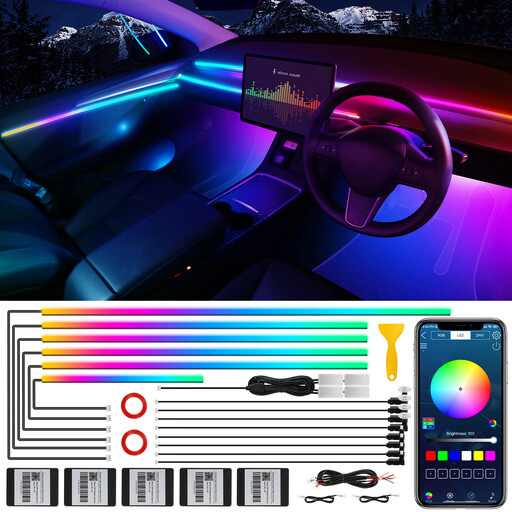
Why this product fits the profile: The kit combines six acrylic light strips with four footwell lights, making it suitable for a straightforward retrofit without door modules.
The product details clearly state the number of strips and footwell lights included. This makes it easier to assess the installation scope before buying.
12-volt rating, app control, touch button and sound sensor; according to the product details, the strips can be cut to size.

Why this product fits the profile: This version includes lights for the dashboard, footwell, door handles and door pockets. It’s aimed at users who want to control several areas either synchronously or separately.
The specifications list the different installation areas, 600 LEDs, 12 volts and the dual-zone function. This makes it easier to compare with smaller kits.
Bluetooth app, touch control, separate zones and several extension cables; according to the product description, individual length adjustment is possible.
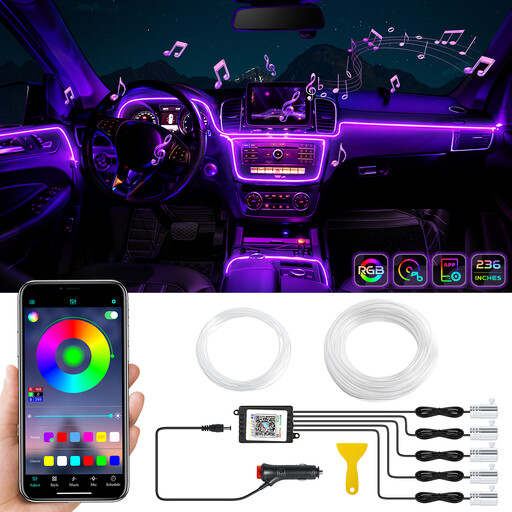
Why this product fits the profile: The 6-metre fibre-optic cable can be divided into three to five sections, giving you flexibility for custom installation locations.
The installation steps mention the transparent tube, cutting and hiding the LEDs. This makes the required DIY effort clear upfront.
Bluetooth app with 29 preset modes, brightness and speed adjustment, and sound sensor; includes a vehicle charger and installation tools, among other items.
We’ve put together a complete, regularly updated list of products that fully meet these strict selection criteria and the safety regulations in force in the EU.
Before fitting, make sure the surface is clean, dry and free from grease. Test all components outside the trim first. Don’t route cables over pedals, airbag zones or moving seat rails. Controllers should be placed in a dry, well-ventilated spot and must not be crushed.
Interior lighting isn’t automatically suitable for every setting on public roads. Avoid light sources that dazzle the driver, impair visibility or distract other road users. For show and tuning purposes, it may be more sensible to use the lights when the vehicle is stationary. Always follow your vehicle manufacturer’s instructions and the relevant regulations.
Many kits are powered via a 12-volt vehicle plug, USB or USB-C. After a functional test, position the strips and connect the main controller to the sub-controllers. Any hardwiring should be carried out professionally.
The lifespan depends on LED quality, heat generation, power supply, moisture and mechanical stress. Without specific manufacturer information, it’s impossible to give a reliable general figure. Sharp kinks, excessive pulling and consistently high temperatures can affect performance.
Power consumption varies depending on the number of LEDs, brightness, mode and kit size. When the vehicle is switched off, the system shouldn’t be left running unnecessarily. Models without an automatic shut-off must be turned off manually via the app, button or remote control, according to the product specifications.