
Lieferung heute & morgen

Qualitätsgarantie

Willkommens-Angebote freischalten: KOSTENLOSE Lieferung | Bis zu 80 % RABATT | Kostenlose 30-Tage-JoyPlus-Testphase
App herunterladen
LED ambient lighting for your car can enhance the look of the dashboard, door panels, footwell or headliner. Many products promise millions of colours, music synchronisation and particularly easy installation. In practice, however, other factors determine whether LED interior car lighting remains practical for long-term use.
The term “universal” does not mean that every kit can be installed equally easily in every vehicle. With retrofit car interior lighting, you need to consider cable routes, gap dimensions, power supply and the position of the control unit. A kit designed for the dashboard is not automatically suitable for door panels or a headliner.
Before buying, you should therefore check:
“16 million colours” describes the available colour range, but says little about how the product is operated. Key factors include brightness control, saved scenes, separate zones and whether the app is compatible with your smartphone.
With RGB LED car lighting, red, green and blue can be combined. RGBW LED lighting adds a separate white light channel. This makes it possible to produce white differently from a simple mixture of the RGB channels. For subtle interior lighting, this difference can be relevant to colour reproduction.
The music synchronisation function on many kits works via a built-in microphone. The system then reacts to sounds detected in the surrounding area. It does not necessarily analyse the vehicle’s audio signal directly. Road noise, conversations and warning tones can therefore also affect the movement of the lights.
For a calmer experience, check whether music modes can be switched off and whether static colours and a fixed brightness level can be selected.
A vehicle lighting kit should be designed for the intended onboard voltage. Product specifications often state 12 V DC or connection via the cigarette lighter. A power supply designed for domestic use is not automatically suitable for a vehicle.
Look out for:
A kit with a mains adapter for indoor use has different requirements from an LED car light strip. When using lighting in a vehicle, only the connection intended for that purpose should be used.
LED strips and fibre-optic systems differ considerably. An LED car light strip produces light directly along the length of the strip. With a car fibre-optic star ceiling, the light source is usually housed in a separate module, while the points of light are distributed through fibres.
Check:
With fibre-optic kits, you need to allow for the distance between the light engine and the desired star point. Leaving a small reserve for curves and concealed cable routing is advisable.
LED interior lighting with app control may use Bluetooth, Wi-Fi or both. Bluetooth is generally suitable for direct control near the vehicle. Wi-Fi models are more suitable for integration into smart home systems, but require a compatible network.
The following questions can help you choose:
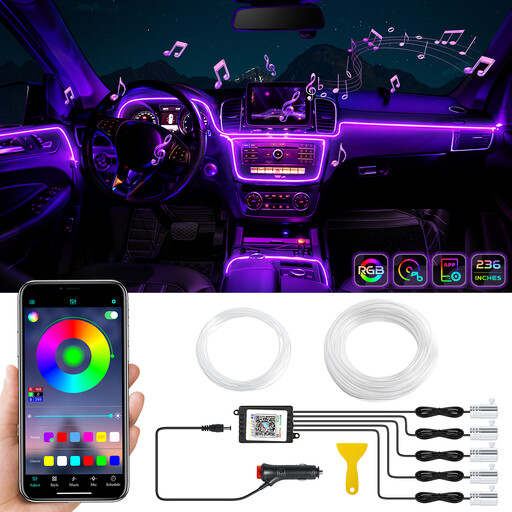
Why this product suits this profile: The kit offers app control, several lighting modes and a 6-metre fibre-optic cable for individually planned accent lighting in the vehicle.
The stated operating voltage of 10–16 V is suitable for the vehicle use described. Nevertheless, the kit should be tested before installation.
Bluetooth app, 16 million stated colours, sound mode and cuttable light guides.
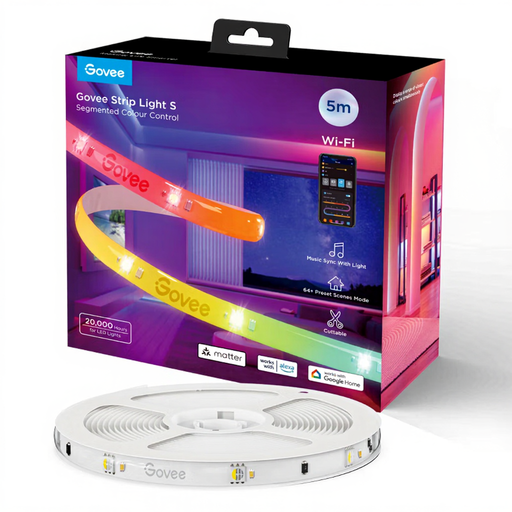
Why this product suits this profile: For home cinemas, gaming rooms and living spaces, the combination of segmented RGBIC control, app control and Matter support is particularly relevant.
The product details specify indoor use, 24 W power and 24 V DC. This clearly separates its suitability for a car from its use in the home.
5 m length, segmented colour control, built-in microphone, Wi-Fi, Bluetooth and Matter compatibility.
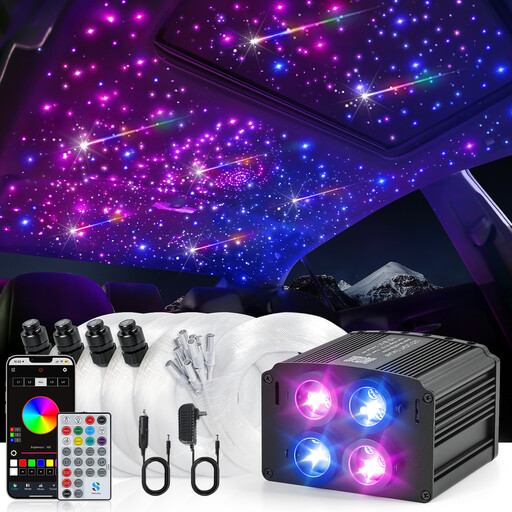
Why this product suits this profile: This kit is aimed at users planning a fibre-optic star ceiling in their car or on a suitable ceiling surface, with numerous individual points of light.
The specifications state 1,000 fibres measuring 4 m, four connections and a separate light engine. Space for the module must be planned before installing the headliner.
32 W light engine, RF remote control, app control, twinkle and meteor modes, plus 4-zone control.

Why this product suits this profile: If you want to connect the dashboard, footwell and door handles in one system, you get several predefined lighting segments and separate control units.
The specified segments and controllers make it easier to plan the intended scope than with a single strip that can be routed freely.
Six LED strips, four footwell lights, four door-handle lights, app control and a microphone for sound effects.
We have put together a complete, regularly updated list of products that fully meet these strict selection criteria and the safety regulations applicable in the EU.
Test the RGB LED car lighting before carrying out the final installation. Clean adhesive surfaces before attaching a light strip, and avoid sharp bends in LED modules or circuit boards. With fibre optics, follow the bend radius specified in the instructions.
The following points are also important in a vehicle:
Different requirements apply in living spaces. 12 V car lighting must not be connected to a mains socket without a suitable adapter. Conversely, a 24 V Wi-Fi light strip is not readily suitable for a vehicle’s onboard electrical system.
Many kits are powered via a vehicle plug or a 12-volt connection. Before installation, check the voltage, plug and power consumption against the product specifications. Permanent wiring should be installed in a way that does not affect any safety-relevant vehicle functions.
The actual service life depends on operating time, heat, voltage, mechanical strain and the quality of the power supply. Without specific manufacturer data, a general lifespan cannot be reliably applied to every kit. Continuous operation with strips left coiled or in poorly ventilated areas should be avoided.
Power consumption depends on output, brightness, colour mode and operating time. A 32 W light engine requires more energy at full power than a small accent light. For ongoing use in a vehicle, adjustable brightness and automatic shut-off are therefore practical criteria to consider.