
Lieferung heute & morgen

Qualitätsgarantie

Willkommens-Angebote freischalten: KOSTENLOSE Lieferung | Bis zu 80 % RABATT | Kostenlose 30-Tage-JoyPlus-Testphase
App herunterladen
LED ambient lighting in your car can enhance the look of the dashboard, doors and footwell. However, there are clear differences between subtle LED car interior lighting and a colour-changing RGB LED car strip in terms of installation, power supply and available features. If you focus only on having as many colours or LEDs as possible, you can easily overlook important details.
Three common buying pitfalls occur particularly often:
Many car ambient lighting systems are designed for 12 V DC. Before installation, check whether the package includes a car plug, USB or Type-C connection, or a separate power supply. A USB/Type-C kit is particularly suitable for straightforward power delivery inside the visible cabin. For a permanently integrated solution, connection via the vehicle’s electrical circuit may be an option, but it should be properly fused and installed by a professional.
Important: A product with a mains adapter for indoor use is not automatically suitable for connection in a vehicle. Specifications such as ‘AC 86–265 V’ and ‘12 V DC’ must not be treated as equivalent.
With a car LED light strip, the nominal length is not the only factor that matters. Check the following:
Acrylic light strips distribute the light along the material, creating an even line of light. Fibre-optic systems, on the other hand, direct the light to individual points. They are suitable for special starry-sky or headliner installations, but require more preparation time.
Interior lighting with app control usually works via Bluetooth. Before buying, check the stated app, operating system and range. Some kits use ‘Lotus Lantern’, ‘LotusLamp X’, ‘LED LAMP’, ‘Magic Lantern’ or ‘StarLamp’. The apps are not necessarily compatible with one another.
The installation surface also affects durability. Plastic, leather, fabric and textured surfaces require different fixing solutions. Clean and dry the surface before applying the product. Sharp bends can damage light guides and conductive tracks. Cables must not interfere with the pedals, steering wheel, airbags or areas of visibility.
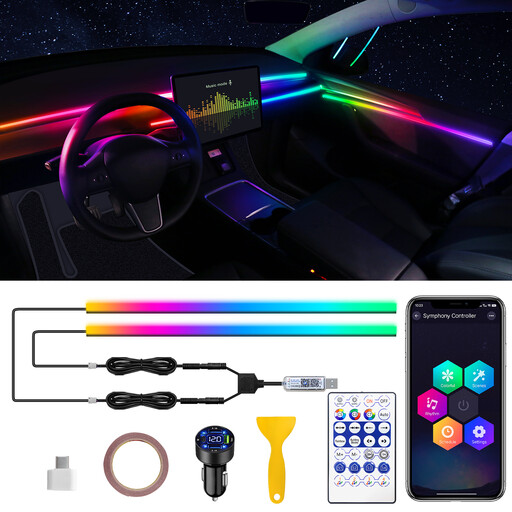
Why this product suits this profile: This 2-in-1 kit is designed for the dashboard and centre console and can be connected via USB or Type-C. It is ideal for buyers who want to get started without extensive wiring.
The package contents list two 55.1-inch acrylic strips, a USB hub, Type-C adapter, remote control and installation tools. This makes it easy to check exactly what is included before buying.
410 LEDs, RGB Smart IC, app control, RF remote control and music synchronisation, according to the product specifications.
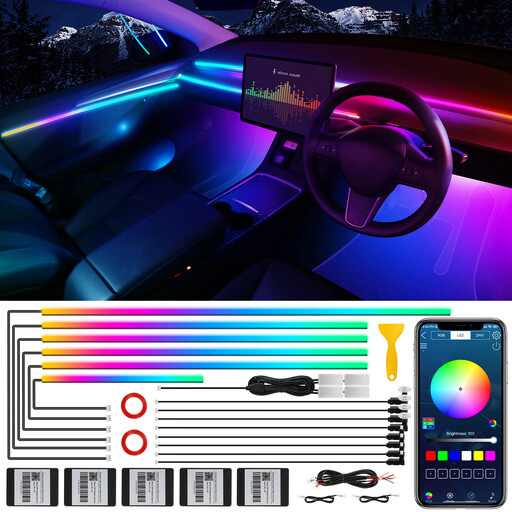
Why this product suits this profile: This kit combines acrylic light strips with footwell lights and separate control for two zones. It is a good choice for users planning a structured installation with different colour areas.
The specifications state 600 LEDs, 12 V, five controllers, two zones and an operating temperature range of -20 °C to 60 °C. These details make planning easier before installation.
175 inches in total, RGB Smart IC, ‘LotusLamp X’ app, touch button and separate zone control, according to the product description.
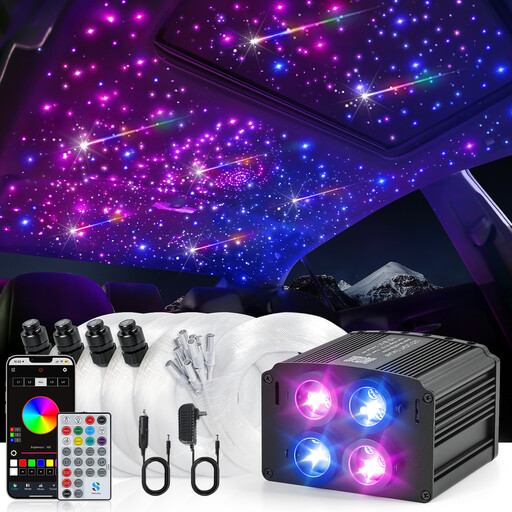
Why this product suits this profile: This fibre-optic system is aimed at DIY tuning enthusiasts, show cars and users specifically planning a starry sky in the headliner rather than conventional LED footwell lighting.
The package contents list 1,000 fibre strands measuring 4 m, four connections, an RF remote control and an app. Even so, the required fibre length should be measured before installation.
32 W motor, four-colour RGBW control, meteor effects, music sensor and more than 20 dynamic modes, according to the product specifications.
Before installation, briefly test all components outside the trim. The power supply must match the specified voltage. When connecting to the vehicle’s electrical system, the fuse, cable cross-section and secure plug connections are important. Installation is not suitable for safety-critical areas such as airbag covers, the steering column or the pedal area.
The lights should not dazzle the driver or obscure any dashboard indicators. It is also advisable to set the lighting to a subtle level while driving. The relevant regulations for vehicle equipment apply on public roads; if you are unsure, a specialist garage or the responsible testing centre can provide advice.
We have put together a complete, regularly updated list of products that fully meet these strict selection criteria and the safety regulations applicable in the EU.
Depending on the kit, it can be connected via a 12 V car plug, USB/Type-C or a separate controller. Before installation, check the voltage, plug and cable length. A hard-wired connection to the vehicle’s electrical system should be professionally installed and properly fused.
The service life depends on LED quality, temperature, power supply, adhesive surface and mechanical stress. Without specific manufacturer data, a general lifespan cannot be stated reliably. Continuous operation, intense heat and kinked light guides can reduce durability.
Power consumption depends on the number of LEDs, the controller’s output and the selected brightness. A 12 V kit with several lighting zones requires more energy than a short RGB LED car strip for the dashboard. When choosing a product, the wattage and connection type are therefore more important than the number of colours alone.