
Lieferung heute & morgen

Qualitätsgarantie

Willkommens-Angebote freischalten: KOSTENLOSE Lieferung | Bis zu 80 % RABATT | Kostenlose 30-Tage-JoyPlus-Testphase
App herunterladen
An LED ambient lighting system for your car can add a splash of colour to the dashboard, doors and footwell. But when you’re buying, it’s not just about RGB colours and dynamic effects. Many kits differ significantly when it comes to connection, what’s included, how the light is delivered and how tricky they are to install.
Claims like “593 LEDs” or “600 LEDs” sound impressive at first. What really matters is how the light is distributed. With basic LED strips, you can often see individual points of light. Acrylic light guides and fibre-optic systems work differently: the acrylic cover can create a continuous line of light, whereas with traditional fibre optics, the brightness depends more on where the light source is positioned.
When looking at an RGB LED interior light for your car, you should check whether the app actually uses Bluetooth, works with iOS and Android, and what settings are available. Some apps only offer colour cycling and on/off. Others let you adjust brightness, speed, a timer, scenes or music control. The name of the app matters too, because different product variants use names like “LotusLamp X”, “Lotus Lantern”, “LED LAMP” or “Magic Lantern”.
The kits are described as suitable for cars and trucks, but depending on the version they need a 12-volt supply. Before installation, you should check that the connector, fuse, cable length and space for the controller are all compatible with your vehicle. Cables must not be routed near airbags, pedals, the steering column or moving seat parts.
The car kits described here mostly specify DC 12 V. A product with a 10–16 V input range may be designed for typical vehicle electrical systems, but you should still read the specific product description. Too high a voltage can damage components; too low a voltage can, according to suppliers, reduce the brightness and response speed of the light effects.
Before sticking anything permanently, it’s a good idea to test everything works. If there are multiple controllers, a main controller is usually connected to sub-controllers. This makes it easier to distribute the lights across doors and the footwell, but it does add to the complexity of routing the cables.
An LED strip light for your car interior can be laid directly along trim panels or in gaps. Acrylic light guides are flexible and are described in product specs as being around 11.7 mm thick. You should compare these dimensions with the gaps in your own interior.
With a fibre-optic ambient lighting kit for your car, the light is carried through a fibre. The fibre must not be sharply kinked or heavily pinched. A 5-in-1 kit with around 236 inches (roughly six metres) of fibre can be cut into several sections. The actual lighting effect depends on whether one or both ends of the fibre are connected to an LED light source.
For a simple footwell light for your car, a set with four footwell lights is enough. If you also want to light up door handles, storage compartments and speaker areas, pay attention to the number of modules. 10-in-1, 14-in-1, 18-in-1 or 22-in-1 kits contain different combinations.
A dual-zone control can, for example, control the light strips and footwell separately. With larger kits that have four controllers or four outputs, you can configure several areas independently. The number of lights included is therefore more important for your choice than a simple marketing claim about the number of colours.
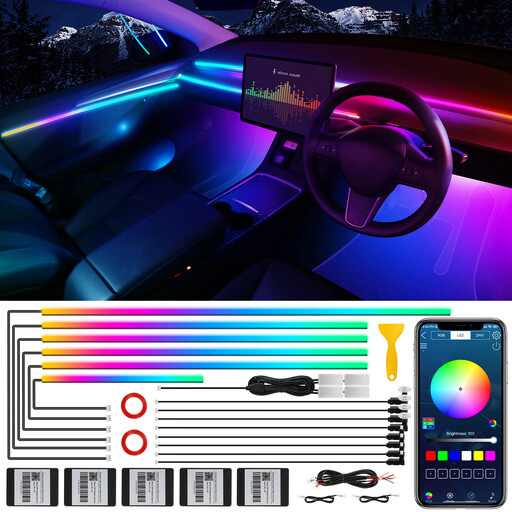
Why this product fits the profile: This kit combines six acrylic light guides with four footwell lights, making it ideal for buyers looking for a straightforward starter setup with app control.
The product description lists the individual strips, four footwell lights and several controllers. This makes it easier to check which areas will actually be covered before you start fitting.
RGB Smart IC, Bluetooth app, music sensor, 12 V operation and, according to the product description, 600 LEDs.

Why this product fits the profile: The combination of six light guides, four footwell lights plus door handle and storage compartment lights is designed for a more comprehensive interior makeover.
The separate control of main and sub-controllers reduces the need to bundle all the lights at a single point. The app reportedly supports both static and dynamic modes.
600 LEDs, 12 V, dual-zone control, Bluetooth app and a kit that covers multiple interior areas.

Why this product fits the profile: This kit is aimed at buyers who prefer a fibre-optic starlight effect for the headliner rather than a classic neon-style LED strip.
The product description lists 600 fibre strands each 4 metres long, four connectors plus app and RF remote control. This makes the installation scope much clearer to plan before you buy.
Four-colour control, twinkle function, music sensor, app control and RF remote control according to the product description.
We’ve put together a full, regularly updated list of products that fully meet these strict selection criteria and the safety regulations that apply in the EU.
Before fitting, test all the lighting functions away from public roads. The surfaces you stick to must be clean, dry and free of grease. Cables must not obstruct your view or any controls. Controllers should not be placed in areas of high heat or moisture.
A music control for LED car lights picks up sound via a microphone. This means the synchronisation can also react to speech or road noise. For everyday driving, a static mode is often more controlled. While you’re driving, the lighting should not be distracting or affect other road users.
Many kits are powered via a 12 V connection in the vehicle. Depending on what’s included, you connect a main controller to several sub-controllers and then control the system via a Bluetooth app. Before sticking anything down, test all the modules and plan your cable routes.
Acrylic or fibre-optic strips can sometimes be cut, according to the individual product specifications. You can’t cut them just anywhere, because resistors, LED connections or light guide sections could be damaged. Always follow the instructions for your specific kit.
The power consumption depends on the number of LEDs, brightness, how long it’s on and the controller. An accurate estimate is only possible by looking at the electrical power rating of the specific product. If the car is parked for long periods, the lighting should be switched off to avoid unnecessarily draining the battery.