
Lieferung heute & morgen

Qualitätsgarantie

Willkommens-Angebote freischalten: KOSTENLOSE Lieferung | Bis zu 80 % RABATT | Kostenlose 30-Tage-JoyPlus-Testphase
App herunterladen
An LED bathroom mirror with lighting combines a reflective surface and a light source in one unit. This saves space and can make your bathroom routine easier. However, models vary considerably when it comes to lighting controls, demisting, installation and ingress protection. If you focus only on the design or a low price, you could miss important details.
An asymmetrical or frameless LED bathroom mirror can look appealing, but it won’t necessarily fit above every washbasin. Before buying, check the available wall space, the distance from the taps and the orientation you want. The depth of the unit is also important, especially in smaller bathrooms.
An anti-fog bathroom mirror usually heats a limited area of the reflective surface. This doesn’t necessarily mean that the whole mirror will remain fog-free. Check whether the function needs to be switched on separately, how large the heated area is and whether it works automatically or manually.
Three light colours may sound like a comprehensive choice. What matters, though, is whether you can actually switch between warm white, neutral white and cool white, and whether you can adjust the brightness. An LED mirror with dimming and a memory function may be more practical than a model with lots of lighting modes that are difficult to set.
The dimensions should suit your washbasin and the layout of your room. A 60 × 45 cm mirror is suitable for compact spaces, while a 100 × 60 cm model gives you more reflective surface for a larger vanity unit. A wider design may be a good choice for couples or families.
Also check:
A bathroom mirror with a touch switch is operated directly on the mirror. Some models can also be controlled using a wall switch. Check whether the touch switch needs to remain on for this to work.
Useful features include:
Integrated LED lighting doesn’t automatically replace the main bathroom lighting. Check the manufacturer’s information on light output and, if necessary, use a suitable room light as well.
The IP44 rating means that the product is protected against solid objects above a certain size and against water splashes from various directions. This is relevant in many areas of the bathroom, but it doesn’t mean you can install the mirror anywhere.
Bear in mind:
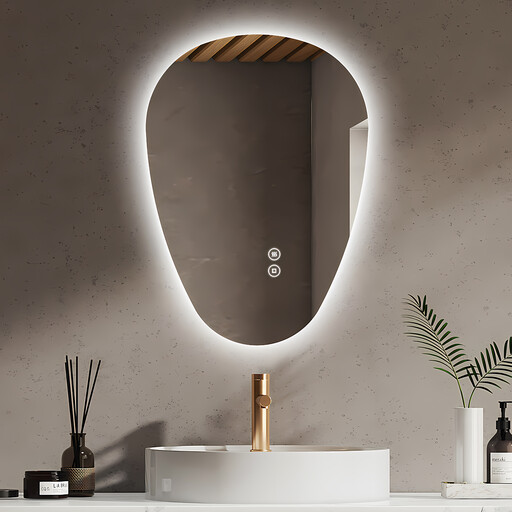
Why this product suits this profile: Its compact size makes it a good fit for smaller washbasins and cloakrooms, or as an illuminated wall mirror in a bedroom or dressing room. The asymmetrical shape adds a design detail without requiring a particularly large wall area.
The three light colours and brightness control are clearly specified. The separate anti-fog button also makes it clear that this function doesn’t need to be on all the time.
60 × 45 cm, three light colours, dimming from 10 to 100 per cent, memory function and IP44 rating, according to the product information.
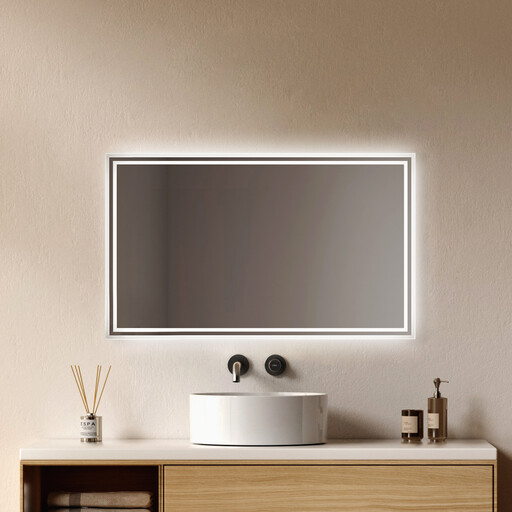
Why this product suits this profile: Its larger reflective surface is designed for wide vanity units and more spacious bathrooms. It can be mounted horizontally or vertically, so you can adapt it to your room layout.
The product description lists the dimensions, four metal hooks on the back, mounting accessories and German-language instructions. This makes it easier to assess the space needed and the installation work before you buy.
100 × 60 cm, warm and cool light, separate anti-fog button, IP44 rating, and polished, bevelled edges, according to the product information.
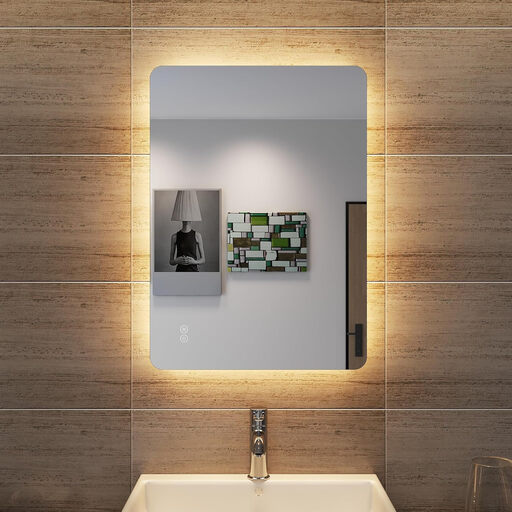
Why this product suits this profile: The rectangular 50 × 70 cm mirror can be used vertically or horizontally. This makes it suitable for family bathrooms, dressing rooms and hallways where you need extra practical lighting.
The product information lists a separate anti-fog button, dimming, a memory function and a sealed back. It also points out that the mirror isn’t intended to be the sole source of main lighting.
4 mm-thick mirror, three light colours, touch controls, memory function, IP44 rating, and vertical or horizontal mounting, according to the product description.
We’ve put together a comprehensive, regularly updated list of products that meet these strict selection criteria and fully comply with the safety regulations in force in the EU.
It depends on the model. Some mirrors have an integrated touch or side switch and can also be set up for control via a wall switch. For a permanent electrical connection, follow the installation instructions and applicable safety requirements. If you’re unsure, consult a qualified electrician.
Lifespan depends on the LED components, power supply, usage and surrounding conditions. Some product information, for example, gives an LED lifespan of 50,000 hours. These figures are provided by the manufacturer and don’t guarantee how long the mirror will actually last in your particular bathroom.
Electricity costs depend on power consumption in watts, daily usage and your electricity tariff. A low LED wattage can help limit consumption, but the specific model’s figures are what matter. An automatic switch-off function, or remembering to switch the light off after use, can also help you manage running costs.