
Lieferung heute & morgen

Qualitätsgarantie

Willkommens-Angebote freischalten: KOSTENLOSE Lieferung | Bis zu 80 % RABATT | Kostenlose 30-Tage-JoyPlus-Testphase
App herunterladen
An LED bathroom mirror can make your daily grooming routine easier and help you plan your bathroom layout. At the same time, unclear product information, unsuitable dimensions or overestimated additional features can quickly lead to the wrong purchase. If you are looking for an illuminated bathroom mirror, an LED mirror with lighting or an LED bathroom mirror cabinet, you should therefore consider more than just the design.
For many models, the integrated LED lighting serves as additional illumination for your face and the mirror area. It does not automatically replace the bathroom’s ceiling or general lighting. The SONNI bathroom mirror with clock, temperature display and demisting function specifically states that the lamp is not intended to provide the main lighting.
An anti-fog bathroom mirror can be more practical after showering, but the function requires electricity and is often activated separately. Check whether there is a dedicated switch, how the function is operated and whether it is clearly described in the technical specifications. A simple indication such as ‘fog-free’ is not enough to make an informed purchase decision.
A large LED bathroom mirror is heavier than a conventional mirror. The wall material, fixing points, cable routing and power connection must suit the installation location. For mains-powered models, the connection should be carried out in accordance with the applicable electrical regulations. Professional installation may be advisable, particularly during renovations or where no preparation has been made.
Measure the available wall space, including the washbasin, taps and room for movement at the sides. A format of 50 × 70 cm, for example, is suitable for compact bathrooms. According to the product information, the SONNI LED Bathroom Mirror can be mounted vertically or horizontally. Around 4 cm of wall depth is required for cable routing.
Larger models, such as a 100 × 60 cm bathroom mirror, require sufficiently strong fixing points. Also check the product weight and whether the fixing materials are included in the delivery.
Variable light colour is particularly practical with a dimmable LED mirror. Cool white can provide clear, high-contrast illumination, while neutral white or warm white may feel more comfortable depending on the room and time of day. It is important that the colour change and brightness control are described in specific terms.
According to the product data, the SONNI model with touch controls offers cool white, neutral white and warm white light. A short press changes the light colour, while a longer press adjusts the brightness. The memory function saves the last setting used.
The specified IP rating is relevant in areas with increased humidity. IP44 means protection against solid foreign objects of 1 mm or more, as well as splash water from various directions. However, the exact positioning in the bathroom must still take installation zones and safety distances into account.
An IP44-certified LED bathroom mirror is not automatically suitable for exposure to a direct jet of water. Read the installation instructions and only use the product in accordance with the manufacturer’s specifications. The mirror should also be cleaned with a soft, slightly damp cloth. Abrasive cleaning products can damage the glass, coating or frame.
The following models meet different requirements: from a compact illuminated bathroom mirror and practical storage to a cosmetic mirror with LED lighting.
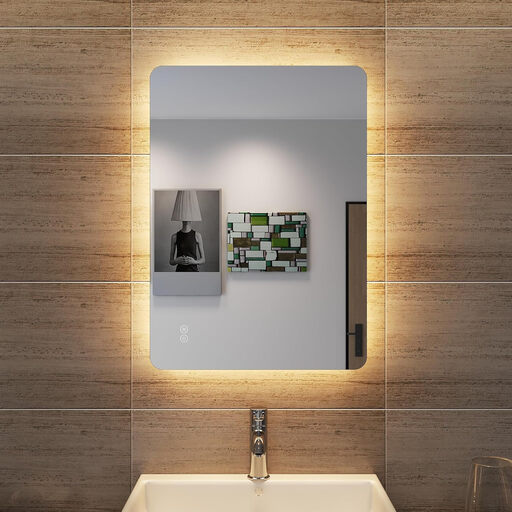
Why this product suits this profile: The compact format is suitable for standard bathrooms and, according to the product information, can be mounted horizontally or vertically. Touch controls and three light colours cover essential grooming needs.
The specifications state the dimensions, 4 mm mirror glass, IP44 rating, dimming function and a separate demisting button. This makes it easier to assess the space required and how the mirror is operated before buying.
50 × 70 cm, three light colours, dimmable lighting, memory function and separately switchable demisting.
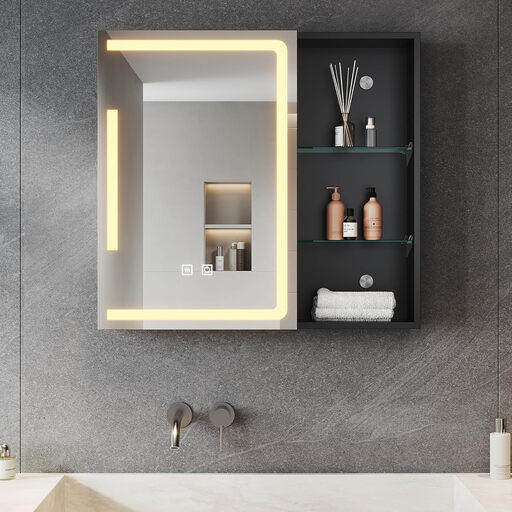
Why this product suits this profile: This model combines a mirror, lighting and storage. Four adjustable glass shelves, a matt black metal cabinet and an integrated socket are useful features for well-equipped bathrooms.
The product description states the depth of 13 cm, the weight of 16 kg, the shelves’ maximum load and the need for wall mounting. This information helps you check the available space and load-bearing capacity.
Dimmable light with three colour temperatures, demisting, soft-close hinges, adjustable shelves and a socket to German standards.
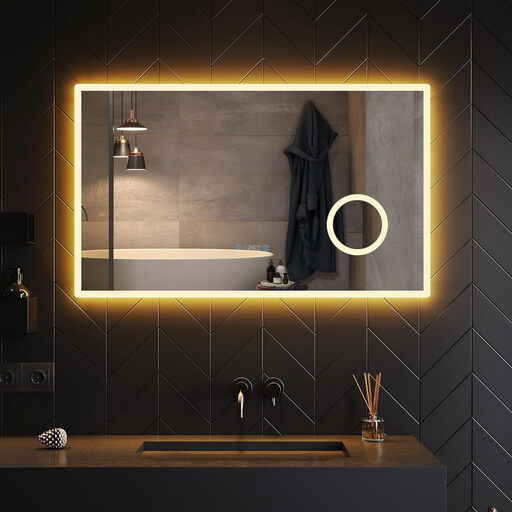
Why this product suits this profile: Designed for larger washbasins and households where the mirror is used frequently, this model offers additional displays, 3× magnification, adjustable light colour and demisting.
The specifications state IP44, 4 mm mirror glass and that the lighting is intended as additional illumination. This clearly sets out the moisture protection and the limits of the light output.
Clock and temperature display, 3× magnification, three light colours, brightness control and a separate demisting function.
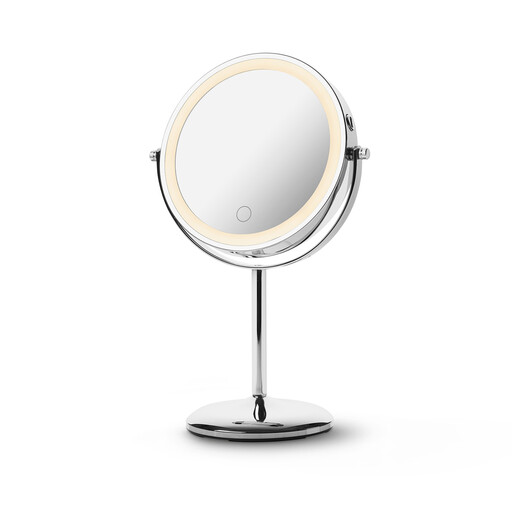
Why this product suits this profile: This round, cordless cosmetic mirror is designed for use at a dressing table, in the bedroom or in a grooming area. Two mirror surfaces and 7× magnification support detailed tasks.
The product data highlights the rechargeable battery and water protection. This prevents it from being mistaken for a permanently installed bathroom mirror.
44 LEDs, three light modes, continuously variable dimming, 7× magnification, memory function and automatic switch-off after 30 minutes.
We have put together a complete, regularly updated list of products that fully meet these strict selection criteria and the safety regulations applicable in the EU.
This depends on the model. Some versions are operated using a touch switch and connected directly to the power supply, while others can be connected to an existing wall switch. Before installation, check the cable length, wall clearance and type of connection. Work on the mains connection should be carried out by a suitably qualified electrician.
The lifespan depends on the model and should be stated in the technical specifications. The SONNI model with clock and temperature display is specified as having an LED lifespan of approximately 50,000 hours. This figure describes the technical specification of the lighting and is not a guarantee of the actual service life under every operating condition.
Running costs depend primarily on the power consumption in watts, daily usage time and electricity price. A simple calculation is: Wattage ÷ 1,000 × operating hours × electricity price per kilowatt-hour. For a realistic estimate, use the power consumption of the specific model shown on its data sheet.